


To the untrained eye, it looks like a splash of welcome springtime color on a drab dirt lot near Stone Avenue and Prince Road.
But to weed warrior Tony Figueroa, this newly sprouted field of distinctive yellow wildflowers is a battleground.
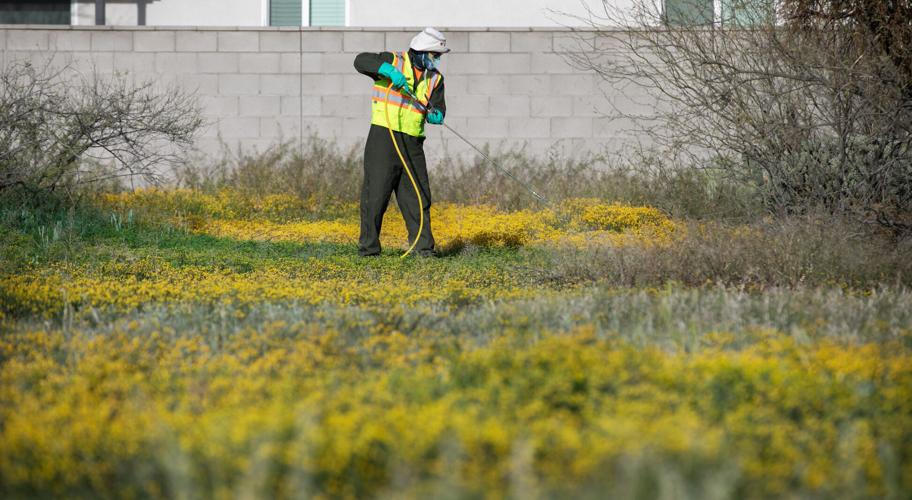
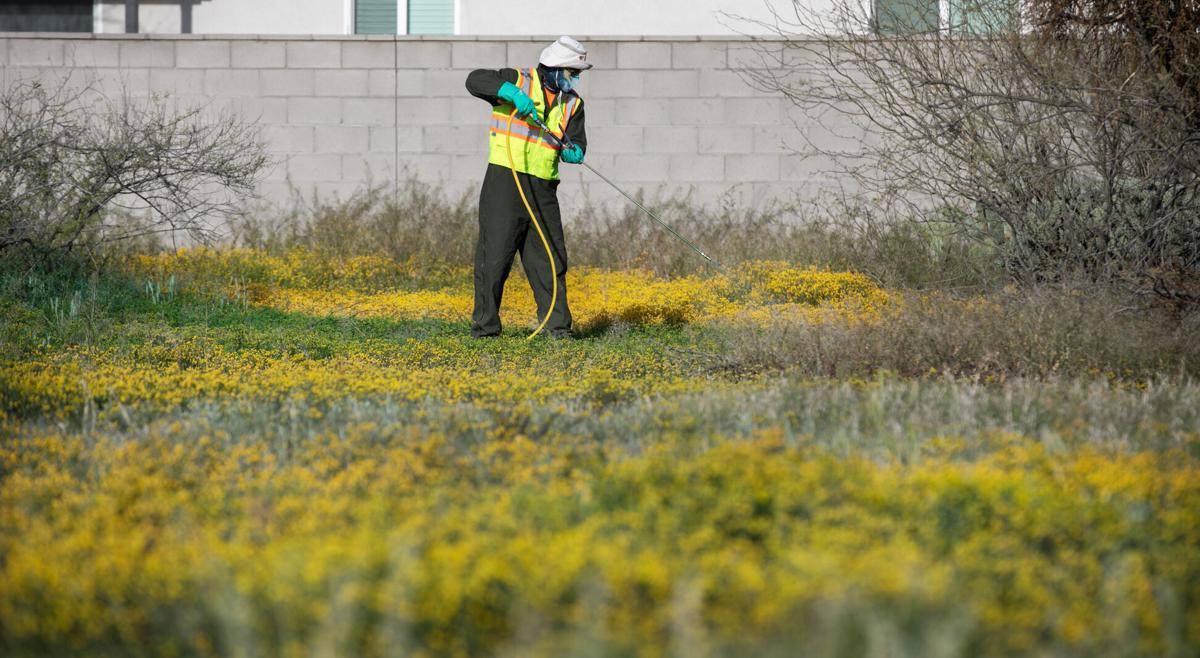
Figueroa spent several hours last week spraying herbicide on Tucson’s newest and largest crop of stinknet, a noxious weed from South Africa that is causing literal headaches in Arizona and California.
“The stuff just invades everything,” said Figueroa, the invasive plant program manager for the Tucson Audubon Society. “It poses a human health threat as well as a threat to the Sonoran Desert ecosystem.”
Invasive “stinknet” (globe chamomile) covering part of a lot at Stone Ave. and W. Pastime Road on April 5.
For those who are sensitive to it, stinknet can trigger skin rashes and asthma attacks. Its namesake stink is subtle, even pleasant at first, but it grows more and more pungent with continued exposure, Figueroa said.
Several members of his work crew have complained of headaches after a full day of working around the stuff.
Worse still, stinknet spreads more easily than other dreaded invaders like buffelgrass, taking root even in undisturbed soil. Left unchecked, it can quickly squeeze out native plants and take over entire landscapes.
Then, when it dries out, oils inside the plant cause it to “burn like gasoline,” producing an acrid smoke that irritates the lungs, Figueroa said. “This stuff has so many hazards associated with it.”
The Arizona Department of Agriculture added stinknet to its list of noxious weeds in 2020.
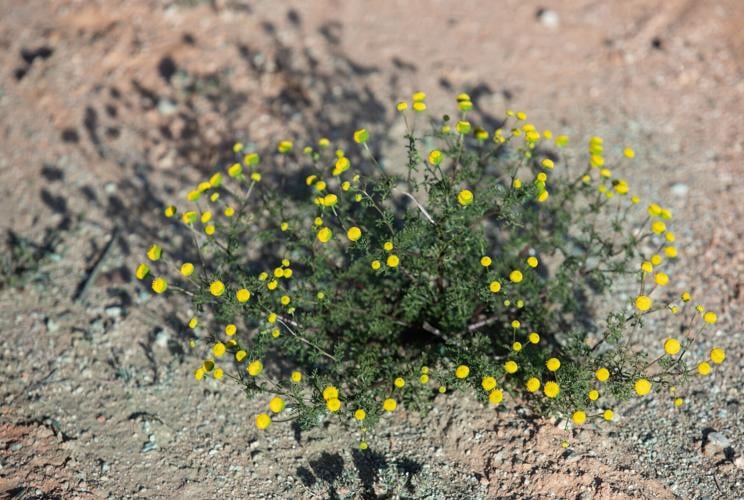
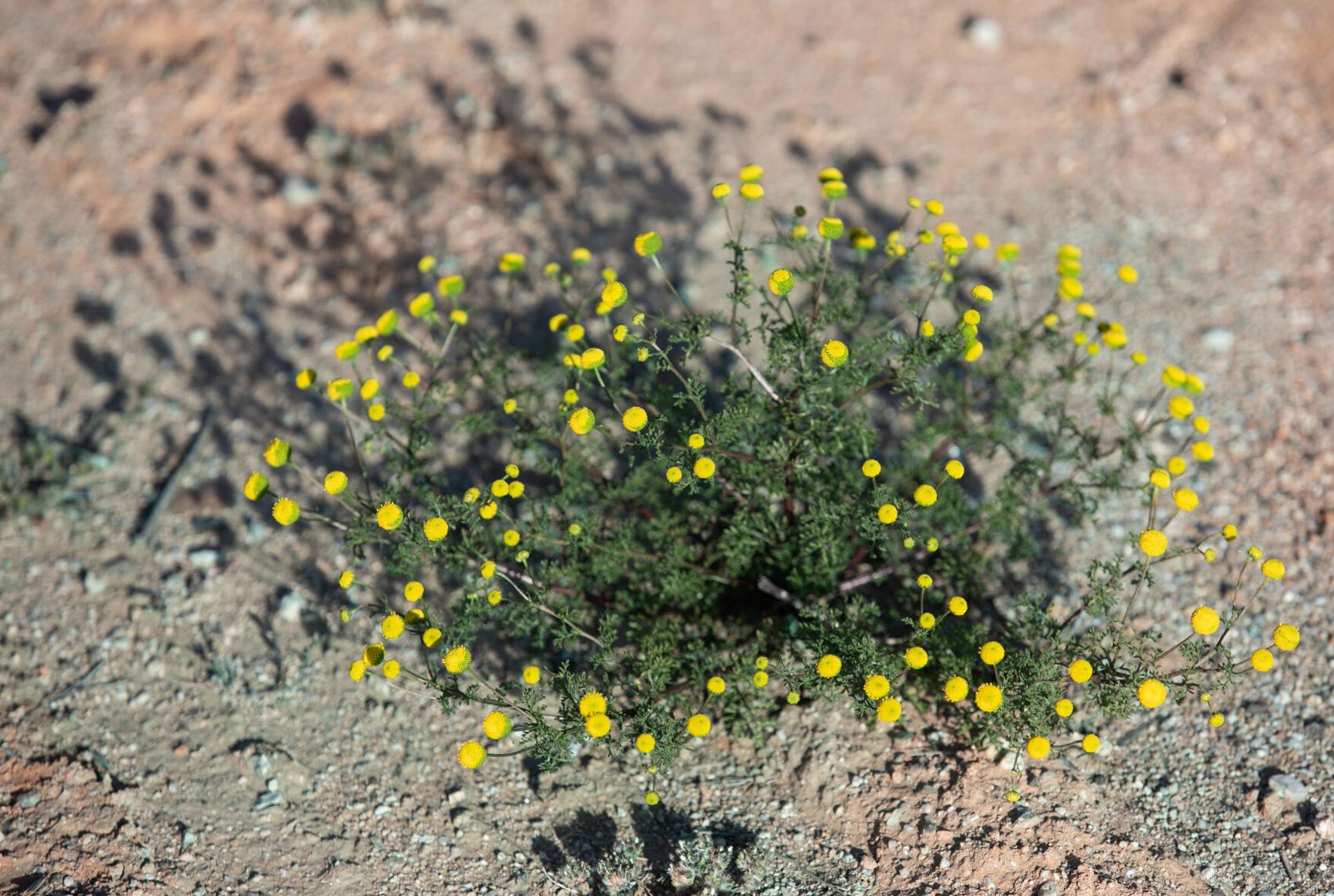
The annual plant emerges in staggered fashion from November to March. Resembling carrot greens at first, it grows in dense mats low to the ground until it erupts with blooms that give it its other, more appealing nickname: globe chamomile.
No other wildflower in Southern Arizona sports the same sunny, ball-shaped blossoms. The Arizona Native Plant Society describes them as “little yellow lollipops.”
Each globe — ranging in size from a pea to a marble — is actually a tiny bouquet of about 100 tightly packed flowers.
Starting in mid-March, the plants produce clouds of “powder-fine” seeds small enough to be dispersed by wind and water or carried away on vehicles, boots or clothing, Figueroa said.
The plant first appeared in Maricopa County in the 1990s and quickly spread outward along major transportation routes as its tiny seeds hitched a ride on the tires and fenders of vehicles. Within a decade, the yellow flowers could be found after any wet winter carpeting empty lots and highway embankments from the northern edge of Phoenix to Casa Grande.
Stinknet finally arrived in Tucson in 2015, popping up on a vacant lot near Prince and Interstate 10, to the dismay of local plant experts.
The noxious plant is running wild on a dirt lot near Stone Avenue and Prince Road.
The team now fighting to keep it in check includes the Department of Agriculture, the Native Plant Society, the National Park Service, Pima County, the Arizona-Sonora Desert Museum and the Southwest Vegetation Management Association.
Tucson Audubon is leading the charge, thanks to a recent $100,000 donation helping pay for equipment, staffing and public outreach.
Figueroa said they have about 20 employees dedicated to combating stinknet and other invasive plants as part of the organization’s mission to protect birds and the places they live.
Tucson Audubon has also launched a website, stinknet.org, to help people identify the plants and understand the threat. The site includes a map of everywhere stinknet has been found so far in Arizona and an online form for reporting new sightings.
Though Phoenix has already fallen to the stinknet invasion, plant experts believe Tucson can be saved.
“I would say we still have a pretty good handle on it,” said Jonathan Horst, Tucson Audubon’s director of conservation and science.
But cool, wet weather this winter and early spring has led to a weedy resurgence. Stinknet has cropped up at several new locations around Tucson, none larger than the vacant lot west of Stone along Pastime Road. The patch there covers almost 2 acres, and some of the plants are already going to seed.
“This is what Phoenix looks like right now,” Figueroa said, standing at the edge of the vacant lot on Tuesday. “You can look up Phoenix Instagram and it’s just this all over.”
A staff member from Pima County Natural Resources, Parks and Recreation spotted Tucson’s biggest field of stinknet while driving through the neighborhood about a month ago.
Since then, Figueroa and his crew have found and eliminated small patches of the plants at about a dozen locations within a mile of the main site. They have also distributed fliers to surrounding homes so residents can be on the lookout for more of the weeds.
Asked how long the vacant lot would have to be treated to keep the stinknet from returning, Figueroa shrugged. “Indefinitely,” he said.
There’s just no way to know how many seeds are already out there or how long they might last as they wait for the next nice, wet winter in Tucson. It’s safe to say the war against these weeds will go on for years.
“It’s a Herculean effort, but you’ve got to start somewhere,” Figueroa said.

