


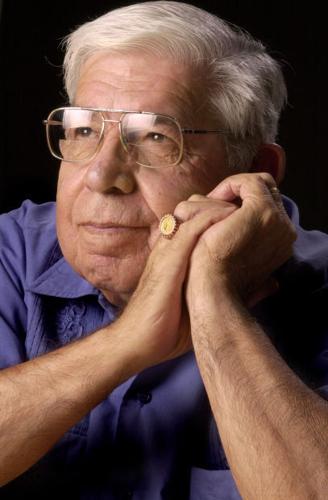

When Ernest F. de Soto was 17 years old, he left his Tucson home, which at that time was on West Congress Street but now gone, plastered by Interstate 10. He went to Los Angeles for adventure and to study.
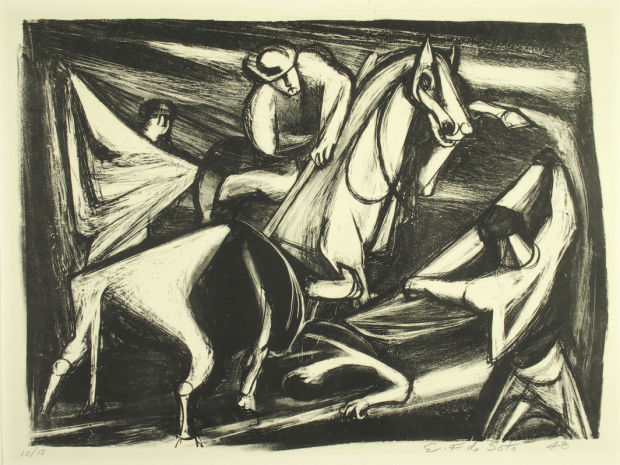
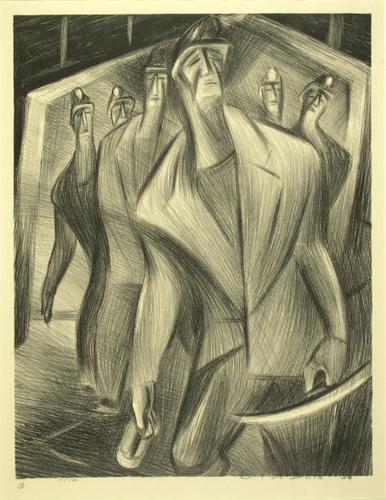
That was just before the Second World War. After the war, de Soto resumed his art education and career, and by the mid-1960s, de Soto would become known as a master printer and lithographer, who worked with some the best and well-known post-war artists in Mexico and California.
De Soto, who was descended from a Presidio family when Tucson was a far-flung Spanish colonial outpost, passed away on December 29 in Tucson. He was considered the first Mexican-American master printer in the United States.
He was rooted in the old-school methods of lithography and printmaking, said Andrew Rush, founder of The Drawing Studio in downtown Tucson.
De Soto, in his retirement, visited and worked in the studio with students and artists, in his unassuming, low-key manner, Rush said.
“He was incredibly quiet and humble. You wouldn’t know who he was unless you asked,” Rush added.
Even his sister, Erma Quiroz of Tucson would come to learn how important and well-respected her brother had become in the world of art.
“I didn’t know he was so famous until people asked him for his autograph,” she said.
De Soto was the man in printing and lithographs.
He began to make his artistic mark in the late 1960s in San Francisco in a press lithography workshop that would bear his name. The de Soto Workshop became a center of creative artwork attracting some of art’s luminaries, many of them from Mexico: José Luis Cuevas, Alejandro Colunga, Rufino Tamayo, Gunther Gerzso, Francisco Toledo and Leonora Carrington.
“As a technical innovator and superb master of the art and craft of printmaking, de Soto has impacted the art of printmaking,” declared the Museum of Printing History in Houston, which presented de Soto’s work four years ago. “De Soto merits national recognition for his contributions to the artistic tradition and craftsmanship of printmaking,” the museum proclaimed.
In 2001 and 2002, the University of Arizona Museum of Art exhibited de Soto’s works in two showings.
Printmaking is a meticulous art form in which artists reproduce limited editions of a work by using multiple images, usually printed on paper or parchment. The artists create a small number and these works, usually numbered under 100, are considered fine works. They are not considered copies and are not made using machines or photography.
De Soto worked with artists to create handmade prints from their paintings, color by color, sheet by sheet, said Rush.
Lithographs, which were developed in the late 1700s in Germany, are created by drawing images with grease on a porous stone, usually limestone. The images are burned with acid and ink is applied, followed by printing the image on a surface. If the lithograph is in color, a different stone is used for each color.
De Soto mastered the art forms and taught others.
As a child he loved to draw, recalled his sister. At home, his mother Artemisa Soto, encouraged him, as did his teachers at Safford and Tucson High. Not long after he moved to Los Angeles, war broke out and the Army drafted de Soto (he would later add “de” to his surname) to work in a camouflage unit, in California and the South Pacific.
After the war, using the G.I. Bill, he studied art first in Los Angeles and then Mexico, where he worked with that country’s iconic artists — José Clemente Orozco, David Alfaro Siqueiros and Tamayo. In the 1950s he lived and worked in New York City, Cleveland and Illinois, teaching and learning.
He returned to Los Angeles in 1967 and earned his master printer’s diploma from Tamarind Lithography. De Soto then moved to San Francisco where he founded Collectors Press Lithography Workshop, which he later renamed de Soto Workshop. He remained in San Francisco until 1993, retiring to Green Valley, south of Tucson.

