



The Tucson City Council took a cautious step toward changing sidewalk ordinances Wednesday to try to make downtown sidewalks and parks safer in the face of growing homeless encampments.
But legal challenges — including a case pending in the 9th U.S. Circuit Court of Appeals — have made the council wary.
The council reviewed a set of proposed changes that would clarify sidewalk rules. For example, when people can be on the sidewalk and how much stuff they can have on it.
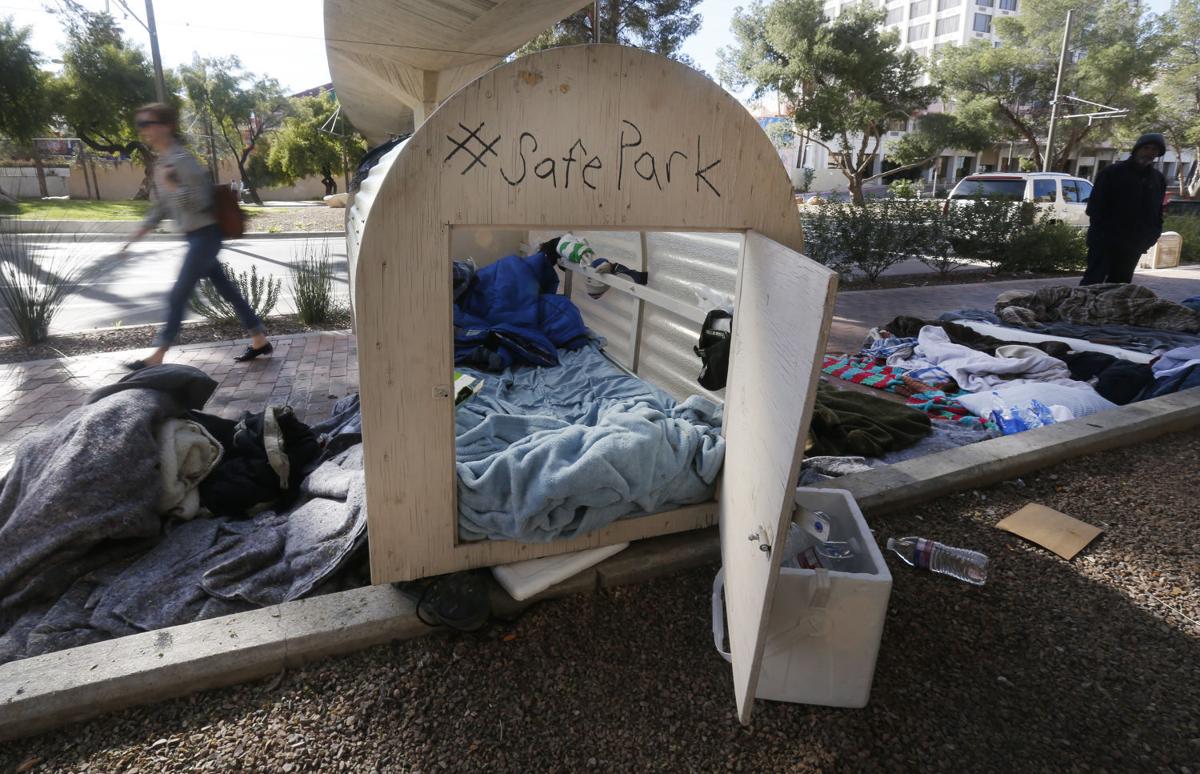
The issue arises from the Occupy Tucson and Safe Park protests, which at their peaks saw dozens of people living in plywood boxes with piles of belongings on busy downtown sidewalks at a park with no bathrooms.
The proposed changes need more vetting and more tinkering, Councilman Richard Fimbres said.
His motion to review and refine the proposed changes and revisit them in 60 days passed unanimously.
The council previously leaned toward a new ordinance that would ban urban camping, but problems with similar laws in Boise and Denver made them rethink that approach.
“Rather than coming forward with a camping ordinance that was previously discussed, this is a more tailored attempt to address some of the issues that we’ve run into over the past several years,” said City Attorney Mike Rankin.
The proposed changes include:
- Making any objects larger than 3 cubic feet and any unattended items an obstruction, and prohibiting people from storing large items on standard 5-foot sidewalks.
“The idea was to use content-neutral terms, basically identifying the size of an item instead of talking about hay bales and farm produce and those other out-of-date items that are listed in the code,” Rankin said.
Three cubic feet is a reasonable amount of stuff without a person taking over the sidewalk, Rankin said. It’s twice what a person is allowed to bring into a library or onto an airplane, for example, he said.
- Prohibiting putting stuff on sidewalks that are part of an underpass, such as the Fourth Avenue underpass downtown.
- Requiring permits for groups giving food to people on the sidewalks. The rule currently applies only to events in parks. One factor for receiving a permit would be available bathrooms, Rankin said.
“What the council has made very clear from the beginning is that on the one hand we need to have adequate regulations to protect and promote public health and safety and avoid some of the health concerns we’ve seen in the downtown area. At the same time we need to preserve and protect constitutional and civil rights of the people who are in the parks and on the sidewalks,” Rankin said. “I think this approach accomplishes both of those things.”
Councilwoman Karin Uhlich said she will resist expanding ordinances.
“It doesn’t work,” she said. “All it does is push the pressure elsewhere. If you don’t allow anybody to hand out a bag of potato chips to a person because their faith moves them to do so, that person will have to beg for food somewhere. People have to eat, they have to sleep, they have to go to the bathroom in order to live. Anything we do to interfere with people’s ability to survive is going to pop up somewhere else.”
The needed solution is a lot bigger than code changes, Uhlich said.
Fimbres said a coalition of government and nonprofit groups are working on that bigger solution, including finding new shelter sites and looking at model programs. “Homelessness is not a crime, and we don’t want it to be,” he said.

