

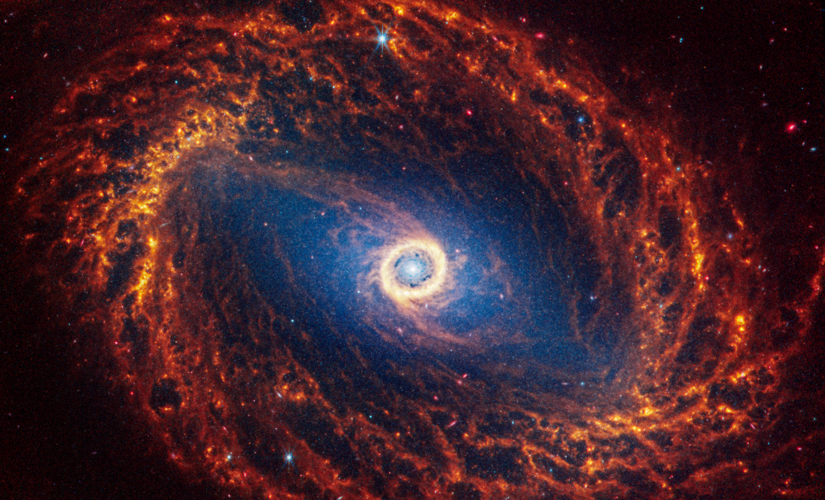
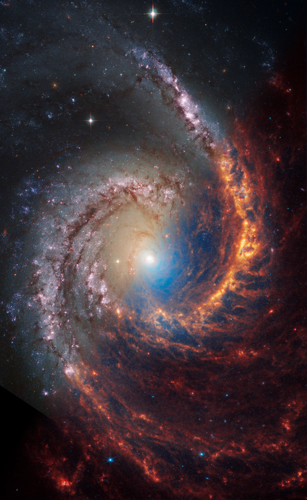

There’s only so much we can learn about the structure of the Milky Way from our vantage point inside of it, so astronomers must study other galaxies to better understand our own.
As part of that effort, researchers from the University of Arizona and elsewhere have released hundreds of new images from 19 similar spiral galaxies, captured in unprecedented detail by NASA’s James Webb Space Telescope.
The images reveal never-before-seen structures and tantalizing clues about how such galaxies form.
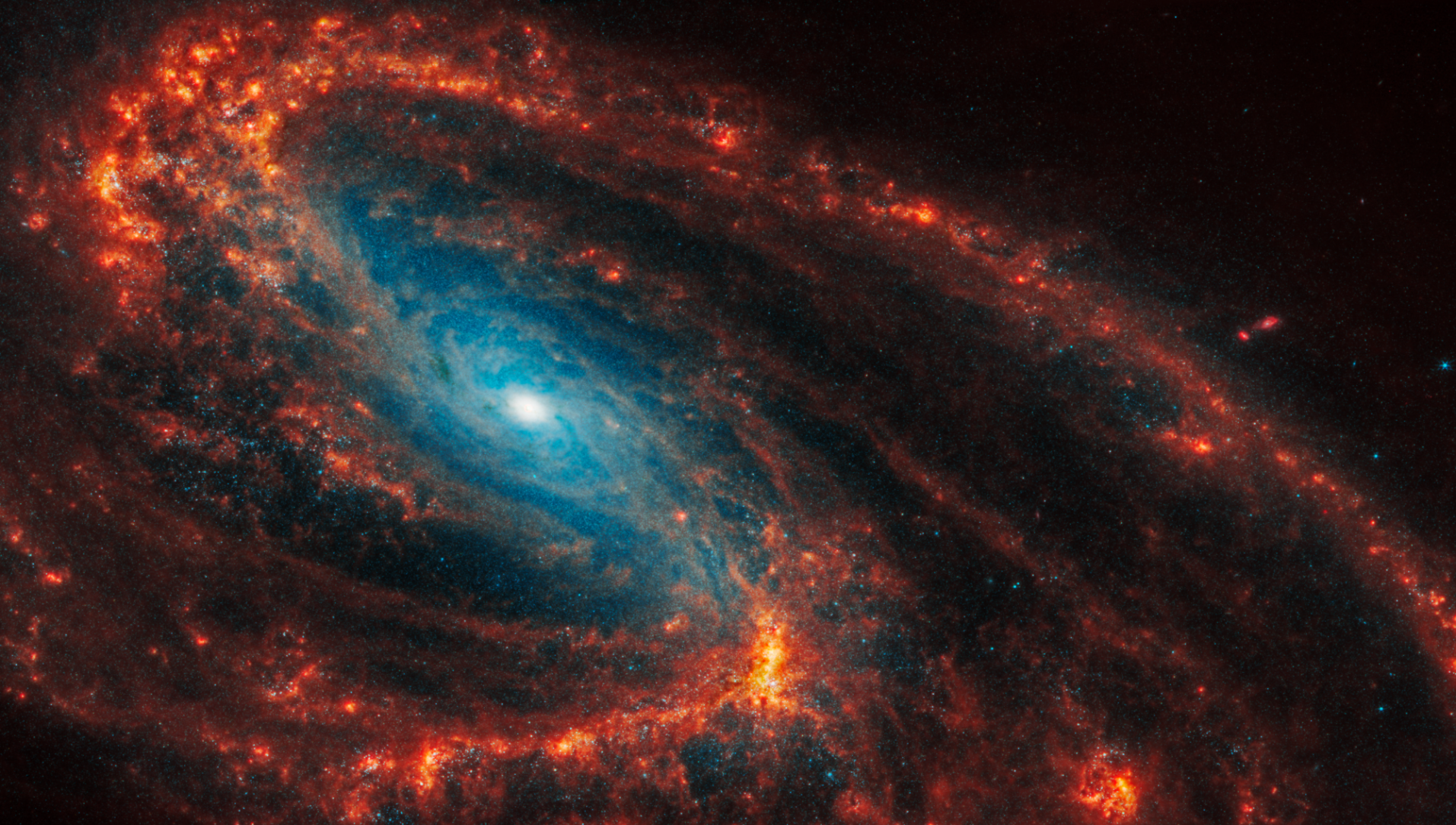
An infrared image captured by the James Webb Space Telescope shows the face-on spiral galaxy known as NGC 3627.
These same galaxies have been studied previously by other telescopes on the ground and in space, but Webb’s powerful infrared cameras can peer through the dust to see what lurks between the stars.
“If you compare that with, for example, the Hubble (Space Telescope) image that we have for the same galaxy, you’ll see that they don’t look exactly the same,” said Jimena Rodriguez, a postdoctoral fellow at the U of A’s Steward Observatory. “In a way, you could say we are seeing the skeleton of the galaxy, with all the structure of gas and filaments that we missed before.”
Webb shows that interstellar gas and dust as glowing wisps of red and orange, dotted in places by the bright red seeds of still forming stars.

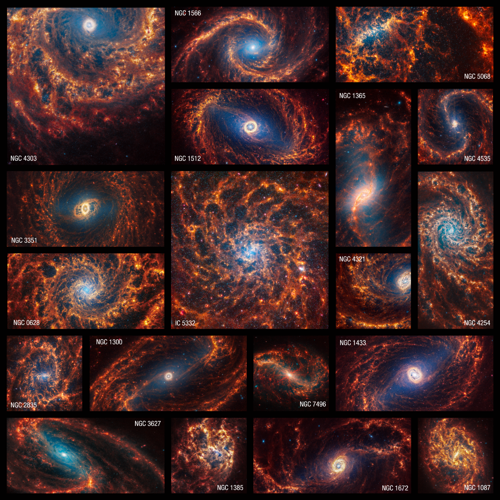
A collection of images shows 19 face-on spiral galaxies observed in infrared by the James Webb Space Telescope.
The images were collected as part of a long-running collaboration known as the Physics at High Angular resolution in Nearby Galaxies program — or PHANGS for short — which includes more than 150 astronomers worldwide.
By releasing the data from Webb to the astronomy community at large, researchers hope to spur new discoveries about galactic structure and behavior.
“In spite of the fact that we are such a large collaboration, I feel there is so much more science here than we can do,” Rodriguez said in a news release from the university. “It is important to open it up to others, so the entire community can explore the current thinking about what we think goes into building a galaxy. It advances our field and astronomy as a whole.”
The newly released trove includes 481 images from spiral galaxies located between 50 million to 65 million light-years from Earth and conveniently positioned with their flat disks facing our way. All of the images can be viewed and downloaded at webbtelescope.org/images.
The 19 galaxies were observed with Webb’s primary Near-Infrared Camera and the telescope’s Mid-Infrared Instrument, two advanced scientific tools developed in large part by a married pair of U of A Regents Professors, George and Marcia Rieke.
Among the previously unseen details teased out by the world’s most powerful space telescope are large, spherical shells carved out of the gas and dust here and there. Astronomers think those holes could have been created by exploding stars.

