


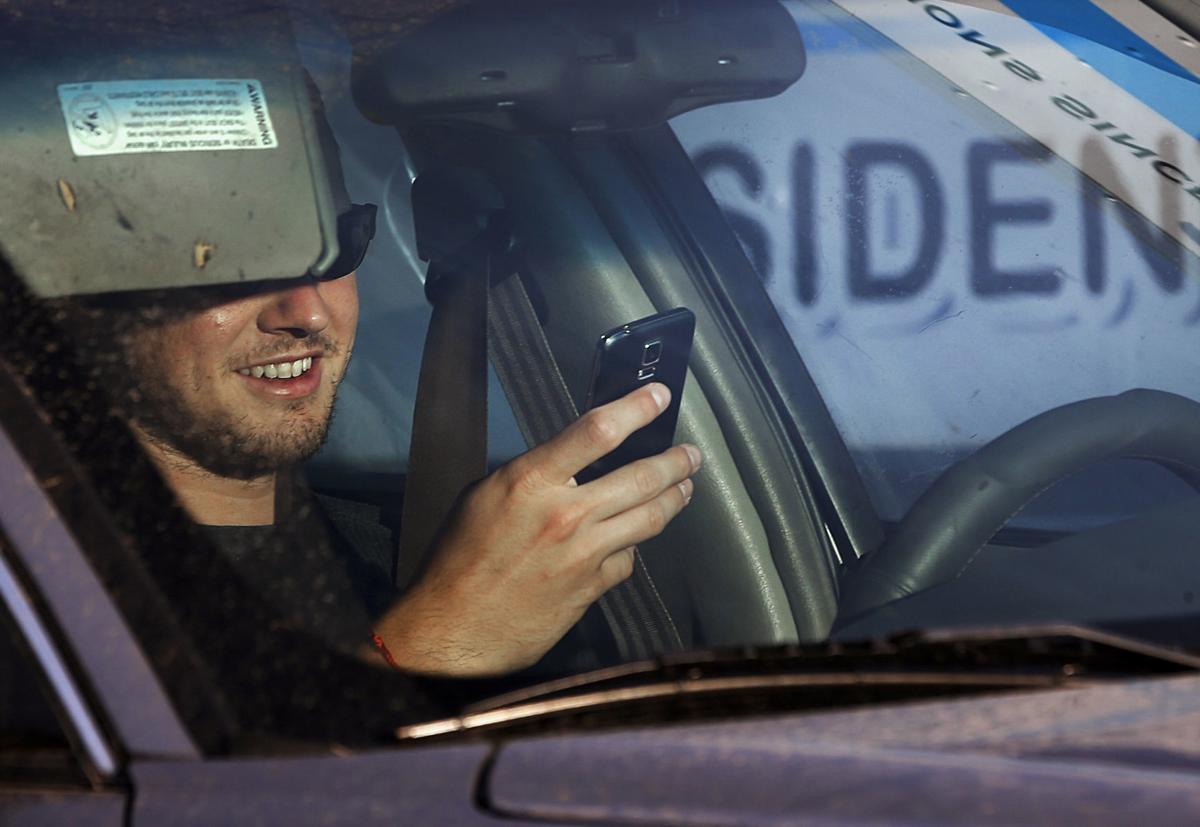
Arizona lawmakers gave final approval Thursday to a comprehensive statewide ban on the use of hand-held cellphones by motorists, sending the bill already approved by the Senate to Gov. Doug Ducey for his anticipated signature.
The 44-16 vote by the House on HB 2318 came after lawmakers defeated a version with many of the same restrictions but a crucial difference: It would have made texting while driving a secondary offense, allowing police to cite offenders only if they were pulled over for some other reason.
“We are only one of three states in the entire nation that does not ban text messaging and driving even though we know the frightening statistics,” Rep. Noel Campbell, R-Prescott, told colleagues. He has been a champion of making texting while driving and the use of hand-held cellphones a primary offense, allowing police to stop motorists solely because they are breaking this new law.
Campbell noted that Arizona cities and counties already have their own versions of the measure.
Under the state law, which would take effect in 2021, a first-time offense would result in a fine of between $75 and $149; subsequent violations could lead to fines up to $250.
Approval would not have come except for the fact that all 29 Democrats supported the measure: Only 15 of the 31-member Republican caucus supported the bill.
But lawmakers also voted 31-29, strictly along party lines, for SB 1141 — a totally separate measure to outlaw “distracted driving,” which also will go to Ducey. Rep. John Kavanagh, R-Fountain Hills, said the two bills are not in conflict.
On one hand, he said it is clear that texting while driving is “inherently distracting” and needs to be banned outright, as HB 2318 would do.
“But we need this bill for other activities,” he said of SB 1141.
And Rep. Travis Grantham, R-Gilbert, said the problem with simply focusing on texting and cellphone use is that it fails to address other things that people do.
“I’ve seen people going down the road brushing their teeth, which I don’t really understand,” he told colleagues.
“There’s people eating burritos who are swerving because they’re trying to put sauce on their food,” Grantham said. “Anything can cause a distraction.”
He questioned what will happen when someone gets killed by a motorist who is reading the newspaper.
“Are we going to run a ban-newspapers-while-driving bill?” he asked.
But unlike the strict texting ban, SB 1141 would not allow a police officer to stop a motorist solely for texting or doing other things, like reading a newspaper. That could occur only if there is evidence that whatever the driver was doing also resulted in an immediate hazard or failure to control the vehicle.
Rep. Isela Blanc, D-Tempe, argued that language is overly broad.
“The communities that are oftentimes over-policed are poor communities, communities of color,” she argued. “I am concerned because we have a racial profiling problem often. This will be a tool to stop anyone in those communities.”
Rep. Diego Rodriguez, D-Phoenix, agreed, saying that increases the chance he might be stopped “depending on who I run into, depending on what part of the town I’m in, depending on what vehicle I’m driving, and depending on how I’m dressed.”
But Rep. Mark Finchem, R-Oro Valley, who was a Department of Public Safety officer, said those concerns are unwarranted.
“If I follow a car for more than two minutes, I have ample reasons to stop it,” he said.
While some lawmakers like Kanvanagh and Finchem voted for both the texting ban and the distracted-driving measure, some did not.
The problem with HB 2318. according to Grantham. is that it is overly broad.
He pointed out that, as approved, it does more than make it illegal for a motorist to have a cellphone in hand. It would also be a violation if someone “supports (a cellphone) with any part of the person’s body” unless the motorist is also using a hands-free device.
“That could be sitting in your lap,” he complained. “That’s way too restrictive.”
House Majority Leader Warren Petersen, R-Gilbert, said it would be one thing if the legislation was limited to things like texting or checking social media. But he said there’s nothing inherently dangerous about talking on a cellphone, even without a hands-free device.
“There have been people who have driven their whole lives holding their phone up, talking on their phone, that have not had an accident, myself included,” he said. “We’re going to make an awful lot of people lawbreakers with this bill.”
The argument that some people can talk and drive did not impress Rep. Randy Friese, D-Tucson.
“That doesn’t mean its safe,” he said.
But Rep. David Cook, R-Globe, said HB 2318 actually can lead to less safety.
He pointed out that people get Amber alerts about missing children, and silver alerts on missing seniors, on their cellphones, information which includes a description of the vehicle being sought.
“That life is just as important,” Cook said, with this law barring people from checking out such messages while driving.
Thursday’s votes occurred with family members of those killed by texting motorists watching in the gallery. House Minority Leader Charlene Fernandez, D-Yuma, specifically addressed the survivors of Clayton Townsend, an officer with the Salt River Police Department who was killed in January when he was struck by a texting motorist while conducting a traffic stop.
“We’re going to get it done today,” she told them.
“I understand the pain of what happened, of losing these officers,” said Rep. Anthony Kern, R-Glendale. But he voted against the measure, saying “it goes a little bit too far.”

