

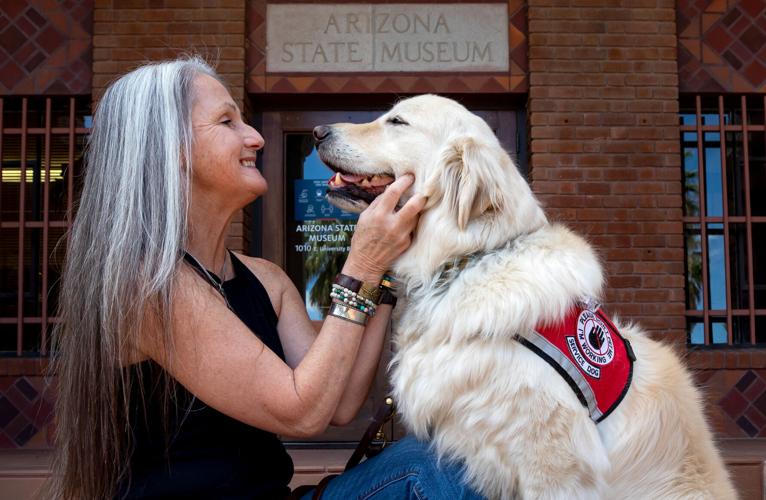
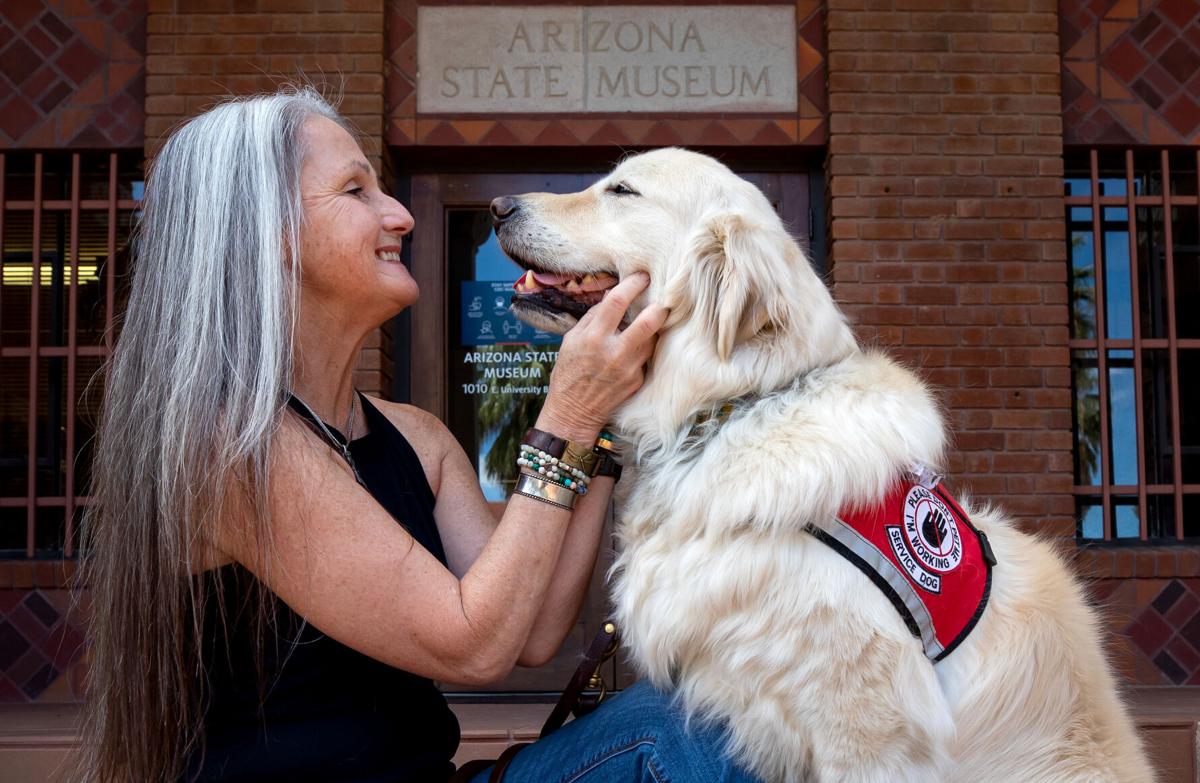
Rejected again. Joey Ramp’s proposed study was dismissed three times, and her service dog Sampson was the problem.
Ramp, 56, has used canine support since a 2006 riding accident when her horse slipped on a gravel road and rolled over her. She broke 23 bones and sustained a traumatic brain injury. Her recovery took a decade, and she developed post-traumatic stress disorder, as well as anxiety, depression and severe agoraphobia, which is the fear of leaving one’s house.
She recently started working with the University of Arizona through her company Empower Ability Consulting, which she started in 2017. Ramp assists students with service dogs pursue STEM majors, a passion that developed due to her own negative experiences in higher education.
The work she does now got started when that study was repeatedly rejected. It was, she soon realized, a symptom of a broader problem.
“Right now, people with disabilities … are not having equal access to the opportunities, primarily in science and in STEM, that other people have,” Ramp said, “and it is my hope that through EAC … I can help create a more open-minded culture, not only for diversity, equity and inclusion but also access.”
Although Ramp says she cannot yet discuss the work she’s doing at the UA because of a non-disclosure agreement, she already has helped many universities and individual students establish equipment and training requirements for service dogs in school laboratories.
In 2011, five years after her accident, Ramp decided to go back to school. Her motivation was largely that her doctors didn’t have the answers she wanted — they could not explain to her how she could be “so dramatically altered,” for example, and what her future might be like — so she decided to pursue those answers for herself as a neuroscience major. That was when she got her first service dog Theo.
And with Theo came the first barriers.
The class this first time was Chemistry 100 at Parkland Community College in Illinois, when Ramp’s academic advisor told her she would need to choose another major because service dogs were never going to be allowed in a science lab.
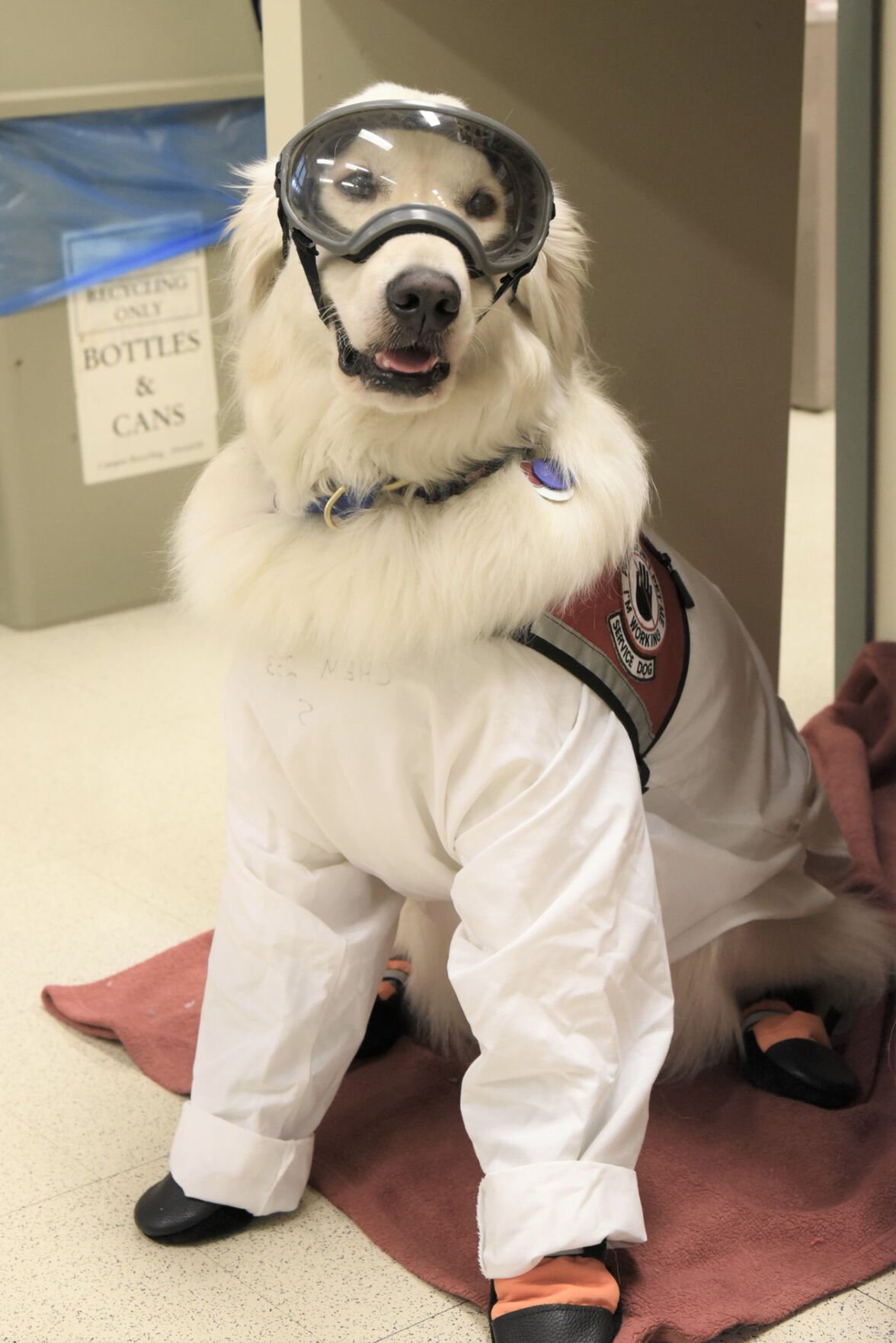
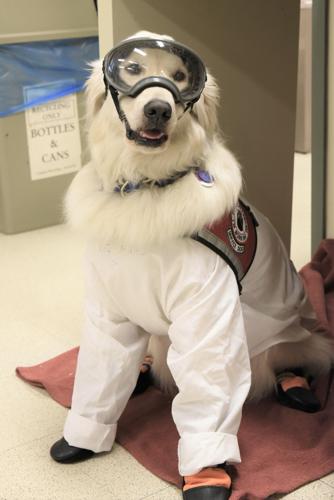
Sampson, a service dog working with Joey Ramp, is ready for a day in the lab.
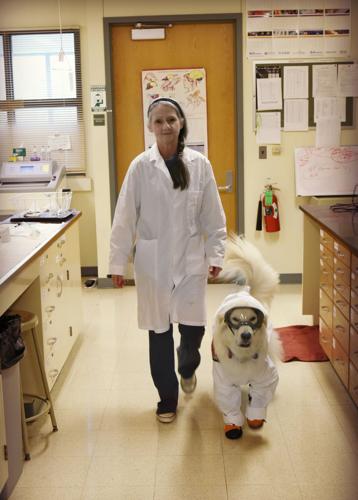
Ramp worked tirelessly with lab managers, faculty and disability office personnel to come up with requirements for her service dog in a lab setting. Later that year, Ramp and Theo were finally allowed to attend that chemistry lab. Theo had to wear personal protective equipment just like anyone else, including his own set of goggles.
Unfortunately, things got more difficult after that.
Each semester, prior to its start, Ramp had to spend weeks or even months trying to convince professors to allow her and Theo into a lab setting.
“I didn’t get the opportunity to just go in and learn like everyone else,” Ramp said. “This was a constant thing.”
Ramp had hoped her situation would improve after she transferred to the University of Illinois in 2014, as the university has a history of accepting and assisting students with disabilities, but that was not the case. The same thing happened there when she was told she could not participate in organic chemistry labs with a service dog.
But, again, she broke down that barrier, and Theo ended up being the first service dog in University of Illinois history to attend a chemistry lab.
Sampson, an 18-month-old fresh out of service dog training, would take up Theo’s torch after he retired because of health complications in 2015, after Ramp’s first year at the University of Illinois.
Despite accomplishing two big firsts for students with service dogs, Ramp’s greatest academic challenge was still to come.
She had to take a behavioral neuroscience class in the Department of Psychology on handling lab rats, a course required in her degree, but it was one the professor insisted would be impossible to complete with a service dog. The dog’s presence could disrupt the rodents’ normal stress levels, the professor said, and skew the study results.
Ramp called on the help of Pat Malik, the now-retired director of the Division of Disability Resources and Educational Services at the University of Illinois, who would help her negotiate with faculty at the Department of Psychology to brainstorm accommodations for Ramp and Sampson for the class.
According to Malik, one department faculty member suggested Sampson sit in a service closet outside the lab while Ramp did her work.
“Sampson, or a service dog, is not an accommodation,” Malik said. “It’s not an accommodation; it’s essential, like a wheelchair is essential to a wheelchair user for mobility.”
Ramp tried to appeal the decision. She says it was her negotiation with the course’s professor that changed her from being a “reluctant advocate” to deciding to pursue disability advocacy as a career.
“They’re slamming their hands on the desk, screaming, red-faced, saying, ‘Why are you being so insistent? You are never going to have a career in neuroscience, face it!’” Ramp said. “That rocked me — that someone could be that angry and that cruel toward anyone and be so close-minded.”
So, Ramp took what she saw as the obvious next step. She would design a study for herself to test whether rats would be more stressed with a service dog around. She ended up receiving a grant for $50,000 dollars to complete this research.
Ramp connected with Justin Rhodes, a professor at the University of Illinois and principal investigator at the Rhodes Lab, and together they drafted a research proposal and presented it to the Institutional Animal Care and Use Committee. That was where she ended up being rejected three times.

Joey Ramp with service dog, Sampson, is ready for work in the lab.
“There’s no reason why it shouldn’t have been approved, that’s for sure,” said Rhodes, a professor with more than 20 years of experience and an animal researcher who works with mice and fish in his lab. “And I’d be willing to stand against anybody for that.”
Malik said she was disappointed in the university, especially considering it was home to Timothy Nugent in the mid-1900s when he made groundbreaking headway for students who use wheelchairs.
“If you want diversity in scientists, you have to allow potential scientists to learn how to be a scientist,” Malik said. “What was (Ramp’s) biggest obstacle? People who can’t think outside the box.”
Ramp was never able to complete the study and lost the $50,000 grant.
Ramp graduated from the University of Illinois in 2019 with a biocognitive neuroscience degree, and Sampson walked across the stage with her, dressed in his service dog vest and with a mortar board on his head.
As she finished up her degree, Ramp was also able to work in a lab setting with Rhodes, who says Sampson’s presence caused absolutely no problems, unless you count him being “so cute.”
Ramp has gone on to work with colleges across the world to develop policies for service dogs in laboratories. She also has individually helped STEM students with service dogs who otherwise may not have had a voice to negotiate course expectations with universities.
As for what’s next for Ramp and her canine companion Sampson, they are continuing their work here in Tucson, which Ramp has decided to make their permanent home. The Texas native says she has missed the desert, and here she has the opportunity to live near her son while working with the UA.
Ramp is also the co-founder and vice president of International Alliance for Ability in Science, an organization providing scholarships to university students who need to buy equipment for their service dogs, which can run between $200 and $250. Much of the scholarship money actually comes from Science Service Dog, a site that sells merchandise featuring Sampson, the now famous lab dog.
Ramp hopes in the future people with disabilities will be recognized for what they are: human beings with a lot to offer in society.
“My hope is that people will start looking at each other as equals,” Ramp said, “and I think that would be my dream come true someday.”

