



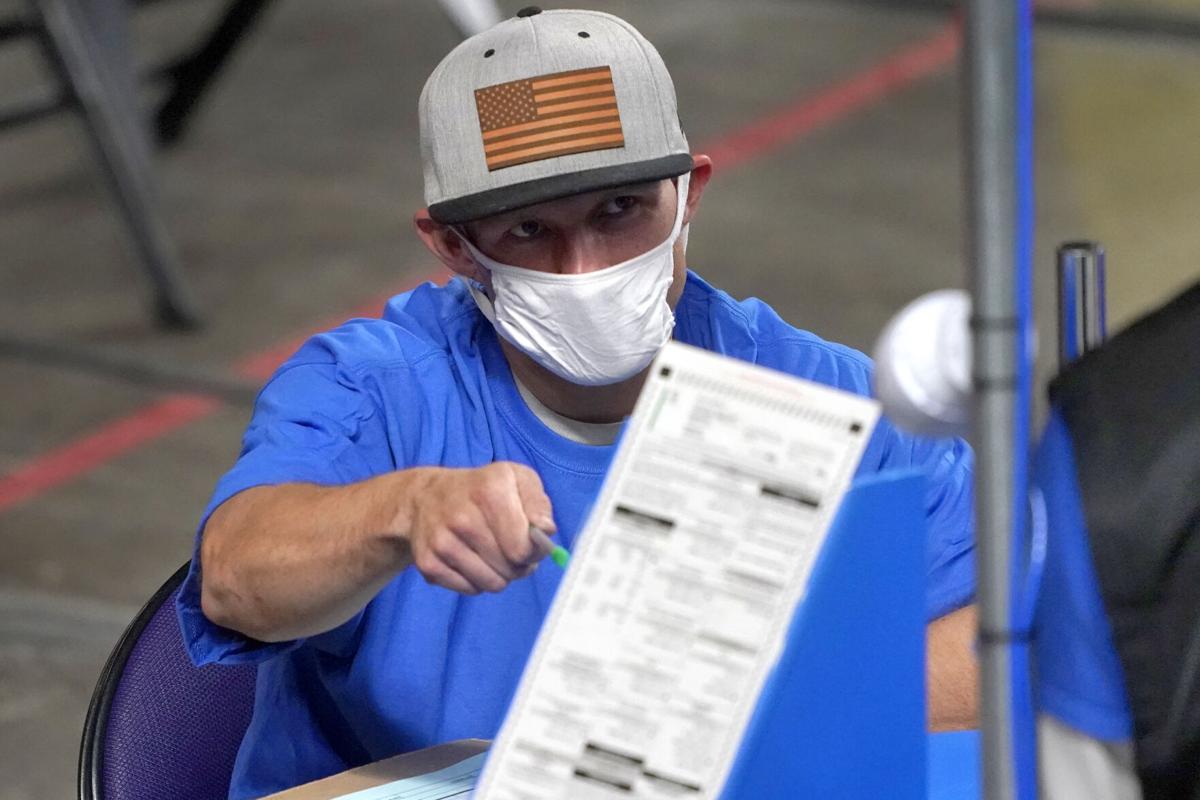
PHOENIX — A judge slapped down the latest claim by Cyber Ninjas, the contractor handling the state Senate’s review of the 2020 election, that it doesn’t have to respond to demands for public records.
Maricopa County Superior Court Judge John Hannah rebuffed a claim by the private firm that it cannot be sued under the state’s public records law. Attorneys for the company argued that such demands can be made only of what are traditionally considered public officials and agencies.
But Hannah, in a sometimes strongly worded decision, said that’s just not how the law works in Arizona.
Cyber Ninjas, hired by Senate President Karen Fann to review the 2020 election results in Maricopa County, has the opportunity to seek an appeal. Hannah, however, said prior decisions by the Court of Appeals support his ruling.
The ruling potentially paves the way for individuals to file demands for production of documents from other private companies on the premise that they are holding public records.
That point did not go unnoticed by Jack Wilenchik, an attorney for Cyber Ninjas.
“If Cyber Ninjas is compelled to respond directly to records requests by any member of the public, on penalty of being sued if it does not do so promptly, then it will create an unforeseen and legally groundless administrative burden on every state contractor and employee,” he argued.
At issue are tens of thousands of documents, emails, texts and other communications that Cyber Ninjas has not yet produced in response to a public records request by Phoenix Newspapers, parent company of The Arizona Republic. That is even after Hannah told the company that the records it has related to the audit are public, ordered it to preserve the records, and then, after the Supreme Court ruled in a parallel case, disclose them within three days.
That three days was up this past week.
Instead, Wilenchik filed pleadings saying there is “zero legal authority” to order Cyber Ninjas to respond directly to a public records request. And, if nothing else, he argued that forcing the company to respond to the public denies the Senate, to which he said the records really belong, the ability to decide “the timing, manner, and form of the production of its own public records.”
Hannah, however, said that ignores a couple of facts.
“Under the unique circumstances of this case the Ninjas are a ‘public officer’ within the plain meaning of the public records law,” he wrote.
He said “officer” means any person appointed to hold any office of a public body along with a chief administrative officer, head, director, superintendent of chairman of any public body. And “public body” means any public organization or agency supported with state funds or spending state dollars.
“The Ninjas have been ‘appointed’ by the Senate as the ‘head’ of the ‘public organization’ conducting what the Ninjas describe as an ‘ongoing investigation of how Maricopa County conducted the 2020 election,”’ the judge wrote.
The Senate is at least partly funding the audit with public money, “which makes the organization a ‘public body’ for purposes of the statute,” he added.
And since Arizona law defines “corporations” as “persons,” that makes the company and “officer” — along with the Senate — responsible for maintaining and disclosing public records, the judge said.
“It follows that Phoenix Newspapers may file an action against the Ninjas … appealing the denial of PNI’s request for audit-related public records,” Hannah said.
The judge also said Cyber Ninjas is a “custodian” of public records.
“The relevant provision (of the public records law) expressly commands persons seeking public records to direct their request to the ‘custodian’ of the records,” Hannah said.
“In the event of a denial, the requesting party has a judicial remedy through a special action like this one,” Hannah said.
The judge also rejected a bid by Cyber Ninjas to be dismissed entirely from the case.
That would leave the Republic suing only the Senate for records that the Senate’s own attorney says it does not have because they are in the hands of Cyber Ninjas. Hannah noted that the Senate’s right to demand those records from its contractor “has been a subject of debate throughout this case.”
The judge said it is settled law that the public records law makes the courts, and not the Legislature, the final arbiters of this public records dispute.
“If the Ninjas are beyond the courts’ authority, the Senate will effectively remain in a position to decide which of the records in the Ninjas’ possession are public records — precisely where (the Court of Appeals) says the Senate should not be,” Hannah wrote. He said that so far, “the Senate has not been inclined to disclose audit-related records to the public on any terms other than its own.”
Hannah stressed that his order still allows the Senate to seek to withhold specific records based on exceptions to the public records law such as attorney-client privilege.
“But procedural problems created by multiple record holders are not a reason to compromise the public’s right to know what its government is up to,” he said.
Fifteen people from six countries took the oath of allegiance during a naturalization ceremony at the Tumacacori National Historical Park, about 50 miles south of Tucson, on September 17, 2021. It was their final step in becoming U.S. citizens. The ceremony was part national Citizenship and Constitution Days. Video by: Mamta Popat / Arizona Daily Star

