


BOWIE — In mid-August, state water chief Tom Buschatzke said plenty of groundwater was available to support new and future agriculture in the rural Bowie and San Simon areas.
Barely three weeks later, on the morning of Aug. 28, Bowie resident Katrina DeWees noticed that her faucets were releasing only a pencil-thin stream of water. Within an hour or so, everyone’s water in this unincorporated community of about 500 was shut off.
While that emergency lasted barely a day before one of the town’s two wells was restored. The second well — by far the biggest — remains out of service. Its water level is too low for the pumps to reach. The utility can’t afford to add piping to move the pumps down, so it’s urging residents not to water lawns, wash cars or fill swimming pools.
The outage doesn’t necessarily mean Buschatzke was wrong. In making a ruling that the area doesn’t need a ban on new irrigated agriculture, he found that continued pumping at current rates would lower the water table 155 feet over 100 years, and the aquifer is known to go thousands of feet deep.
But former state water director Kathleen Ferris, who helped draft the pioneering Arizona Groundwater Management Act as an attorney in 1980, says Bowie’s problem shows what can happen when you allow groundwater pumping in rural areas that don’t have regulations like those in urban areas such as Tucson and Phoenix.
“The law wasn’t written for those domestic users in rural areas. The law was written to protect existing ag users, written totally from an ag point of view,” said Ferris.
The only mechanism to protect such areas is to create a state Active Management Area that can limit one well’s pumping to protect other wells, said Ferris, now director of the Arizona Municipal Water Users Association in Phoenix.
But a leading pomegranate farmer in the area, Larry Romney, says Bowie’s water problem has been “overblown and exaggerated.” He says the kinds of regulation that exist in cities would destroy a rural economy by limiting agricultural growth and production.
“The unintended consequences would be devastating,” he said. “It would cause more problems than it would solve.
While this debate continues, residents such as DeWees and Barbara Farhart are pointing fingers, wondering how this could have happened so suddenly, although they are thankful that enough rain fell here last week that their lawns and trees didn’t need water. In the past week, the community’s water use has dropped by half, said Dan O’Neal, board chairman of the Bowie Water Improvement District, the community’s water utility.
“We’re having cool weather right now,” O’Neal said. “When the weather gets hotter, it’s going to make it worse.”
Water utility ‘Running on a shoestring’
Bowie’s wells haven’t dried up — it’s just that the aquifer was suddenly lower than the pumps.
The wells sit on opposite sides of a massive, 50-foot-tall steel water storage tank at what passes for the center of this community, on Eisenhower Street just west of the Interstate 10 business loop. The small well, which pumps about 120 gallons a minute, was drilled in 1976; the bigger one, which pumps about 300 gallons a minute, came in 1982.
“The piece of paper we got from ADEQ (the Arizona Department of Environmental Quality) showed that the holes in the ground where the wells were drilled are 907 feet,” said O’Neal.
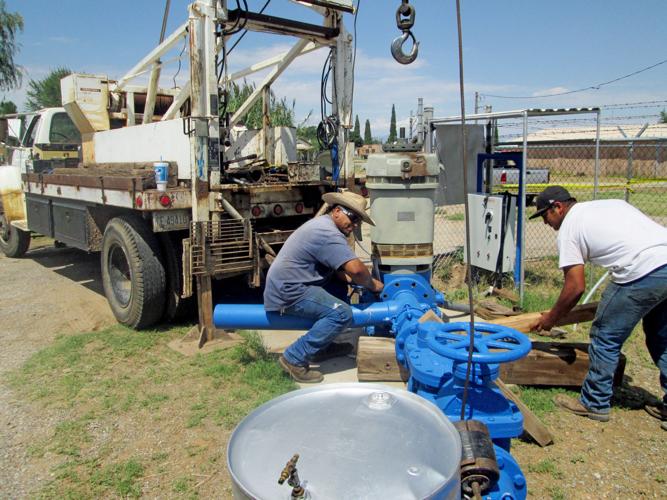
When the wells shut down, Cochise County officials, the Red Cross and other nonprofit groups, and companies such as Target and Safeway quickly delivered other emergency supplies. By that night, a driller was installing piping so crews could lower the smaller well’s pumps 60 feet. By 3 p.m. Saturday its water was turned back on after a state-certified environmental testing firm declared it safe.
But the big well is much more complex — workers had to pull out at least 10 sections of pipe last week — and it will take up to $50,000 or $60,000 to restore, O’Neal said.
It’s no mystery why they both stopped working at once, O’Neal said as he stood near the water tank last week. “Over time, the aquifer lowers. We have a drought. Over the years, the wells have dropped. It’s normal for an aquifer.”
Utility officials had noticed that the big well had stopped pumping on Aug. 26, two nights before the smaller well gave out, he said.
The utility probably could have done more to catch the problems sooner, the utility chief said, if it had more money.
“You’ve gotta realize that we’re running on a shoestring,” he said. “We have 204 customers, no budget and they’re paying $39.99 a month. That brings in around $7,000. We pay the USDA (the U.S. Department of Agriculture) $1,575 a month to repay a loan for new plumbing, and we pay a $4,000-a-month electric bill to run the pumps. That’s $5,000 out of the $7,000. Then we’ve got labor, insurance and upkeep.
“When I took over five years ago, there was nothing,” he said. “We had very little cash, everything was off except the electric and that was going to be shut off in a week. I had to come up with a $10,000 deposit to restore our account.”
A possible source to help repair the well is the State Water Infrastructure Finance Authority. It offers low-interest loans to pay for water pipes and pumps. But the soonest the authority could advance a loan to Bowie is at its Dec. 16 meeting — if the utility gets its application in eight weeks in advance, said Susan Craig, the authority’s communications director.
“When the grant money is in my hands, I’ll believe it,” O’Neal said.
“NOT CALLING WOLF”
Three-year Bowie resident Farhart was still upset about the water service outages last week as she sat in a swinging chair on her front porch.
“I wish they would have given us notice in advance. I think they knew this months ago and didn’t tell us to watch the water. Nobody even told us on Friday until we learned on Facebook,” she said.
About every two months, in the middle of the day, her water service has shut down for two hours or so at a time, she added.
On Aug. 28 when the water went out, a friend from out of state was visiting, and they had to get buckets of water from the Fire Department for drinking and showers.
“You gotta be monitoring the water,” she said. “You can see how much water there is in the town. Why isn’t somebody watching this? Why wait for both wells to go down at the same time?”
A block or two away, DeWees was also fuming last week, but not at the utility.
She’s frustrated that the Arizona Department of Water Resources rejected the ban on new agriculture. Dozens of landowners had argued that it was unfair to stop them from planting new crops when five large growers who pushed for the ban had planted pistachios and pecans and drilled wells in recent years — essentially expanding their operations. then preventing anyone else from doing so.
She’s nervous about the many new pecan and pistachio orchards farmers are planting, even though she realizes that farmers are the mainstay of the town’s economy. With California farmers increasingly moving to the area, she worries about what the water supply will be like when her 17-year-old son grows up, adding, “We’re not thinking about the future of anything.”
She said she’s been noticing water pressure problems off and on since early July — pressure would be good, then it would drop. A few days before the water went out, she “started filling trash cans and everything I had” with water, she said.
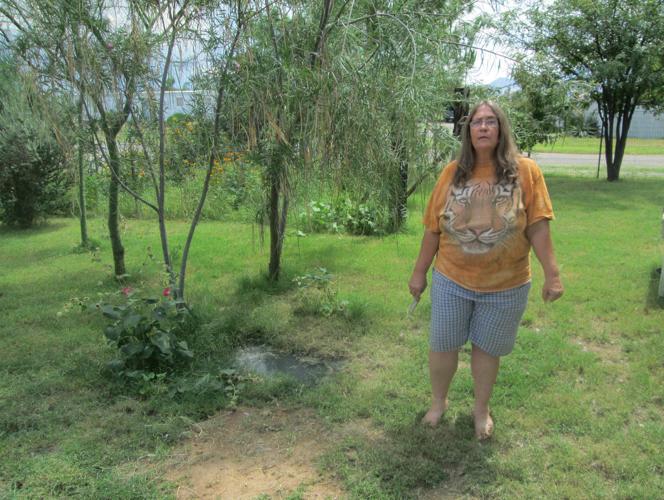
The current cutbacks don’t affect her much because she doesn’t water her lawn and many of her trees live on gray water from her sinks and washing machine. But had this happened in June, when it was hotter and drier, “I probably would have lost some trees,” she said.
Farming is increasing
Water utility chairman O’Neal wouldn’t say whether farms’ pumping had lowered Bowie’s wells.
“I need everyone’s help. Nobody can say for sure,” he said. “But since I moved into town in 2000, ag has increased a lot. When I first got here, I could go a lot of places in the desert I can’t go to now because there’s (pecan and pistachio) trees there.”
But, “of course ag pumping has had an effect. All pumping has,” said pistachio grower Mark Cook, one of the large growers who petitioned to ban new agriculture. “I venture to guess that no farmer has a well that they haven’t had to drop their pumps in the last 10 years. Pretty much without exception, every time we pull a well to do maintenance, we’re setting it back deeper than it came out.”
Cook, who gets drinking water from his own well, said he’s glad Bowie residents didn’t have to go without water too long. But he hopes this event opens his neighbors’ eyes.
“We’re not calling wolf here,” he said.

