

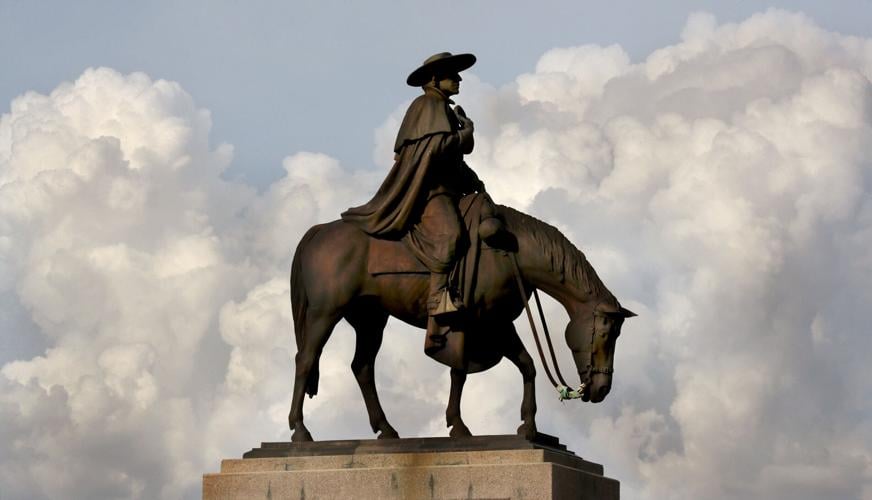




Padre Eusebio Francisco Kino sits on a horse overlooking South Kino Parkway at East 15th Street in Tucson.
The sculpture of the 17th-century Jesuit priest’s travels by horseback is fitting of Kino’s life and legacy as a Jesuit missionary, explorer, cartographer, rancher and farmer. He founded 21 missions in the Pimería Alta — what is now Northern Sonora and Southern Arizona.
A second equestrian bronze statue is shared with Segno, Italy, where the padre was born in 1645. The plaza in Segno was renamed after the padre in 1991 when the sculpture — a gift from the city of Tucson, Pima County and private donors to Segno — was installed in the plaza. The street that leads to the town square is Via Sonora and another street that goes from the square to the church of Torra where Kino was baptized is Via Arizona.
On Aug. 8, the Kino Heritage Society, which is dedicated to promote Kino’s cause for sainthood and to educate the public about him, is holding a celebration in front of the Kino statue on 15th Street and Kino Parkway in Ward 5. Councilman Richard Fimbres will lead the commemoration activities of “Three Statues for Three Nations” at 8:30 a.m.
“This will be a historic event and in a couple of years, we are hoping Father Kino will be beatified as a saint for all to love and cherish,” said Fimbres.
A third Kino celebration at a later date is planned in Magdalena de Kino, Sonora, where the third equestrian bronze statue was gifted in 1989.
Kino died March 15, 1711, at age 65 in Magdalena. His visible skeletal remains are in a crypt at La Plaza Monumental, about 50 yards from María Magdalena Church.

Father Eusebio Francisco Kino in a painting by Tucson artist Frances O'Brien.
The Tucson celebration will include a 10 a.m. public Mass at the downtown St. Augustine Cathedral at 192 S. Stone Ave. The priests concelebrating Mass are the Revs. Gregory Adolf, president of the board of directors of the Southwest Mission Research Center; Christopher Corbally, a Jesuit Vatican astronomer; and Peter G. Neeley, associate director of education for the Kino Border Initiative. Adolf and Corbally are founding members of the Kino Heritage Society. Bishop Edward J. Weisenburger, of the Roman Catholic Diocese of Tucson, will not participate because he will be out of town.
A private reception will follow at the diocesan pastoral center, which is adjacent to the cathedral. The reception is sponsored by the Knights of Columbus Councils 4584 and 2058.
In Segno, a celebration will pay homage to Kino, who was born Eusebio Chini, said Alberto Chini in a recent email to Rosie Garcia, president and founding board member of the Kino Heritage Society, a community-based group working under the diocese.
The festivities in Segno will include a Mass in the town square celebrated by the Archbishop of Trent Lauro Tisi, said Alberto Chini of Segno. Chini is a 10th-generation collateral descendant of Kino’s on an uncle’s side.
The first statue was erected in Tucson in 1988, according to “Kino A Legacy,” a book written by the late Jesuit Rev. Charles W. Polzer, a Kino scholar. The three statues of Kino on horseback were casted by the late sculptor Julián Martinez of Mexico City. Martinez accepted $25,000 for the project that Polzer described as “most generous.”

A woman prays at the temporary crypt of Father Eusebio Francisco Kino in Magdalena, Sonora, Mexico in July, 1966.
Garcia said the Tucson celebration is important because “it will continue to keep the Kino legacy alive. Padre Kino, the “Patron Saint of the Borderlands” had a social justice vision for all,”’ she said.
“This celebration of the Three Statues for Three Nations is a wonderful opportunity to celebrate the enduring legacy of Padre Kino as the ‘bridge builder between peoples and cultures’ and an opportunity to strengthen our shared histories and our common humanity,” said Adolf.
“There is no one like Padre Kino that represents the union of these borderlands with such gallantry,” said Rafael Barceló, Mexican consul in Tucson. “Sonorans as well as Arizonans appraise his enduring legacy as a builder of a new community, having put together worlds that were apart with a deep understanding and respect for humankind and a cosmogony that has prevailed as an aspiration both for Mexico and the United States.”
Last year, Pope Francis approved that Kino be declared a “venerable” person, which is two steps away from sainthood. At that time, Weisenburger said the pope’s formal approval recognized Kino’s life of “heroic virtue.”
“Padre Kino is especially recognized as an extraordinary example of evangelization, science and respect for the dignity of the poor,” wrote Weisenburger in an email to parishioners.
The process to canonize Kino began in the 1960s and it started in Hermosillo, Sonora, Mexico. According to the U.S. Conference of Catholic Bishops website, after a candidate becomes venerable, the next step is blessed and then canonized as a saint.
Contact reporter Carmen Duarte at cduarte@tucson.com or 573-4104. On Twitter: @cduartestar

