

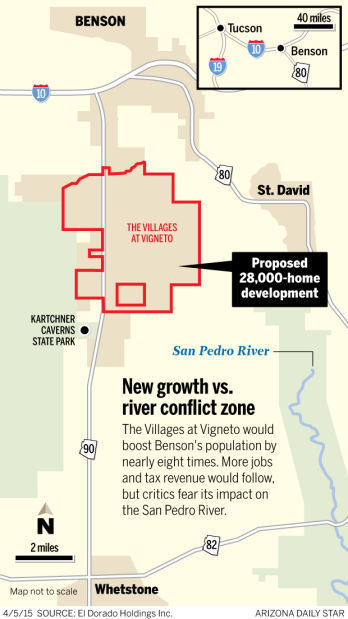

BENSON — The Benson City Council gave its first stamp of approval to the planned Villages of Vigneto project in the Whetstone Mountains, despite concerns from a packed house that the development threatened the area’s water supplies and the fragile San Pedro River.
The council voted 6-1 to approve a preliminary development plan for the 28,000-home development, which could hold 70,000 people. Councilman Patrick Boyle cast the only “no” vote at the Monday night meeting before a crowd of about 100.
The development would lie in the Whetstone Mountains, straddling Arizona 90, which stretches south from Interstate 10 toward Kartchner Caverns and Sierra Vista.
The project’s 12,300 acres already has zoning for a 60,000-home project. But the developer has said the company doesn’t want to build something that big and is proposing something much more cohesive than the earlier plan.
“Our desire is to do something far more conscientious, in keeping with the landscape,” Mike Reinbold, a partner with Phoenix developer El Dorado Holdings told the council. “We want a community not bound by walls or with little boxes. We want to create a community with an abundance of open space.”
Opponents acknowledged after the vote that they face a challenge in rounding up support for a referendum drive to challenge this project, in the fashion of a successful effort back in the 2000s to overturn a Cochise County rezoning for another big project. One reason is that the opposition forces hailed from Tucson, St. David, Cascabel and Sierra Vista, although they pointed out the developer is also an outsider.
After the meeting, Benson Mayor Toney King pledged that the city will keep a close eye on the project’s water impacts. He said, “If it comes to the point where they say the water is in jeopardy, if we have to put a stop to it, we will.
“I feel that over the years, we have a lot of water studies that have been done for previous developments,” King said in an interview. “I feel confident, from what I’ve been told over years of study, that we do have water.”
The developer has taken precautions to save the water, and not use it “fruitlessly,” said King, now in his third term as Benson’s mayor on top of three City Council terms. “They’ll be very positive about their use of water.”
Opponent Robert Blanchette laughed when told of the mayor’s assurance that the development would stop if water supplies proved inadequate. He called the vote a waste of time, given what he saw as the council’s pro-development bias, and said he was only surprised that one councilman voted no.
“When has a developer ever stopped anything?” said Blanchette of St. David. “He’s in it for making money.”
He and other opponents pleaded vainly with the council to hold off on the new plan until more studies can be done of the region’s water supplies.
“The developer says the project will begin even without your vote,” said Debbie Collazo, a Tucsonan who sent a prepared statement opposing the project to the meeting. “Talk about arrogance. Don’t be pushed around by developers and law firms from Phoenix.”
El Dorado Holdings plans to submit a final development plan to the city in 30 to 45 days, Reinbold said after the council meeting. The first homes should be ready for occupancy in late 2017 or early 2018, he has said.
But during the meeting, eight speakers warned that the region’s water supplies aren’t limitless. While the Arizona Department of Water Resources has certified that the project has an adequate water supply for 100 years, speakers denounced that thinking as speculative.
“The idea that the developer can guarantee a 100-year water supply is pure fiction,” Blanchette said. “No one can predict future rainfall. Arizona has been in an extended 15 year drought. No one predicted it. We don’t have a CAP canal or a lake or a river that runs consistently to tap into once groundwater runs dry.”
Les Corey, a longtime Tucson conservationist and professional ecologist, said in a statement read to the council that it’s critical the community obtain a more complete picture of the development’s likely impacts on Benson and the middle San Pedro River basin.
“Water is life in the desert, and without it, your community will not thrive in the ways that you and your residents desire,” said Corey, whose statement was read by Anna Lands of the rural Cascabel community north of Benson.
Councilman Jeffrey Cook said when he first learned of El Dorado’s purchase of the property last year, his first thought was of the San Pedro. He went online and pulled up all kinds of reports on the river, and concluded it’s probably the world’s most studied river.
“I think we can do another 45 years of study and still not know what we can’t see beneath the surface,” said Cook, speaking of the impacts of water pumping on the river. Later, he said he believes that 2,000 wells drilled along the San Pedro since the year 2000 pose a more immediate threat to the river than this project.
If an upcoming U.S. Geological Survey report on the river area’s water use and recharge, or other future reports, raise red flags about the water supply, “I’d have to see it” before reacting, Mayor King added.
“I have to tell you that this is one of most honest developers we’ve dealt with,” King told Reinbold during the meeting. “You’re very open. Your books are very open. If you don’t have an answer, you find the answer for us. I can tell you that the trust factor with this development is very strong, the strongest I’ve ever had.”
Norm Meader, a Tucson resident and Cascabel landowner, said the city and developer need to monitor groundwater levels as the development proceeds and minimize water use through the use of efficient appliances, home furnishings and landscaping.
The city also needs to use computer model studies to show how groundwater levels will decline over time, and maximize the amount of groundwater recharge and water harvesting that occurs, he said.

