


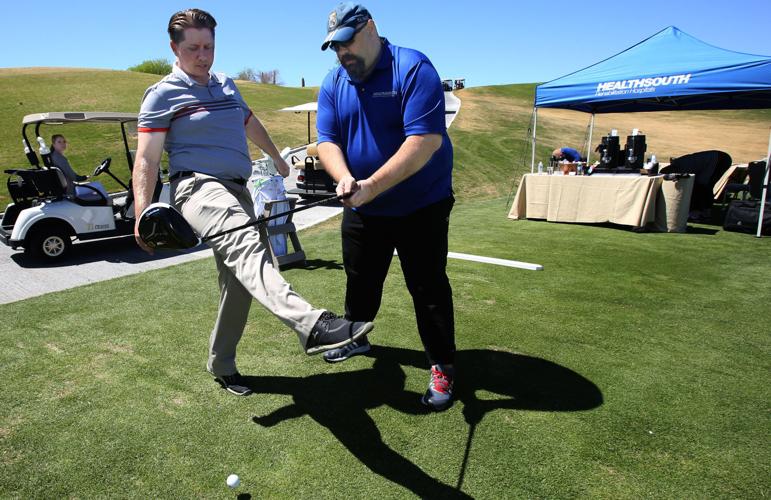


Before Eric Cline swings, the golf pro asks about his physical limitations.
“None,” Cline replies. “Just my vision. My peripheral vision.”
Watching Cline, 42, walk across the Starr Pass Golf Club course and then hit a few balls, it is impossible to detect remnants of the devastating ruptured aneurysm and stroke that nearly killed him two years ago.
The aneurysm burst on March 26, 2015, which was Cline’s fourth wedding anniversary. At the time, Cline was a captain with the Rural/Metro Fire Department in Sahuarita, and the ruptured aneurysm was completely unexpected. He did not have high blood pressure, had not been having headaches, and his age put him at low risk.
When the aneurysm burst, it caused Cline to suffer a stroke, and his prognosis was terrible. He was hospitalized at Tucson Medical Center, and firefighters from across town held vigil for him. His eyes were unresponsive, and he wasn’t responding to pain. It appeared he might be brain dead. Doctors talked to the family about organ donation.
But just as his family was trying to accept the worst, Cline coughed and began reacting to touch.
Long road
The recovery was grueling. Cline initially could not walk and hardly spoke. He spent two months doing inpatient rehabilitation and another six months as an outpatient. The last time the Star visited with Cline was in July 2015 — four months after his aneurysm and stroke. At that time, he limped, his left arm hung at his side, he was sensitive to noise and struggled with his short-term memory.
The father of three young children no longer limps, his memory has improved and he tolerates noise just fine. There are no outward signs of the so-called “left side neglect” that challenged him as he worked to get better. The only left side problem that lingers is with his left peripheral vision, he says.
“It is basically gone,” he says. “I did have to give up my driver’s license and right now I have to rely on others. ... I like driving and I like my independence. So I’d like to get my license back.”
Cline also gave up his 20-year firefighting career, which was a painful but necessary decision. It had always been his dream job, and he loved the work.
“That was a difficult thing to get through. I know he’d really wanted to stick with it,” says his wife, Risa Kottabi Cline, 36, who works for a local preschool business. “He wants to work. He loves being around people and loved being around the guys at the fire department.”
Her husband’s sleep patterns aren’t what they used to be and he now gets sleepy during the day. He also sometimes has trouble regulating his own voice and doesn’t read as much as in the past, his wife says.
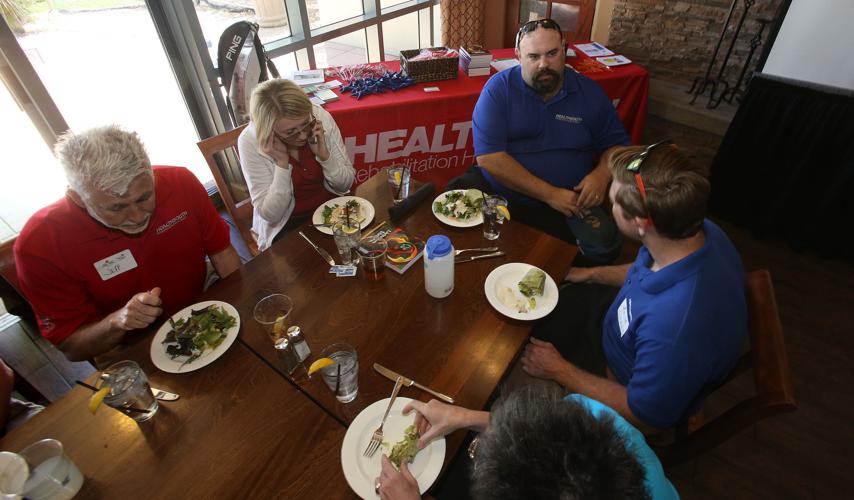
Yet Cline maintains a laid-back and cheerful demeanor. It’s evident at the golf event, which is called Surviving Strokes. The annual event pairs stroke survivors with golf pros to give them some social time outdoors. Cline not only played, but was also a keynote speaker at a lunch following the event.
Helping others
Cline is looking forward to having a new role, volunteering with stroke survivors doing rehab at HealthSouth Rehabilitation Institute of Tucson, which is where he did his rehab. HealthSouth was a sponsor of the Surviving Strokes event, along with the Tucson chapter of the American Heart Association/American Stroke Association.
“I’ve seen the bad results of strokes. I lucked out,” he says. “There were days I didn’t want to do rehab, but they pushed me and I’m glad they did. It improved my life tenfold.”
As he went through rehab, Cline had to put conscious effort into doing tasks that most of us don’t think about, like going up and down stairs and reading. He had a tendency to not see the left side of words.
Cline hopes he’ll be able to motivate others to work hard in rehab because that’s the only way to get results, he says.
“He’s been able to succeed and be a very active man after,” says Andrew Yost, a speech-language pathologist at HealthSouth who worked with Cline during his recovery. “It’s effort — a lot of simple and mundane tasks to rebuild patterns.”
Potential recovery is based on hard work. It’s effort put in, no matter what age you are, Yost says. And it helps that Cline has a good sense of humor — he jokingly refers to Yost as Justin Bieber.
“I just love us”
Kottabi Cline says her hope on that first night in the hospital two years ago was for her husband to live — she had no more expectations.
She’s been happily surprised by the amount of progress he’s made ever since. For a while she thought he’d always need a wheelchair. Then she assumed it would be a walker. As it turned out, he needs neither. The couple has a disability permit for their car, but rarely make use of it.
One of the best parts is that her husband’s personality is the same, Kottabi Cline says. Cline still uses his trademark sarcasm, even if his delivery is sometimes a little off, she says.
“He’s done really, really well,” she says. “When it’s the two of us, we laugh hysterically. I just love us. We still have a great relationship.”

