


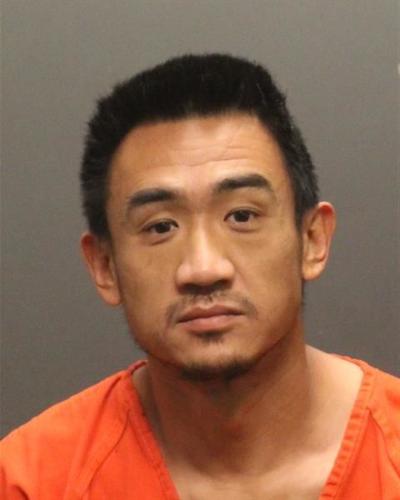
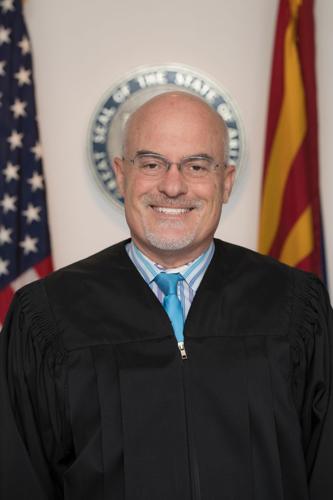

A Pima County judge took the witness stand, then took the Fifth at a court hearing held to decide if he was acting as a government official when he made death threats and fired a “warning shot” that landed inches from an unarmed man he suspected of stalking him.
“I am invoking my right to remain silent,” Justice of the Peace Adam Watters replied when asked under oath to describe what happened on the street outside the judge’s home on a Sunday afternoon in February.
Watters’ decision to keep quiet at an Oct. 27 evidence hearing thwarted a defense lawyer’s attempt to have the stalking suspect’s arrest thrown out on constitutional grounds.
Santa Cruz Superior Court Judge Tom Fink, assigned from a neighboring county to hear the case, ruled that the limited evidence available without Watters’ testimony did not prove Watters was acting in a law enforcement role when he forced the man from his car at gunpoint and threatened to shoot him in the head before firing in his direction.
The distinction is important because several rights guaranteed by the U.S. Constitution automatically kick in when someone is detained by law enforcement, such as protections against use of excessive force and search or arrest without probable cause.
“There’s just a lack of a record before the court,” Fink said. “The record is limited and incomplete.”
Watters was subpoenaed to testify by defense lawyer Jeff Grynkewich, who represents Fei Qin, 38, a Tucson landlord charged on suspicion of stalking by repeatedly driving by Watters’ Catalina Foothills home and leaving trash in the front yard.
Some of the junk mail was addressed to tenants Qin had recently tried to evict in a case heard in Watters’ courtroom, authorities said.
Grynkewich played for the court a video Watters took of himself just before the shooting in which he repeatedly threatened to kill Qin before firing a shot from that landed inches from the man’s foot.
The defense attorney said Watters, 59, is effectively on duty around the clock since he and other judges are on call day and night to rule on warrant requests. Being a judge, “is not a nine-to-five job,” Grynkewich said.
He also claimed the Pima County Sheriff’s Department showed favoritism to the judge by letting him go free after the incident, effectively giving its blessing to Watters’ conduct that day.
Cochise County Attorney Brian McIntyre, who is prosecuting Qin because the Pima County Attorney’s Office declared a conflict of interest, defended the integrity of the law enforcement investigation and said Watters “was not acting in a law enforcement capacity” and had rights as a private citizen “to self-defense and defense of premises.”
“At best, we have a citizen who went too far at a particular moment,” McIntyre said of Watters’ conduct.
Watters was not prosecuted for the shooting because an out-of-town county attorney determined a conviction was unlikely. Testifying under oath could have jeopardized that favorable legal outcome had Watters said anything under oath that conflicted with his account to law enforcement.
Qin’s trial is slated for Dec. 6 in Pima County Superior Court.

