



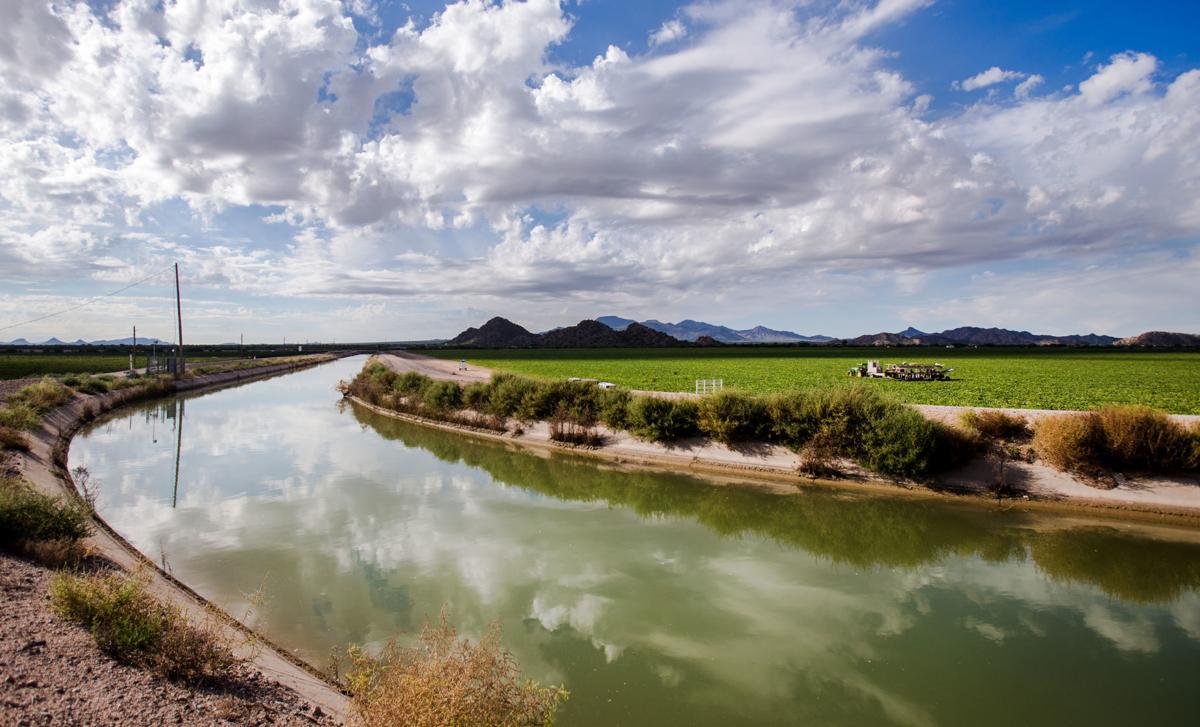
PHOENIX — Pinal County farmers are facing pressure to use their water more efficiently as they seek state subsidies for new wells to replace their Colorado River water.
At an Arizona House committee hearing this week, farmers and their advocates came under questioning from committee Democrats about water use and plans to use it more efficiently. They were urged to use more drip irrigation on crops and to try experimental practices such as one being researched at the University of Arizona to use solar panels to shade crops and save water.
The farmers said they believe in efficiency but it must work economically.
“You talked about agriculture and cattle and how important all that is in Pinal County,” Rep. Rosanna Gabaldon, a Sahuarita Democrat, said to Chelsea McGuire, an Arizona Farm Bureau lobbyist. “I guess what I’m looking for is, there is research, not only from the U.S., but around the world, in regards to how to grow crops using less water. I want you to actually address what Pinal County has looked at.
“Our water supply is very finite. We in the state of Arizona need to look at better practices,” Gabaldon said.
“What I can tell you,” McGuire replied, is that regardless of what that research says, it’s going to cost money to implement those programs. If that is not an economically viable decision for those farmers to make, they’re going to go out of business.”
Pinal farmers said they’re already extremely efficient in their water use, and that at least 85 percent of their water actually irrigates crops, as opposed to running off or seeping into the aquifer.
The questioning came shortly before the House Natural Resources, Energy and Water Committee voted unanimously Tuesday evening to approve spending more than $16 million in state money over the next few years to help Pinal farmers pay for the cost of new wells.
The farmers plan to pump groundwater to replace Central Arizona Project water they expect to lose starting in 2023. A Senate committee voted 6-1 Wednesday evening for a similar measure.
For the most part, committee Republicans didn’t focus on the efficiency issue, talking much more about the high importance of farming to Pinal County’s economy and to local and national supplies of cotton and dairy products.
But the minority Democrats’ votes are important to give the legislation a two-thirds margin needed to take effect in time to meet Thursday’s federal deadline for adoption. In the House, nine Democrats must vote “yes” along with all 31 Republicans to make the two-thirds.
Federal statistics strongly suggest that Arizona farms are thirstier than their counterparts .
Arizona farmers use the most water per acre, on average, of those in any state for all crops, U.S. Department of Agriculture data shows. This state’s average of 4.4 acre feet per acre was more than twice the national average in 2013, the last year for which data is available.
On individual crops, Arizona farms ranked highest in water use on cotton, alfalfa, hay, vegetables, barley, sorghum and wheat — all grown in Pinal County.
Production of all those crops except for cotton and wheat rose in the county from 2002 to 2012, says a recent UA report on Pinal County agriculture’s economic impact.
For four crops grown in Arizona, including cotton and alfalfa, their farmers also got better crop yields per acre than those in all other states. But those yields were not nearly as much above the national average as was their water use, USDA data shows.
One key reason for higher water use is that in central Arizona and in the Yuma area, “we can irrigate year-round because of climate,” said Brian Betcher, general manager of the Maricopa-Stanfield Irrigation District in northern Pinal County.
With enough water, good climate sometimes allows crops to be planted two or three times yearly, he said.
“Pinal County is uniquely positioned to grow the crops we do. It may be the best area in the country, climate and soils wise, to do so,” Betcher said.
Also, many other parts of the U.S. can rely on local rainfall for water supplies, while arid Arizona must rely on irrigation water, and those disparities aren’t reflected in this data, Betcher said.
“Many crops do not do well in cooler climates. It’s all about soils, climate, growing conditions and water delivery capability,” Betcher added.
But the data show why Arizona farmers need to find ways to save water and grow less thirsty crops, said Rep. Kirsten Engel, another Democrat who questioned Pinal farmers about water use.
She and Gabaldon voted for the drought plan legislation out of concern for Lake Mead, for which the plan is trying to save water. This week, $2 million was added to drought plan legislative bills, strictly for conservation programs in Pinal County and other areas, including Tucson, with state-run water management areas.
“The farmers’ reasons for using so much water may all be true, but we are unquestionably at a time of water shortages,” said Engel, a UA law professor. “We should definitely be doing better.”
“I would have hoped for maybe a little more interest in changing business as usual,” she said Wednesday of farmers’ responses the day before.
Betcher told legislators Tuesday that when his and other irrigation districts built CAP canals in the 1980s, to bring Colorado River water, “they built them at the highest maximum efficiencies.” Almost 90 percent of the farmland was “leveled” at that time to promote efficiency, he said.
“We started in a world of conservation,” said Betcher, adding that over the years “we pushed growers toward more efficiencies.”
Today, only 4 percent of the farms’ water is lost to evaporation and seepage in irrigation canals, he added.
He and others said that while drip systems can help in some places, it’s not the “end-all, be-all,” in part due to its cost.
“We have a 5,000-acre farm, 1,100 acres of it in drip,” Pinal farmer Dan Thelander told the committee. “We and our landlords spent in excess of 2.5 million dollars to install drip systems. But if you took all farm ground in Pinal and put it into drip, my calculations are that it would cost $460 million.”
Engel touted the solar panel idea, the subject of research led by Greg Barron-Gafford. He’s an assistant professor in the UA’s School of Geography and Development. Barron-Gafford describes the practice as a new way of “doing agriculture in the dry lands of the world.”
But Betcher said that with projects like that, “you have to be able to prove it as being able to expand to a commercial-sized farming operation, to make money on it.”

