

A new University of Arizona study shows severe grief can increase a person’s risk of heart problems.
Experts are encouraging people in mourning and their loved ones to take symptoms seriously and prioritize self-care.
The study’s senior author, UA associate professor of psychology Mary-Frances O’Connor, said she hopes the results will help clinicians better treat their bereaved patients, who are at higher risk for hypertension and other heart-related problems.
Broken heart syndrome, also called stress cardiomyopathy, can happen when a person experiences sudden acute stress that can rapidly weaken the heart muscle, according to Johns Hopkins Medicine.
Local hospice providers and grief workers say they’ve seen plenty of evidence that broken heart syndrome is real, but they hope the study will provide additional validation and help facilitate conversations about grief and effective ways to manage it.
‘Emotional stress test’
O’Connor said she’s always been fascinated by the way a person’s emotional life can effect their physical health, and bereavement is a particularly powerful example.
In the first six months after the loss of a partner, a man is almost twice as likely to die compared to a man who has not experienced a similar loss, O’Connor said.
“Knowing that dying of a broken heart is a real phenomenon … there’s no doubt there’s this profound impact of such an emotional and important event in our external lives that’s getting under our skin and into our organs,” she said.
After losing her mother after a long terminal illness, O’Connor said she was more comfortable talking about death and loss and sitting with grieving people than most other 26-year-olds.
This allowed her to interview people in-depth about their experiences and see how what they were telling her mapped against clinical findings of their overall health.
O’Connor called this most recent study the latest in a long line of efforts to understand the connection between the loss of a loved one and medical consequences. She was motivated by the idea of dying from a broken heart.
“From before, we know that overall, bereaved people in that six-month window tend to have slightly higher blood pressure and heart rates than non-bereaved people, but they seem to return to their own baseline around that time,” O’Connor said. “It made sense that the extra stress on the heart from grieving might be a cause of medical outcomes, including mortality.”
The study included 59 participants who had lost a close loved one in the past year. Researchers used a process called “grief recall,” talking to each participant for 10 minutes and asking them to share a moment when they felt very alone after the death of their loved one. Researchers then measured the participants’ blood pressure.
“It was kind of an emotional stress test,” O’Connor said.
After grief recall, participants’ systolic blood pressure — the amount of pressure that the heart exerts on the arteries while beating — increased by an average of 21.1 millimeters. This is roughly as much of an increase as would be expected during moderate exercise, O’Connor said.
Among participants, the people who showed the highest level of grief symptoms experienced the greatest increase in blood pressure during the grief recall. This means it isn’t just the death of a loved one that impacts the heart, but also the emotional response to that loss, O’Connor said.
“That’s important because all of us get upset when we talk about a really important loss in our life,” she said. “If we know people experiencing more severe grief might be at more risk, that’s something we can assess or track, even in a primary care office.”
A time of increased risk
O’Connor studies an intervention called “progressive muscle relaxation” in her Grief, Loss and Social Stress Lab. This technique teaches grieving people to tighten and then fully relax the major muscle groups in their body, an intervention that can be helpful for curbing stress levels.
Learning to manage one’s grief is key, but it’s important to keep in mind that hypertension during grief is still hypertension, she said.
“So it’s also appropriate to give them hypertension medication. The heart doesn’t know where that stress is coming from,” O’Connor said. “Sometimes people think they feel something going on with their heart and it’s just grief … but if you feel that you’re having heart-related symptoms, take those very seriously because this is a time of increased risk.”
For many people who lose a loved one, all their attention and care has been focused on the person who was ill, but that can come at the expense of the caretakers’ own medical needs.
“When you know someone who is bereaved, it’s appropriate as a form of support to remind them of their annual exam or dentist appointment or mammography screening,” O’Connor said. “Most health consequences we see would be detected in just a normal office visit.”
O’Connor, whose book “The Grieving Brain: The Surprising Science of How We Learn from Love and Loss” was published last year, is finishing up work on a second book that will include the research from this study. “The Grieving Body” will include her findings about cardiovascular and immune consequences of bereavement.
“I continue to look for interventions that will help address the physical and medical side of grieving, in addition to the emotional side,” she said.
Helping people manage their grief
The staff at Harmony Hospice, 1200 N. El Dorado Place, is well acquainted with O’Connor’s first book, saying they use her solid, peer-reviewed research to further understand how they can help people manage their grief.
Owner and CEO Brianna Henderson opened Harmony Hospice seven years ago, after working as a social worker for people with Alzheimer’s disease.
A self-proclaimed “touchy-feely holistic grassroots lover,” Henderson said hospice work has since become both her life and her passion.
“Hospice is that grassroots, that community-based care,” she said. “And we want to help our community, educate our community and be a part of our community.”
Henderson said that while it’s a Medicare requirement for hospice providers to offer bereavement care to patients and families, it was always her goal for Harmony Hospice to have a separate community education component.
“A lot of (hospices do the) bare minimum. But we’ve made these amazing connections with so many of our families, and then to just leave them hanging after their loved ones pass is doing them an injustice,” Henderson said. “Not all hospices are created equally. I think the difference is I’m local and I’m a social worker. I never got in it for the money.”
Henderson said her goal of providing community education has been “super successful,” thanks to Murray Flagg, director of education and grief support. Harmony has now been offering in-person and virtual groups, special presentations and continuing educational units to the community for free for the past several years.
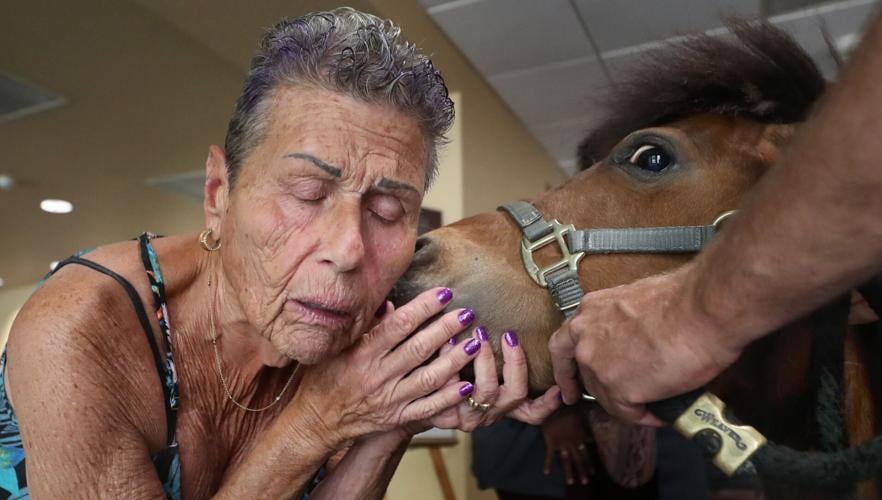
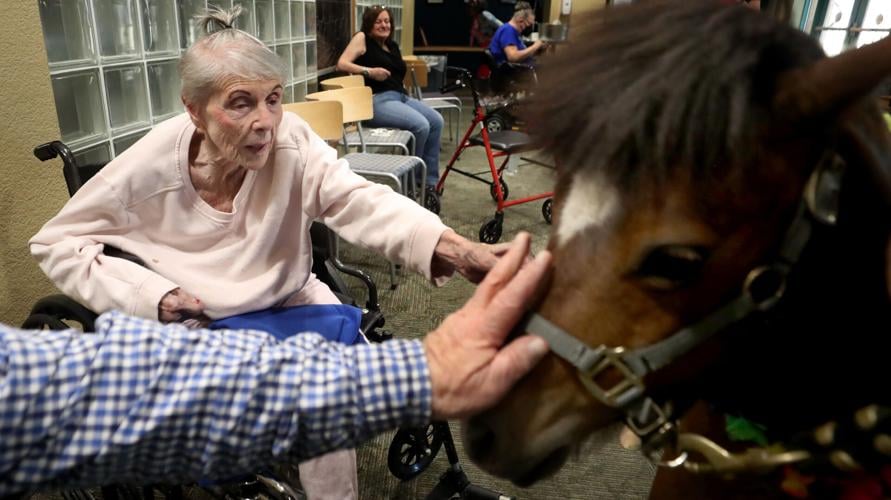
They also regularly visit assisted living communities and hold events meant to inspire joy. Last week, staffers and volunteers — including Nellie the miniature horse — spent time with residents at Handmaker Jewish Services for the Aging.
Flagg’s groups include information about the science and biology behind grief, including anticipatory grief, which is the distress a person may feel in the days, months or years before the death of a loved one or an impending loss.
Harmony Hospice offers 10 in-person and virtual group sessions every week, including grief and anticipatory grief, pet grief and Ho’oponopono, a Hawaiian exercise for reconciliation and forgiveness.
“The ripples of one person’s end-of-life journey spread throughout a much larger segment of our town, community, church, whatever, than we even realize,” said Flagg, who spent years traveling the world as a minister in The Salvation Army. “Those ripples need to be dealt with, and that includes the people who provide care.”
Henderson said one of her favorite things about Flagg’s work is that he defies the stereotype of traditional grief groups.
“I think a lot of people have this misconception and when they think about grief groups, they think about siting in a circle and everyone has to share and cry,” Henderson said. “Murray always has some awesome education, so it feels more like learning, but you can also process and talk. It’s not like that traditional scary group feeling that people don’t want to come and share.”
Broken heart syndrome
Henderson and Flagg said they’ve seen plenty of examples of broken heart syndrome, but that the medical community long has been skeptical of its validity.
“Now with all the (medical testing), they’ve come to say it’s a real condition. But society still doesn’t teach people about grief,” Flagg said. “We don’t talk about it. It’s a painful conversation to have with your loved one about what they want when they die. And with anticipatory grief, the majority of the country has no idea it’s a real thing you deal with as you approach the loss of a loved one.”
Henderson and Flagg are hopeful O’Connor’s research will help educate people about the effects of unmanaged grief and the importance of having conversations about death and loss.
“There’s so many emotions when we’re in the process of losing someone and after that,” Henderson said. “I just don’t think our society is good at exposing some of those feelings.”
‘A grief illiterate society’
Tucsonan Patrick Cunningham has been a hospice chaplain for nearly 40 years and has seen the toll grief can take on people leading up to and following a loss.
“We are a grief illiterate society and even those who are literate in grief and how to communicate, it’s often the situation that people still don’t talk about it,” Cunningham said. “It’s interesting, since it’s such a common occurrence. There are very few areas in life we share with so many others, but grief is one of them. We’ve all had losses.”
Talking about grief has a powerful and healing effect, Cunningham said, but it’s important to continue those conversations in the days, weeks and months after a loss.
“Typically people rally around the bereaved at the time of the memorial service. They bring the casseroles over and all that, which is very nice, there’s nothing wrong with it,” he said. “But even six days later, it’s kind of forgotten and the bereaved is still walking around with his or her pain.”
Cunningham said talking about grief and loss can be uncomfortable, but it’s more uncomfortable for the person who has suffered the loss to feel like friends and family are avoiding them or won’t have those conversations.
Even if a person is uncomfortable talking about loss, there are other ways to support a person in mourning, Cunningham said.
“One of the simple things is just in any way that you can, convey to someone some solidarity with them and some sense of just a little bit of community,” he said. “That sends a clear message that you are not alone.”
Being silent with a person in mourning is a perfectly valid response, Cunningham said, adding that it’s especially important to not try to change the bereaved person’s feelings about the situation or fix them.
“If someone says, ‘Oh, my life is over,’ and I say, ‘No, it’s not. You’ve got so much ahead of you in life,’ I’m trying to change your feelings and your thoughts,” he said.
Cunningham said that after working with thousands of patients and families, he’s seen the stress that grief can place on the heart and has long believed in broken heart syndrome.
He’s hoping the UA study will help bring a greater understanding to the effect grief can have on the body and help facilitate more conversations about loss.
“When people start telling their stories, it’s amazing how many of us have have layers of grief,” he said.
Researchers in Ireland conducted a study that suggests Mondays could be the most likely day to have a serious heart attack.

