


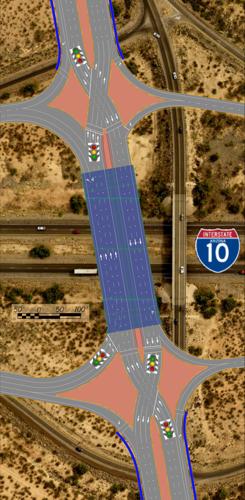
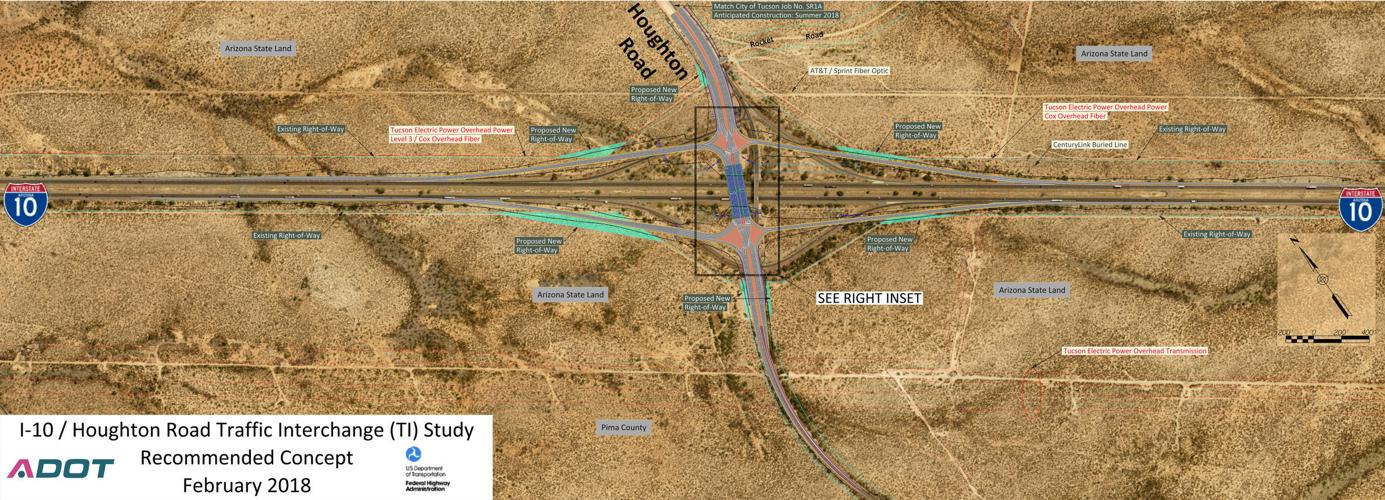
Pima County is slated to get its first diverging diamond interchange at the South Houghton Road-Interstate 10 crossing. Construction on the roughly $33 million project is expected to begin in 2020.
What, you are no doubt asking, is a diverging diamond interchange?
Here’s the basic idea: Vehicles traveling on Houghton over I-10 will jog left before the overpass, crossing the other direction’s lanes of travel. Without another controlled intersection, vehicles will be able to turn left onto the interstate onramp. Immediately thereafter, the lanes will again cross the other direction’s lanes and return to the standard side of the road.
A link to a video showing how it all works can be found on the online version of this story.
Yes, this does mean that on the bridge deck, Tucson drivers will get a taste of driving in Great Britain and parts of the rest of the world. Opposing traffic will be to your right, not your left (though your steering wheels can stay where they are).
As strange as the arrangement may seem, the Federal Highway Administration has dubbed them a “proven solution for improving safety and mobility at interchanges.” A study of the diverging diamond interchange in Springfield, Missouri, the first in the country when it was built in 2009, found that total crashes nearly halved after its completion. The interchanges also handle higher volumes of traffic better and can reduce delay times by as much as 60 percent, according to the highway agency. Additionally, they are often cheaper than other alternatives.
The local interchange is surrounded by undeveloped desert, but substantial growth in the area is anticipated, as are much larger traffic volumes along I-10, according to the state transportation department. Three other diverging diamond interchanges are planned in the Phoenix area.
Still have questions or comments about them? You can email projects@azdot.gov or call (855) 712-8530.
Meanwhile, the Road Runner is trying to revive an element of the column that has been moribund since yours truly took over: reader Q&A.
This is not to say that your questions have gone unheard. On the contrary, some of your messages and emails proved to be great column material. If you’ve got an interesting or pressing transportation question, drop a line, though there are no promises it will make the column.
Q: In January, column reader Ellis wrote in wondering about a “small intense blue light” at East Sunrise Drive’s intersections with North Swan and North Craycroft roads. “What is their purpose?” he asked.
A: Ana Olivares, the Pima County transportation director, said the lights are intended to alert sheriff’s deputies when cross traffic runs red lights. The blue lights come on as soon as the corresponding light turns red, allowing deputies to “determine if the light was red without being in direct view of the traffic signal,” Olivares wrote.
The blue lights were installed at the request of the Sheriff’s Department last October. Three other intersections have the technology: North La Cholla Boulevard and West Ruthrauff Road, La Cholla and West River Road and West Ina Road and La Cholla.

