


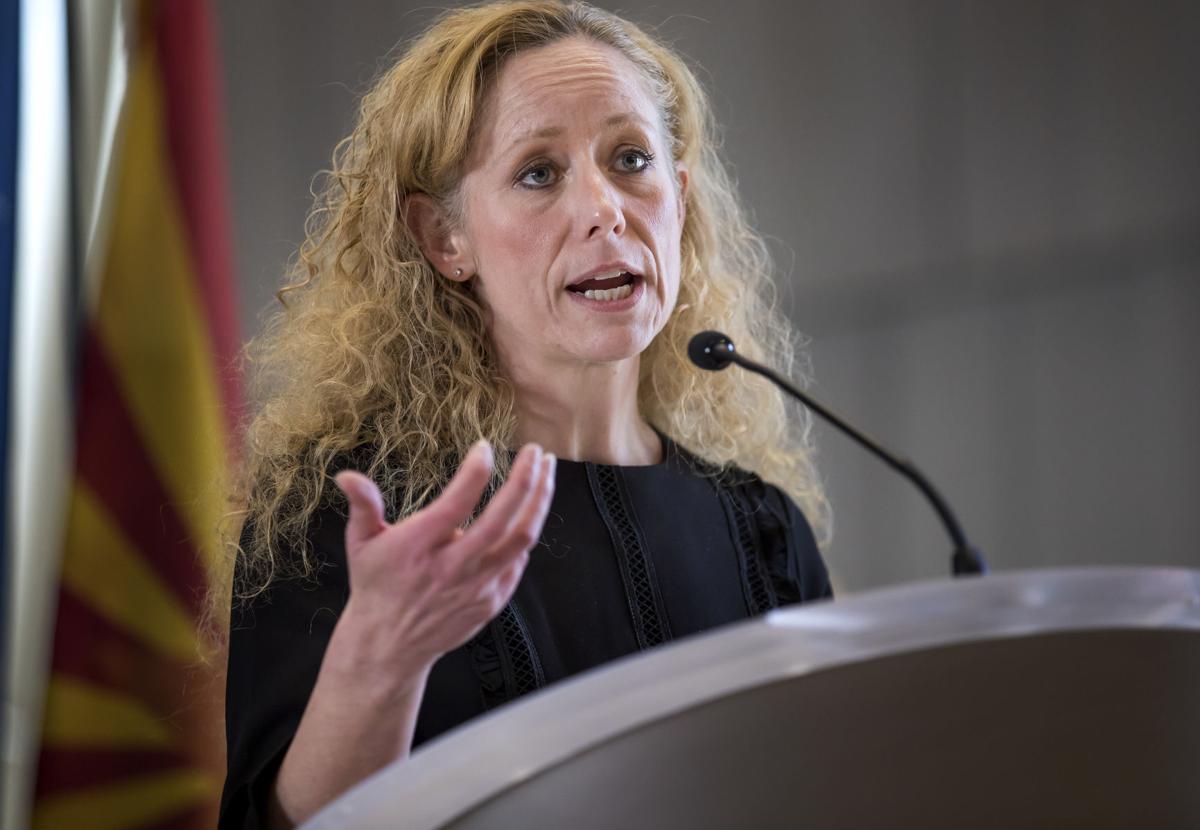
PHOENIX — The state’s top health official said Friday there’s no reason to continue to limit business occupancy, prohibit large group gatherings and require customers to wear masks because Arizona hospitals now have plenty of space.
Dr. Cara Christ’s explanation came the day after Republican Gov. Doug Ducey, saying the pandemic is under control, abolished all limits that remained on businesses and public gatherings and allowed bars to reopen. He also ordered local governments to lift mask mandates, but Tucson’s mayor said he will have to take the city to court to do so.
During a March 24 update, Pima County's Chief Medical Officer Dr. Francisco Garcia discusses the state's rejection of a federally funded vaccine site in Tucson and their plans to expand vaccine availability.
Christ said the main reason restrictions had been imposed and bars closed was the fear of overwhelming the state’s health-care system with COVID-19 patients.
Now, she said, the use of hospital and intensive-care beds is way down.
More to the point, Christ said many of the people who are most at risk of getting seriously ill from the virus, meaning the elderly, already have been vaccinated.
The state health chief acknowledged that some businesses are not following her advice that — despite dissolution of the gubernatorial orders — they should continue to enforce mask use and to maintain social distancing.
There were reports of at least one bar promoting the idea that customers are now free to crowd in. But she said that is no reason to continue to make social crowding and failure to wear a mask illegal in business settings.
She said individuals now need to assess their own risk of severe complications if they get the virus.
“Hopefully, there weren’t a lot of our older Arizonans at those bars,” Christ said.
She also pointed out that businesses remain free to enforce mask and social distancing requirements. And she is suggesting they do that.
But she brushed aside questions about whether Ducey’s new order undermines businesses’ ability to gain compliance as customers could argue that the governor has said it’s OK to go maskless.
“They’ve always had — some of them, I can’t say all of them — the ‘no shirt, no shoes, no service’ ” requirement, Christ said.
“They can extend that,” and enforce things like mask mandates at the door in exactly the same way, she said. “They do have the authority to be able to require those types of mitigation strategies.”
She was asked how the decision to convert health requirements into recommendations was made by the Ducey administration. While Christ said hospital capacity was a key factor, she conceded she and Ducey did not consult with any of their top officials.
In fact, several of the state’s major hospital chains released a statement calling Ducey’s move to jettison mandatory distancing and mask requirements as premature.
“A downward trend is not synonymous with the elimination of the virus,” the hospitals said in a joint statement.
Christ did not dispute that contention.
“We could see another spike in cases,” she said. But Christ said that’s not the metric that drove the original decisions to impose restrictions. And she said it should not be the metric to decide whether to lift them.
“Really, what we were trying to prevent is an overwhelming of our hospitals and our health-care systems,” she said.
That also is the reason that health-care workers and those at the highest risk of developing complications from the virus and needing hospitalization were among the first to get vaccinated.
“We’ve got higher vaccination rates in those vulnerable populations, which is going to keep our hospitalizations down,” Christ said. “The severe outcomes are really what we’re trying to prevent, those hospitalizations and those deaths.”
Put another way, Christ said, the overall number of people infected is not, in and of itself, significant — and not a reason to have state-imposed mandates.
“If it’s just cases and you’ve significantly reduced the hospitalizations and deaths, do we do that with other diseases?” she asked.
“We don’t” Christ continued. “Everything is a recommendation.”
Beyond that, Christ said she and Ducey made the decision that Arizona has to return to a point where people make their own decisions about the risk the virus poses to their own health.
She said that’s no different than any other disease, like the flu, where her department makes various recommendations but ultimately leaves it up to individuals to assess their own health risks.
“It’s really about that personal responsibility,” she said.
Consider the flu, she said. “We’ve recommended for years that everybody get a flu shot, wear a mask, to stay home when you are sick. All of that works for influenza, just like it does for COVID.”
But Christ pointed out that those flu recommendations never translated into mandates, even as the state sees a surge in hospitalizations every winter.
The decision to scrap mandates comes as the state remains far short of having 70% of its population vaccinated, the point at which Arizona would approach “herd immunity” so that a new outbreak would not spread rapidly.
As of Friday, March 26, the state reported 1.2 million were fully inoculated, whether with the second dose of the Pfizer or the Moderna vaccines or the single-dose Johnson & Johnson vaccine. That is only about 22% of those 16 and older, the age at which the vaccine has been approved for use.
There continues to be a demand for vaccinations, and people who say they’re still having problems getting appointments. That raises the question of whether the new order scrapping any mitigation mandates sends the message to some that inoculation is no longer necessary.
“I don’t know that would necessarily be based on us lifting the restrictions,” Christ said.
“There are a lot of people that don’t like getting shots, that are vaccine hesitant, especially about this specific vaccine,” she said, despite assurances that it is safe and effective. “But we know we are going to have demand decrease as we continue through the next few weeks.”
That will take a shift in “messaging,” getting out into communities as opposed to simply having large inoculation sites, Christ said.
“We will hit a point where it’s going to be more about convenience and having it be in the neighborhood or having it being administered at a doctor’s office while they’re doing something else,” she said.
Photos: San Xavier Mission enters phase two of conservation project
Conservation of Mission San Xavier's East Tower
Updated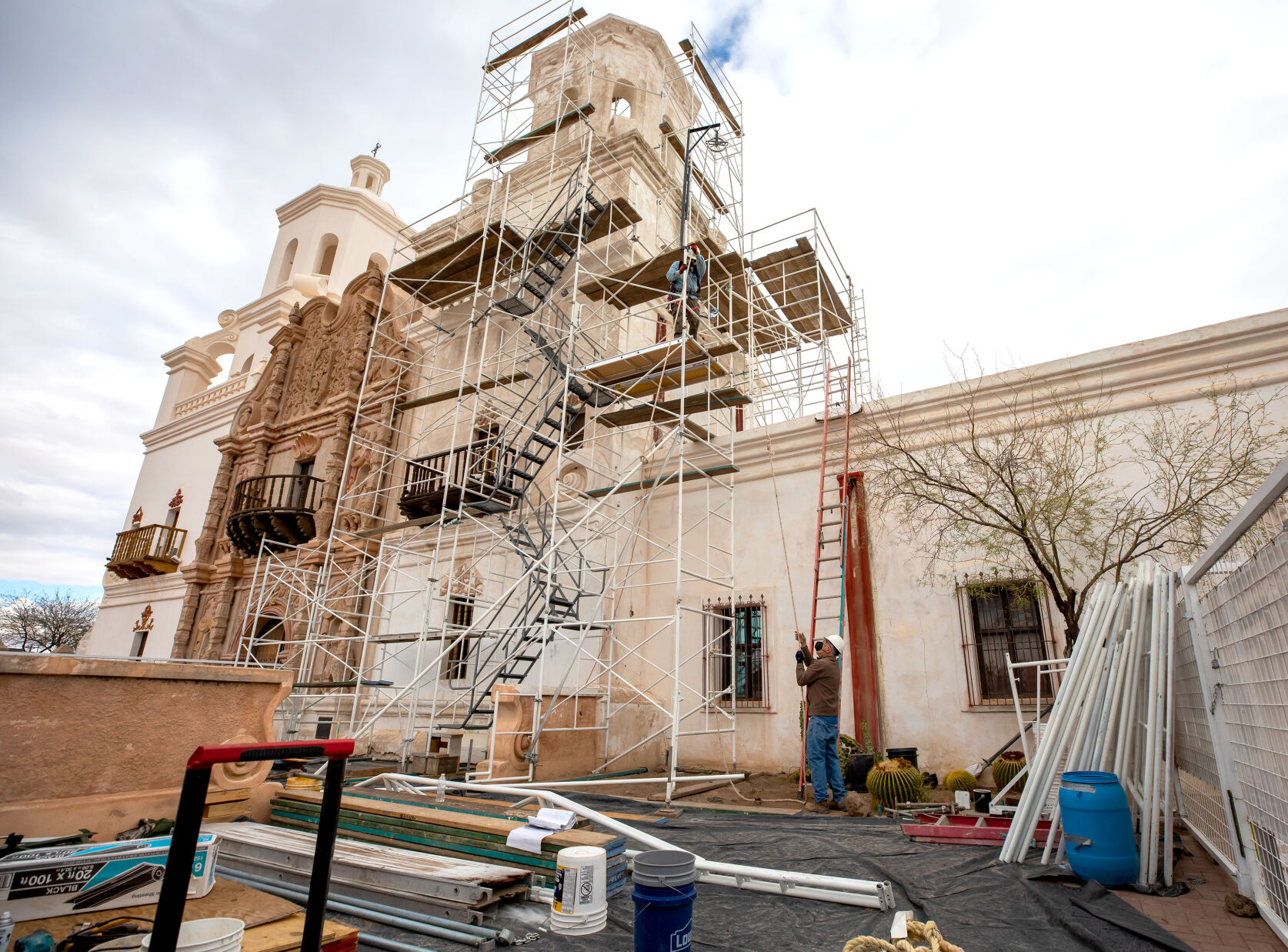
Eric Means, bottom right, project general contractor, and Jarvis Juan, crew member, work on building the scaffolding for phase two of the conservation of San Xavier's East Tower project at San Xavier Mission, 1950 W. San Xavier Rd., in Tucson, Ariz. on March 24, 2021.
Conservation of Mission San Xavier's East Tower
Updated
Jarvis Juan, crew member of Means Design and Building, works on building the scaffolding for phase two of the conservation of San Xavier's East Tower project at San Xavier Mission, 1950 W. San Xavier Rd., in Tucson, Ariz. on March 24, 2021.
Conservation of Mission San Xavier's East Tower
Updated
Eric Means, project general contractor, and Jarvis Juan, crew member, work on building the scaffolding for phase two of the conservation of San Xavier's East Tower project at San Xavier Mission, 1950 W. San Xavier Rd., in Tucson, Ariz. on March 24, 2021.
Conservation of Mission San Xavier's East Tower
Updated
The scaffolding for phase two of the conservation of San Xavier's East Tower project is photographed at San Xavier Mission, 1950 W. San Xavier Rd., in Tucson, Ariz. on March 24, 2021.
Conservation of Mission San Xavier's East Tower
Updated
Visitors walk outside of the San Xavier Mission while Eric Means, project general contractor, and Jarvis Juan, crew member, work on building the scaffolding for phase two of the conservation of San Xavier's East Tower project at San Xavier Mission, 1950 W. San Xavier Rd., in Tucson, Ariz. on March 24, 2021.
Conservation of Mission San Xavier's East Tower
Updated
A poster informing visitors about the project hangs in front of some fencing while Eric Means, project general contractor, and Jarvis Juan, crew member, work on building the scaffolding for phase two of the conservation of San Xavier's East Tower project at San Xavier Mission, 1950 W. San Xavier Rd., in Tucson, Ariz. on March 24, 2021.
Conservation of Mission San Xavier's East Tower
Updated
Jarvis Juan, crew member of Means Design and Building, works on building the scaffolding for phase two of the conservation of San Xavier's East Tower project at San Xavier Mission, 1950 W. San Xavier Rd., in Tucson, Ariz. on March 24, 2021.
Conservation of Mission San Xavier's East Tower
Updated
Eric Means, project general contractor, and Jarvis Juan (not pictured), crew member, work on building the scaffolding for phase two of the conservation of San Xavier's East Tower project at San Xavier Mission, 1950 W. San Xavier Rd., in Tucson, Ariz. on March 24, 2021.
Conservation of Mission San Xavier's East Tower
Updated
Jarvis Juan, crew member of Means Design and Building, works on building the scaffolding for phase two of the conservation of San Xavier's East Tower project at San Xavier Mission, 1950 W. San Xavier Rd., in Tucson, Ariz. on March 24, 2021.
Conservation of Mission San Xavier's East Tower
Updated
Eric Means, project general contractor, watches as Jarvis Juan (not pictured), crew member, works on building the scaffolding for phase two of the conservation of San Xavier's East Tower project at San Xavier Mission, 1950 W. San Xavier Rd., in Tucson, Ariz. on March 24, 2021.

