



Since the constitutional right to an abortion ended nearly two weeks ago, Arizona’s reproductive health-care doctors have been grappling with no clear guidelines on what’s legal when it comes to saving their patients’ lives.
“We are all sort of in this hold,” said Dr. Julie Kwatra, a Scottsdale doctor and state representative with the American College of Obstetricians and Gynecologists. “Only we can decide what is life-threatening for our patients.”
Several clinicians interviewed by the Arizona Daily Star said since the June 24 overturning of Roe v. Wade, they are not sure when they can legally help if a pregnancy puts a woman’s life at risk. Does death need to be imminent, or can it be a substantial risk and therefore a procedure would be performed in advance?
Some of Arizona’s doctors are referring patients in need of an abortion to New Mexico and California right now, said Dr. Victoria Fewell, a Tucson physician who specializes in obstetrics and gynecology for Banner-University Medical Center Tucson.
California, Colorado and New Mexico are three states bordering Arizona where women can travel for an abortion. However, Kwatra said, that’s not a solution for what’s happening, and not an option if care is needed more immediately.
“It’s really important not to normalize sending women out of state for health care,” she said.
The clinics in neighboring states are getting deluged with patients, Kwatra said. In some instances, she said, by the time a person can get an appointment, they might be in a much more dangerous point for care.
The law is “deliberately gray,’’ she said, adding that she has advocated for years that the Arizona Legislature not “criminalize medicine.”
Ballot initiative effort
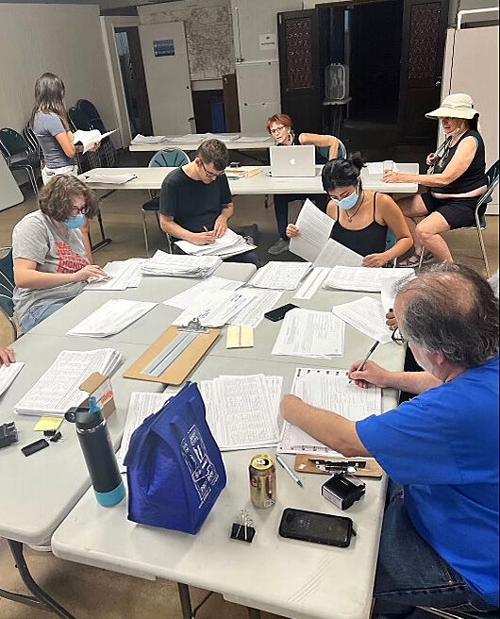
The statewide Arizonans for Reproductive Freedom has been working to collect signatures for a ballot initiative for the Nov. 8 election, a constitutional amendment providing physicians the right to carry out decisions regarding prenatal care, childbirth, postpartum care, contraception, sterilization, abortion, miscarriage management and infertility.
They need to turn in at least 350,000 signatures by Thursday, July 7.
The measure would also provide a right to a surgical or medical abortion until the point of viability in the pregnancy which, under the measure, would be defined as when “there is a reasonable likelihood of sustained fetal survival outside the uterus, with or without artificial support.”
Without the initiative, abortions will be largely unavailable in Arizona until November 2024, when there could be another shot at a voter initiative on the ballot, said Will Humble, executive director of the Arizona Public Health Association.
“The decision about whether the 1884/1901 anti-abortion laws dominate or whether the contemporary new law just limiting abortions to the first 15 weeks will need to be settled by the Arizona Supreme Court,” Humble wrote in a recent report on abortion in Arizona since the U.S. Supreme Court overturned Roe v. Wade.
“Sadly, the makeup of that court is solidly conservative and is very likely to side with the state and enforce the 1884/1901 anti-abortion laws.”
‘Scariest part of this’
In Arizona right now, if a woman came to a hospital with life-threatening hemorrhaging, Fewell said as an example, doctors can perform an abortion to save her. However, she said it is unclear if they will now be legally scrutinized for these surgeries.
“The scariest part of this for doctors is that there are many, many reasons we perform an abortion to save a life,” she said. Sometimes, complications are known ahead of time, and a woman might wish to end her pregnancy to avoid that risk.
The American College of Obstetricians and Gynecologists reports that pregnancy imposes “significant physiological changes” on a person’s body, and these changes can “exacerbate underlying or preexisting conditions, like renal or cardiac disease, and can severely compromise health or even cause death.”
Other complications that can require an abortion include ectopic pregnancies, which is when a fertilized egg implants outside the uterus, pregnancy-induced high blood pressure — called eclampsia — that can can occur before the fetus is viable, as well as cancer treatment that requires chemotherapy.
For now, here’s what’s known to be legally available in Arizona:
“Plan B,” which is considered emergency contraception and not abortion, is still legal in Arizona, Kwatra said, and doctors are still able to recommend it. The pill, which is sold over the counter and needs to be taken within 72 hours of unprotected sex, is intended to prevent a pregnancy after unprotected sex. It’s often used to help victims of sexual assault.
Another similar drug is called Ella, and it must be taken within five days of unprotected sex.
Kwatra is concerned about states restricting access to these drugs going forward.
“Once the protection of Roe is off, everything is on the table,” Kwatra said.
The abortion-inducing drugs mifepristone and misoprostol cannot be prescribed for abortions in Arizona at this time, she said, raising a question that’s being asked around the country: Do states have the legal authority to ban drugs that have been approved by the U.S. Food and Drug Administration?
“This is religious zealotry bleeding into our medical systems with massive ramifications for women and families,” said Tucson Dr. Eve Shapiro.
The United States’ maternal mortality rate is already high compared to other developed countries, she said, and changes in abortion access will dramatically compound this.
Shapiro said she’s already seen an increase in people seeking access to both emergency contraception and birth control pills.
“Unfortunately, since the Title 10 money got messed up, we can’t get contraceptives as easily,” she said, referring to Arizona’s federal grant money earmarked to provide reproductive health care to low-income, underinsured and uninsured people.
“In Arizona, we don’t provide ways for women to prevent pregnancy if they want to.”
Demonstrators gathered at the Evo A. DeConcini Federal Courthouse on 405 W. Congress St. on Monday, July 4 to protest Arizona’s response to the Supreme Court’s decision to overturn Roe v. Wade. Specifically, the state's decision to maintain restrictive abortion laws such as ARS-13-3603 and SB 1164. The two pieces of legislation have been at the center of the abortion controversy in Arizona, with legislators going back and forth on which piece of legislation could be enacted in the November election.
Petitioners were present at the protest, hoping to raise the 356,457 signatures needed to put a “right of reproductive freedom” in the Arizona Constitution that would bar local and state governments from interfering with the right to elective termination.
The protest started at the courthouse on the corner of West Congress Street and South Granada Ave., where speakers shared demands for reproductive freedom. Police were present at the protest, which lasted from 6 p.m. to 9 p.m., with officers on bikes leading the crowd and police cars blocking traffic from the protestors' route.

