



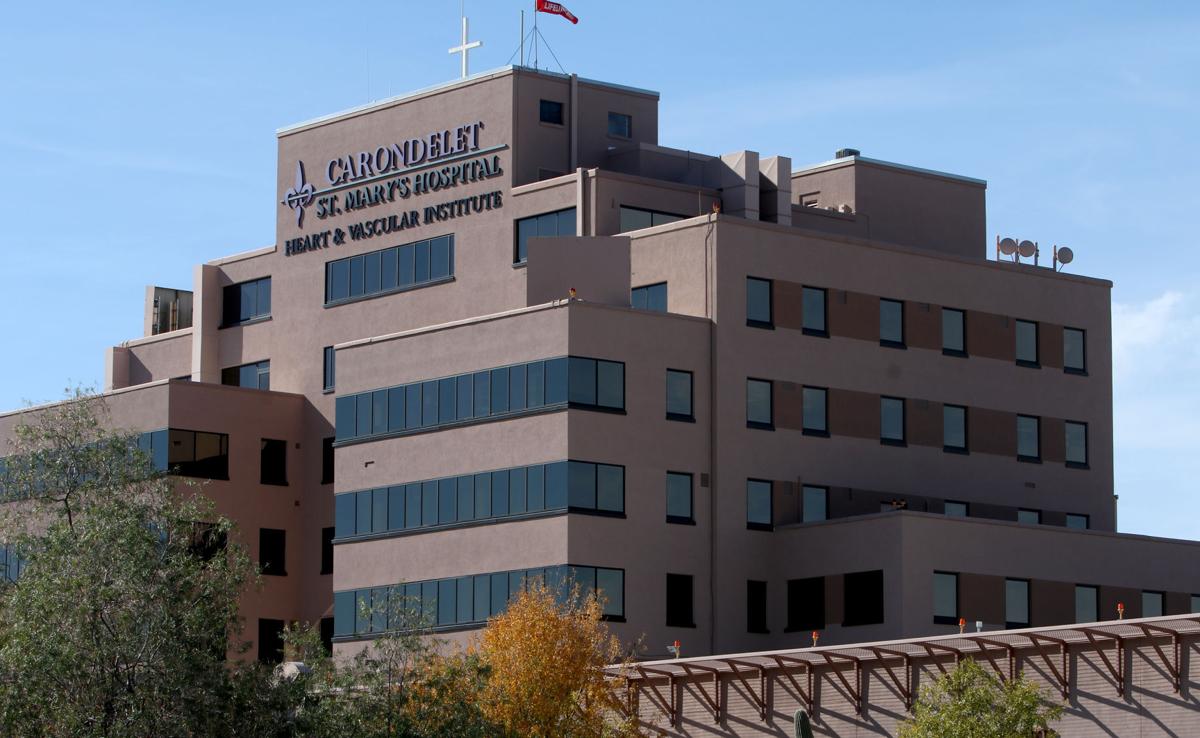
A Tucson surgeon is looking to change the way women think about breast cancer by educating them about the screening process and empowering them to take their health into their own hands.
For Dr. Karen Hendershott, a breast surgical oncologist at Carondelet St. Mary’s Hospital, breast cancer is personal.
In January 2017, she felt a lump in her armpit while showering and, as a surgeon who had been treating breast cancer for nearly 10 years, she knew right away what she was dealing with.
“I said some words that are not appropriate for a family newspaper in the privacy of my shower,” Hendershott said.
“I didn’t have the luxury of not knowing what was going to happen. So, as soon as I felt the lymph nodes, I kind of knew what I had bought myself into, which was going to be chemotherapy, surgery and radiation.”
After getting a mammogram — an X-ray of the breast — and an ultrasound of her breast and armpit with the help of colleagues, they found some abnormal- appearing lymph nodes and a mass in her breast. From there, they did a biopsy and confirmed that it was cancer.
“I actually got my pathology results in between cases while I was operating on other people,” Hendershott said. “For me, because it had already spread to the lymph nodes, the best way to move forward was to start with chemotherapy.”
After over four months of chemo, Hendershott also had a lumpectomy, which is a surgery to remove the abnormal tissue and lymph nodes, followed by radiation.
“I have a type of breast cancer that is more sensitive to hormone-blocking medications, so things like tamoxifen and arimidex, that lower the female hormones in the body. So it wasn’t surprising that we didn’t have a huge response to the chemotherapy,” she said. “The next step then, once I was done with my surgery and radiation, was to start hormone-blocking pills that I’ll be on for at least the next 10 years.”
As a surgeon, Hendershott said she jumped right into problem-solving mode. But even for her, the word cancer carries a heavy weight.
“It’s hard. Anytime you hear the word cancer, you get scared,” she said. “You have questions and there’s a lot of unknowns. How are you going to respond to treatments? What is it going to feel like? And you can know the details and the facts, but that doesn’t really change how you’re going to experience it.”
Hendershott said she also stayed focused on her son, who was 11 at the time, and made sure he had the support he needed to get through that difficult time.
A personalized approach to treatment
While Hendershott was working with breast cancer patients long before her own diagnosis, she said her experience has allowed her to connect with patients on a more personal level.
“I can share my experience with patients,” she said. “I don’t want to make it about me in the exam room, so I’m not always talking about it, but I think it helps them sometimes to know that I’m not just recommending something because that’s what the textbook says. I really understand what I’m asking them to do when I talk to them about going through surgery and other treatments. I don’t take it lightly.”
For Hendershott, having this personal connection with patients is crucial because fear can often prevent people from seeking proper treatment.
“I think a lot of people walk into the room and they’re scared, you know, they immediately think they’re going to die and the reality is that most women with breast cancer do fantastic over the long term,” she said. “I think it helps them to see me back at work and engaged and living my life, that my hair grew back and all those little things that help reassure them that it’s not fun, but it’s not permanent.”
Even before her diagnosis, Hendershott said her decision to pursue breast surgical oncology as a career originally came from the loss of one of her best friends to breast cancer at just 36 years old.
“She was one of those women with no family history and no reason to believe she should be diagnosed,” she said. “So, it was personal for me.”
Understanding the risks
According to the Centers for Disease Control and Prevention, about 1 in every 8 women in the U.S. will develop invasive breast cancer over the course of her lifetime, resulting in over 41,000 deaths each year.
Men can also be impacted by breast cancer. More than 2,600 men are diagnosed in the U.S. each year, resulting in about 500 deaths.
“There’s still a lot of fears about breast cancer in the community,” Hendershott said. “There are a lot of people that don’t understand their risks. A lot of people believe that if they don’t have a family history of breast cancer, that they don’t need to get mammograms and that’s not true. Eighty to 85% of women to get diagnosed have no family history. That’s why we need to screen everybody.”
Hendershott recommends that women with average risk — no family history or gene that predisposes them to develop breast cancer — should start screenings at the age of 40 and get annual mammograms.
“Women who are at high risk, though, may need to start their screenings even before then and may also need to use breast MRIs as part of their screening process,” she said.
While most breast cancers are found in women 50 years and older, 11% of new cases each year are found in women younger than 45 years old. In addition to family history and genes, people who had childhood cancers that required radiation of the chest, such as lymphoma, are also at a higher risk for developing breast cancer.
Breast cancer rates vary among different racial or ethnic groups, according to the CDC. It is the second-leading cause of cancer-related death among white, African-American, Asian/Pacific Islander and Native American women.
Although the rates of breast cancer are lower in Hispanic populations, it’s the leading cause of cancer-related death for Latina women.
“We’re all at risk,” Hendershott said. “I think the more we know, the better we can help care for ourselves and be a little bit less scared about what we need to go through.”
A lot of the myths
With Breast Cancer Awareness Month running through the month of October, Hendershott hopes to educate the community about the screening process and settle some fears that people may have.
St. Mary’s Hospital will host a free seminar to address breast cancer myths on Tuesday, Oct. 22, at 5:30 p.m. According to Hendershott, who will speak at the seminar, there is still a lot of misinformation out there regarding how breast cancer is caused and who is at risk.
For example, Hendershott said she often hears people say that breast cancer can be caused by underwire bras or even deodorant. She confirmed that neither of those are true.
“I’m going to touch on a lot of the myths that are out there about breast cancer, what causes it, how we do over the long term, who gets it and why, and try to kind of help people leave a little bit more informed and therefore more empowered in terms of how they approach their own risk for breast cancer,” she said. Hendershott will also discuss 3D mammograms, which many health care providers are now offering instead of the traditional mammograms.
“The 3D mammogram is a much more accurate version than what we’ve had in the past,” she said. “It takes hundreds of pictures of the breast, rather than the traditional two views that we used to get. And by doing that, we’re able to be more accurate in picking up breast cancers and we’re able to reduce the number of false alarms and the people who have to come back for additional pictures and biopsies.”
The 3D mammograms are also better at seeing through dense breast tissue, which has been a problem with mammograms in the past, according to Hendershott.
Overall, Hendershott hopes to reassure women within the Tucson community that they don’t need to be scared to get their screenings or potentially being diagnosed with breast cancer.
“The fact is that the overwhelming majority of women are going to live long, healthy, complete lives, even if they get diagnosed,” she said. “My goal is for women to look back at this experience five or 10 years from now, and have it be one of the least interesting things that have happened to them because they’ve lived such a full and complete life after their diagnosis. And I know they don’t feel that way when they first meet me, but I hope in the long run, that’s what we can accomplish.”

