



When Dolores Badilla Olivares was 19 years old, she went downtown to enroll in beauty school. Being a hairdresser is something she had always wanted to do when she was younger.
But someone at the school told her no. She’s not fit to be a beautician, was the school’s response. Go learn to type, she was told.
She wouldn’t be able to stand all day because her right leg is shorter than her left leg, they told her.
Olivares had heard it before, in some form or another. She limped. She was “handicapped.”
In elementary school, kids teased her. When she entered Tucson High School, she was treated differently.
Not wanting to endure four years of pity, she dropped out of high school and repeatedly knocked at the beauty-school door. Finally the school accepted her and Olivares became the beautician she had longed to be.
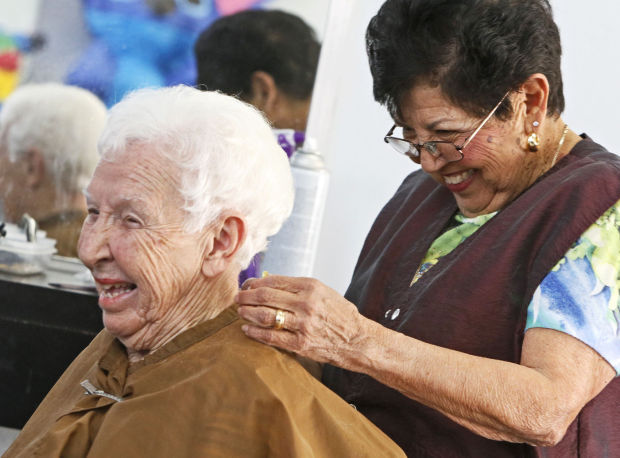
That was 57 years ago and today, Olivares, 78, continues to style women’s hair. It’s a job she cherishes.
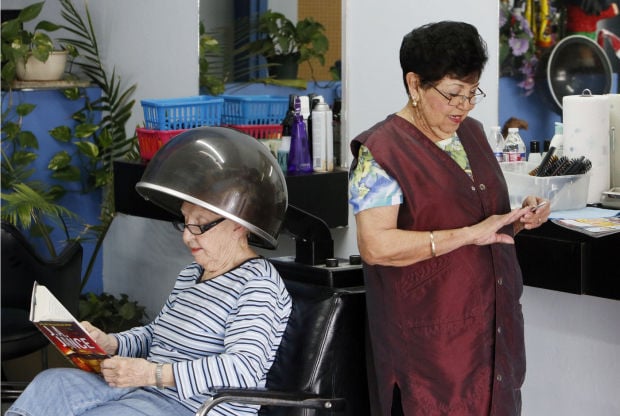
“People thought I had a disability,” she said while a longtime client sat under a hair dryer reading a mystery book by Tucson author J.A. Jance. “But it never bothered me.”
Born with ganas, her grit stretched beyond what most people could not imagine. Within several years after leaving beauty school, Olivares opened the first of her two beauty shops.
The little girl who was teased on the playground and treated differently in high school became a business owner at a time when few women, much less Chicanas, could call themselves that.
She credited her mother and father, Julia and Manuel Badilla, for encouraging her to follow her desire to become a hairdresser. She also credits Ricardo Manzo, who was the principal at her elementary school, which back then was called El Rio. He taught her to ignore the mean kids who teased her.
“Mr. Manzo made me realize I could do what I wanted to do,” she said.
After her first few years working as a hairdresser, her family helped her open her first shop, in 1961, on West Speedway at North Riverview Boulevard, between El Rio Golf Course and the Arizona State Schools for the Deaf and the Blind.
Dolores Beauty Shop became a gathering place for women, not just from the west-side barrio, but from downtown businesses, banks and government offices.
“We were busy, busy all the time,” said Olivares, with relish. “It was me and the other girls. That was my life,” she said.
The women chatted away in Spanish and English. Olivares got to know each and every client. Women back then had their hair done weekly, Olivares said. Cut, curl, perm. She also fixed up a lot of wigs, which were common then, she added.
“They were very faithful to us,” she said of her clients.
They still are.
“She makes me feel good,” said Dolly Ketchem, who has been Olivares’ client for nearly 30 years. Every Thursday, Ketchem faithfully goes to Monte Carlo Hair Studio at West Prince and North Fairview roads, where Olivares rents a chair.
Another longtime customer, Lenore Porter, said Olivares did her mother’s hair. Porter considers Olivares special.
“I practically have no hair and she makes me look great,” Porter said.
But for more than one woman, Olivares made a bigger impact that went beyond hairstyling. She nurtured future businesswomen.
“She gave me a chance when no one would hire someone with little experience,” said Mary Lou Quihuis, owner of Lulu’s Express Your Hair, a beauty salon on North Grande Avenue in Barrio Hollywood, around the corner from where she worked with Olivares for eight years beginning in 1978.
“She taught me to be patient with customers and to work hard, 24-7,” said Quihuis, who has owned her shop for 27 years.
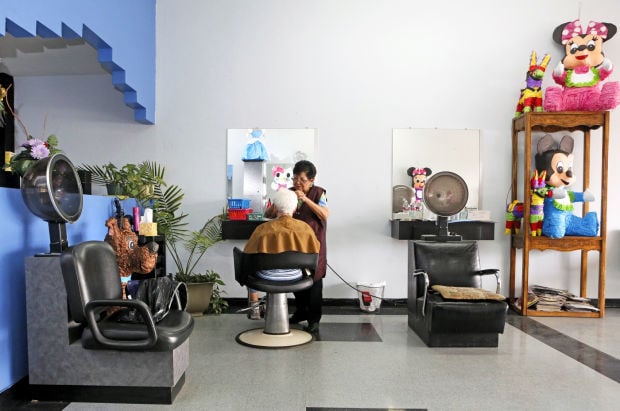
After 24 years on West Speedway, Olivares opened her second shop on West Prince Road. She kept that shop for 20 years. She took a break for more than a year to care for her ailing father but she couldn’t stay away from a beauty salon, and 10 years ago she moved to Monte Carlo, a beauty salon that doubles as a piñata shop.
“She’s a hard worker, said Sylvia Gastelum, Monte Carlo owner and piñata maker.
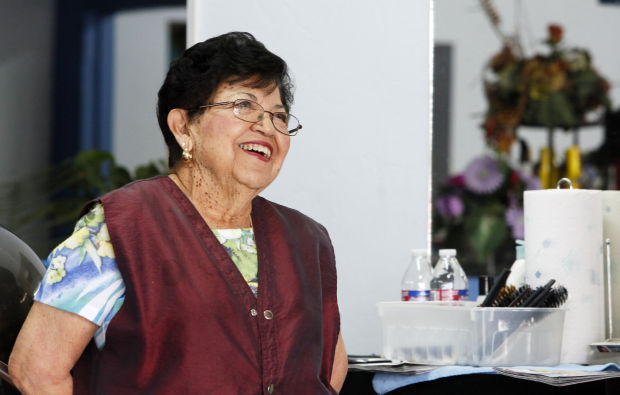
A diminutive women — she doesn’t pass 5 feet — Olivares has a huge smile.
And what about all these years standing while attending to her clients?
“Really, truly I didn’t have that much trouble. It was natural,” she said, and added: “I was supposed to be doing this. I did this.”

