

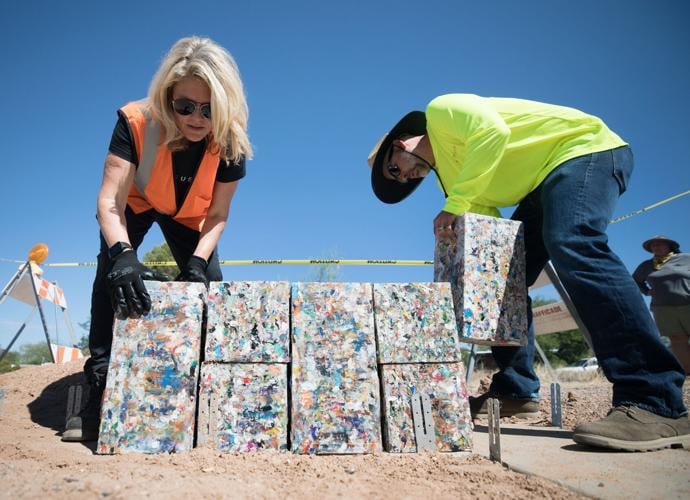


On a sunny Thursday morning, residents of Tucson’s San Gabriel neighborhood gathered to observe the construction of a new bench.
It was not the event itself that drew the crowd, but the composition of the new structure: The bench was built from 28 blocks of compressed trash.
It’s Arizona’s first construction project made from reused plastic blocks created by the startup company ByFusion.
The California-based company places plastic into a patented machine that uses steam and compression to churn out 22-pound blocks that fit together with interlocking pegs. On Thursday, the blocks were used to create the foundation of a V-shaped bench on a neighborhood median.
The project is the brainchild of Tucson City Councilman Steve Kozachik, who has advocated for the city to become the first municipality to regularly use ByFusion’s blocks in construction projects.
“The whole idea of reduce, reuse, recycle — the reuse piece way too often gets forgotten,” he said. “What really is the cool element is when we can put (plastics) back into the production stream, we’re putting it back into circulation, instead of just putting it on a pallet and shipping it to China.”
Of all the materials Tucson residents put in their recycling bins, about 30% aren’t recycled due to contamination, according to the city’s environmental services department. The city paid the Republic Services Material Recover Facility, which processes Tucson’s recyclables, $314,085 for contaminated waste in fiscal year 2021, and $257,211 in contamination fees so far this fiscal year.
ByFusion’s blocks are made of plastics considered unrecyclable by standard recycling plants, such as plastic grocery bags, bubble wrap or products contaminated by food waste.
“We take all types of plastic waste, primarily all of the unrecyclable, no value, just into the landfill material,” said Heidi Kujawa, CEO of ByFusion. “We put it to good use, we repurpose it. Our process isn’t really recycling; it actually truly is repurposing.”
Kozachik wants the city to buy its own ByFusion “blocker” machine and use the blocks for projects voters approved in 2018 through Proposition 407. He said the blocks could be used to build ramadas, benches and trash-bin enclosures as part of the $225 bond package for city park amenities.
Kozachik paid for the San Gabriel bench with about $10,000 from his ward budget. The councilman, however, is pushing the city to buy a $1.3 million machine to create the plastic blocks at the Republic Services facility.
“Once you put it into the blocker, they superheat the plastic, and it melts it all together. We don’t care if it’s dirty. Whereas at the (material recover facility), they do. It constitutes contamination, and it’s costing the city money,” Kozachik said.
The issue, according to the councilman, is Republic Services’ concern the machine would divert plastic away from its own operations and pull money out of its revenue stream.
Republic Services “sort of holds the trump card right now,” Kozachik said. “So there’s a deal to be had breaking through the Republic Services’ sort of bureaucratic, knee-jerk ‘No, you’re trying to take money out of our pocket’ reaction. But I think they will see that the community is so supportive of this.”
A Republic Services representative said in an email: “The ByFusion machine is a City Council-led effort, and Republic is not currently participating.”
Kujawa, however, said her company has had “some really great conversations” with Republic Services. ByFusion envisions the facility could still recycle higher-quality plastics while the block-making machine takes lower-grade materials the facility would otherwise divert to a landfill.
“It’s a new way of thinking. They have a very established business now. There’s some work to be thought about. We don’t want to be disrupting (Republic Services’) business,” Kujawa said. “But we believe that if we put this capability in or near their facilities, they’re going to help capture more of the stuff that they really want.”
Kozachik said he wishes the city was more aggressive in pushing for the ByFusion machine, which could further Tucson’s climate resiliency goals. For now, he’s buying the blocks himself.
“I’m demonstrating to the city by this project that this can be done. And it can be done at a fairly easy scale,” he said. “It seems to me that in the spirit of partnership, we ought to be able to sit down with (Republic Services) and say, ‘We want to pull some of the contaminants out of the waste stream, and we want to reuse them. Why is that an issue for you?’”
Reimagining a median
The median where the new plastic-composed bench sits is where the students of the San Gabriel neighborhood wait for the bus to school.
“We’ve been seeing kids standing out here just in the weeds ever since we’ve been here,” said Peter Ronstadt, who lives near the new bench site. “I think Tucson is neat in the sense that you see so much reutilized stuff in this town … seeing people reuse trash to make it into something creative or artful, or in this case, something useful for a community, which is great for kids to sit on as opposed to trudge through weeds.”
Paige Anthony, co-president of the San Gabriel Neighborhood Association, said plans are in the works to turn the median into a “pocket park.” The bench is the first step in a long-term vision to clean up weeds, build water retention basins and create a bike boulevard adjacent to the median.
“I’m so appreciative that (Kozachik) was on board for getting this going and really creating, instead of this weird, empty, dead, weed-filled median, more of a pocket park that’s going to serve our community,” Anthony said.
The bench also has local sustainability ties, as it was topped with a 250-pound recycled glass overlay created by Anita Goodrich, who repurposes materials through her company Bottle Rocket Design.
“Everything that we’re doing falls under the umbrella of reuse,” Kozachik said. “It’s all stuff that this community is so far ahead of us on. They so want us to be doing this stuff and pushing the bureaucracy, whether it’s the city or Republic Services … we’re gonna show them we can get it done.”
The San Gabriel neighborhood received a new bench in a median. Councilmember Steve Kozachik is pushing the city to use blocks made from plastic in future construction projects. The 22-pound blocks are made of plastics considered unrecyclable by standard recycling plants, such as plastic grocery bags, bubble wrap or products contaminated by food waste. The blocks are made by a L.A. based startup, ByFusion. This is their first project in Tucson. Video by: Mamta Popat, Arizona Daily Star

