



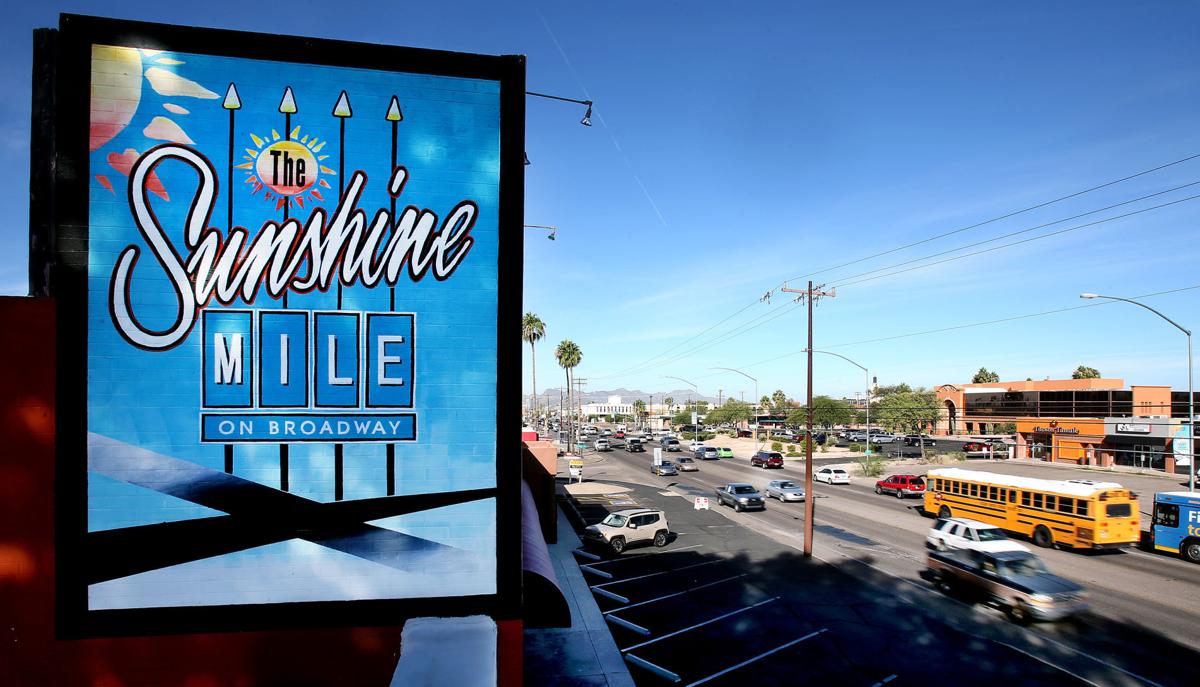
A fight is brewing about the fate of dozens of properties along the Sunshine Mile, with a member of the Tucson City Council calling for the city to stop sending what he called eviction notifications to properties that will be affected by the East Broadway widening.
At the heart of the issue is whether the city staff is ignoring a proposal by the Rio Nuevo Multipurpose Facilities District to find new redevelopment uses for buildings affected by plans to widen Broadway between Euclid Avenue and Country Club Road to a six-lane road with bike lanes, sidewalks and landscaping, with construction starting in 2019.
The term “Sunshine Mile” dates to 1953, when local merchants held a contest to come up with a name for that strip of Broadway, just east of downtown.
Rio Nuevo spent $25,000 in taxpayer funds for a study, launched earlier this year, to assess properties that could turn empty buildings on the Sunshine Mile along Broadway into thriving businesses once the voter-backed widening initiative is done.
It also could keep the doors open for some existing businesses that are slated for demolition or, at the very least, slated to become vacant, said Councilman Steve Kozachik.
The city has been acquiring properties in this area for years in preparation for the widening. Some buildings have already been demolished as preliminary work for the project gets nearer.
Kozachik argues those efforts are being undermined by the city staff, saying businesses are continuing to receive notices from the city outlining possible relocation benefits, effectively slamming the door on future negotiations with Rio Nuevo for possible future uses.
He believes businesses are getting one clear message from the city — that the planned widening will close their businesses next summer.
The Project for Public Spaces, a New York City-based nonprofit hired by Rio Nuevo, has drafted a report after months of meeting with businesses and property owners about whether some buildings in the Sunshine Mile can be saved from demolition. The report, which has not been finalized or made public yet, outlines what buildings could be saved from being razed.
“We are ... beginning to demolish buildings that may be preserved if we were acting on the PPS study,” Kozachik said. He said the plan was to wait on the report before sending out eviction notices to properties. Not waiting on the report, Kozachik said, is a waste of taxpayer money.
One example used by Kozachik is the 1950s-era Solot Plaza, 2545 E. Broadway, where business owners recently received notices from the city about relocation benefits.
But the city staff said the 90-day notice to vacate was triggered by federal law since access to the business is impacted by the widening project and parking spaces are being removed.
“This is not an eviction notice but a notification that they are now due relocation benefits,” said Mike Graham, a spokesman for the city’s Department of Transportation.
The notice doesn’t necessarily require businesses to close, but without direct access from Broadway and parking spaces blocked off because of construction, it could prove difficult to operate some businesses.
The city staff has been working with Rio Nuevo for months on about 40 properties along the Sunshine Mile to identify those that could be transferred under Rio Nuevo’s control, said Robin Raine, the Broadway project manager with the Transportation Department.
Under existing state law, the city could not offer incentives or major zoning variances to businesses affected by the construction. However, the special tax district is not covered by the state’s gift clause. That could allow Rio Nuevo to offer some incentives to the same businesses.
The notices being sent out, Raine said, are to give businesses time to plan before work begins next fall to start moving utility lines ahead of the widening.
Kozachik sees it differently, saying it is a waste of taxpayer funds to let the PPS study sit idle.
“We have two different sets of activities going on, one is an activity that forces demolition because the letters indicate that the property owners are going to be bought out,” Kozachik said. “At the same time we are sitting on this draft report (that preserves structures).”
Raine said it is possible some properties could be set aside if there are questions about possible redevelopment opportunities with only a minimal impact to plans to widen the east-west corridor.
Kozachik wants more, saying he would prefer the city to stop current efforts and work closer with Rio Nuevo to identify properties that can be spared the wrecking ball.
He was the lone member of the council to vote against the adopted Broadway widening plans, saying, in part, that traffic counts on the road don’t warrant the widening project.
Dozens of buildings are already empty, victims of an uncertain future ever since the city first promised to widen Broadway in 1989.
The city has worked closely with local residents and businesses for two years and has reduced the number of buildings that could be torn down for the widening from 130 to 27.
However, Rio Nuevo officials estimate up to 80 businesses along the two-mile stretch of Broadway will either be torn down, empty or underused when the widening is complete.

