

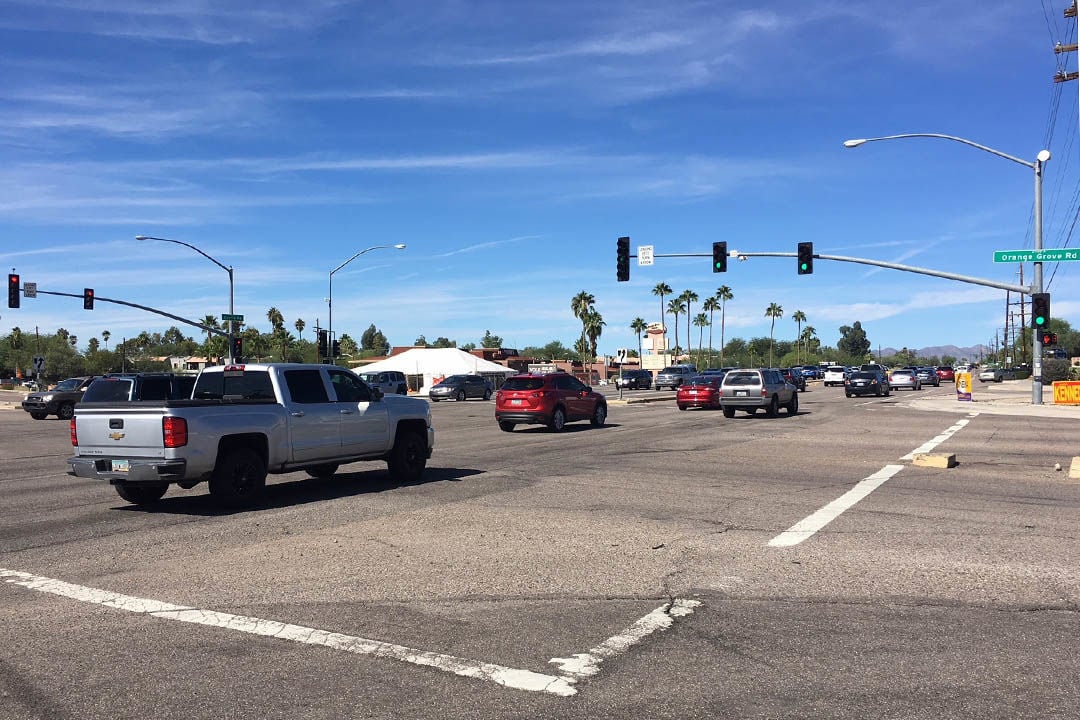

Thanks to updated traffic-signal technology, drivers along an 8.5-mile stretch of Oracle Road will likely see faster commute times.
Installed last summer, the adaptive-signal timing system allows traffic signals to adjust based on how many cars are on the road.
“We’re seeing a couple of minutes improvement; it amounts over that 8-mile stretch to about a 10 to 15 percent improvement in travel times,” said Tom Herrmann, spokesperson for the Arizona Department of Transportation.
Which means motorists could shave off up to three minutes on what usually is a 20-minute commute. And those few minutes may just be what gets someone to work in time.
The new detection is radar-based and can communicate with other corridor traffic signals to adjust the signal timing. It works not only for green lights, but also for motorists needing to make a turn.
James Gomes, a traffic engineer in ADOT’s Transportation Systems Management and Operations, works to optimize the performance of existing infrastructure. He described how the system operates.
“The advanced detection can detect the platoons of traffic that are coming up or down the main line, Oracle Road,” Gomes said. “We also have a communication system and we use point-to-point radios. These radios allow the traffic-signal controllers to talk to each other, and when those controllers are talking to each other they can relay the information about how much traffic is coming up and down the corridor.”
Gomes said depending on vehicle demand , the system can determine how much green time is given in each direction.
“Before we turned the system on, we had an average number of stops around six or seven, so if you’re trying to drive up and down, you’re going to hit red lights six or seven times,” Gomes said.
Now it’s down to about three or four stops.
As one of the busiest roads in Pima County with about 60,000 vehicles passing through every day, the signal improvement can also help increase overall safety, Herrmann said, adding there’ll be less reason to rush, change lanes or speed unreasonably.
“During the rush periods it’s improving safety because if that traffic is flowing, there’s no need for you to dart back and forth between lanes and try to pass this guy to get in front of that guy,” Herrmann said.
But just remember, it’s best to go the speed limit.
“If you drive right at 45, you’re going to make all the lights,” Herrmann said. “Once people realize that, they’re going to drive the speed limit, and that is certainly safer than people rushing, going 10 or 15 miles over and changing lanes.”
State Route 83 to close for ramp-realignment project
Workers will be closing the exit ramp of Interstate 10 at State Route 83, near Vail, starting Dec. 3.
The work is for a ramp-realignment project to improve safety at the interchange.
Traffic will detour to the Wentworth Road and Colossal Cave Road exit to travel on the north I-10 frontage road back to State Route 83. The detour lasts until Dec. 7.
ADOT officials say westbound I-10 ramps and the entrance ramp from SR 83 to eastbound I-10 will remain open.
Aerospace Parkway to close for railroad work
Starting Dec. 8, Aerospace Parkway will be closed at the railroad crossing until 12 a.m. on Dec. 9. The road is south of Tucson International Airport.
Union Pacific Railroad crews will be upgrading the existing tracks and installing new crossing panels. Motorists should use alternate routes.

