

The Stonewall Jackson Mine was a notable silver producer in the Globe mining district between 1876 and 1883.
According to official and unofficial reports, it produced from $500,000 to $2 million worth of high-average-grade silver ore. Silver content mined was considerable, carrying five to 50 ounces of silver per ton.
It was discovered by prospectors Theodore “Dory” H. Harris and Charles McMillen while they stopped to recover from excessive inebriation during a journey to the White Mountains. The pair found the rich silver outcropping that eventually became known as the Stonewall Jackson, named for the prominent Confederate general from Virginia.
This discovery enticed immediate development by a multitude of miners working the eastern slope of the Sierra Apache Mountains.
The Stonewall Jackson Mine comprised the 300-foot, three-compartment McMillen shaft and the 600-foot Stonewall Jackson shaft. Ore was processed on the property with a five-stamp mill, later increased to 20 stamps.
McMillen acquired $60,000 of high-grade silver from the mine prior to selling it to a Santa Rosa, California, company for $160,000.
A half mile east of the mine, the town of McMillenville — later changed to McMillan — was established in 1876.
Christened after McMillen, its first post office opened on Dec. 12, 1877, 10 days prior to Globe City’s post office, about 20 miles to the south.
Its population and ore production was also greater than Globe City’s, which was renamed Globe in 1878.
With an influx of around 1,000 people, the camp rapidly filled with boarding houses, dance halls, gambling casinos and saloons.
Water was supplied from a nearby creek and springs.
A classic shootout between two rival parties involving a mining claim was the town’s first documented killing. Both men died in the street.
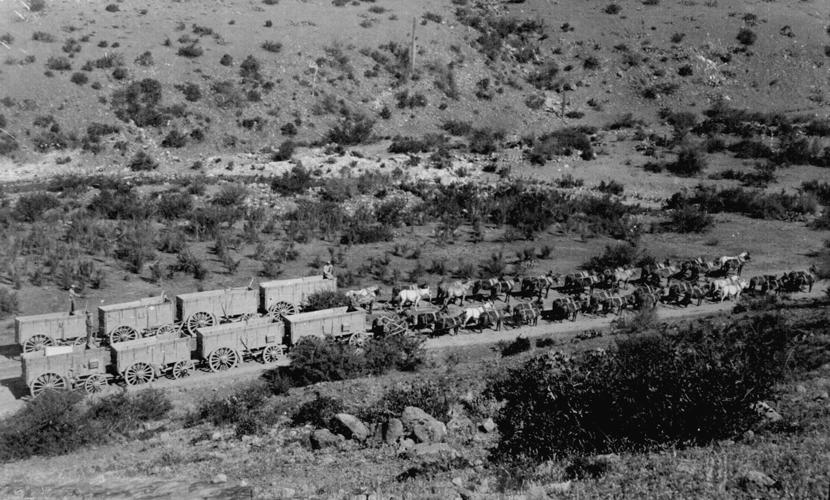
McMillenville was supplied by an arduous wagon road that connected it with Globe through the Copper Hills and Richmond Basin.
Merchants with affiliations in Silver City, New Mexico, and Globe established shops in McMillenville.
The road also reciprocated, serving wagonloads of silver ore, transported from the mine to a reductions works along Pinal Creek.
The town remained active until the early 1880s, when miners lost the silver vein at the 600-foot level of the mine.
Another issue of consequence was the failure of pumps to stem the volume of underground water that permeated from below the surface of the mine.
By 1882, the mine was abandoned and the post office closed.
Earlier that year, the town was attacked by Apaches. Advanced warning enabled women and children to seek protection in the Stonewall Jackson tunnel.
Pat Shanley’s two-story adobe building enabled the townsmen to ward off the attackers with strategic rifle fire until reinforcements arrived in the form of soldiers stationed at Fort Apache.
Rising silver prices led to attempts by the McMillen-Stonewall Mining Co. to develop the property using diamond-drilling during World War I, but the broken nature of the ground proved prohibitive to development.
A 50-ton cyanide mill was erected at Richmond Basin on the west side of the Apache Range, nine miles from McMillenville. Yet no significant production was credited from the local mines at the time.
Early accounts conclude that 40,000 tons of discarded silver was left over on the local mine dumps, including from the Stonewall Jackson Mine.
While McMillenville declined in significance, Globe would become the county seat of the newly created Gila County on Feb. 8, 1881.
That same year, the price of silver declined and copper prices rose to nearly 20 cents a pound.
A branch rail line, from Globe to the Southern Pacific at Bowie, arrived in 1898.
The prosperity of Globe in the early 20th century was ensured by the discovery of the nearby Miami and Inspiration copper ore bodies, the establishment of several mills at Miami and Inspiration, and the erection of a central smelter.

