


An active search for gold among mining companies continued in the various layers of shale and limestone found throughout the Amole Mining District in the Tucson Mountains during the first half of the 1900s.
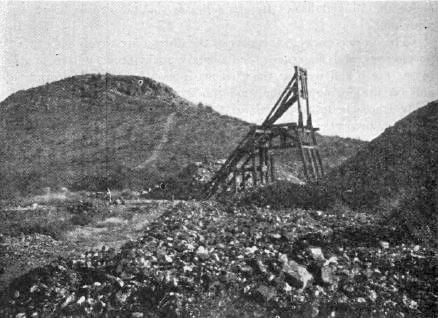
In 1919, the Arizona-Tonopah Mining and Milling Company and Southwestern Metal Mine Inc. broke ground at Beehive Peak, followed by mining at Snyder Hill off Old Ajo Road, which successfully yielded silver-lead ore in the 1920s.
Limestone from this deposit was also used in the construction of parts of Ajo Road.
The Great Depression halted or hindered production of these mines.
Additional small-mining operations in the Amole District included the Old Pueblo Mine, financed by the Tucson Consolidated Mining Company, in 1907. This claim included the “Quien Sabe Shaft,” which featured a depth of 517 feet.
Several years later, the Calument and Arizona Copper Co. conducted diamond drilling in the form of five 1,500-foot drill holes revealing copper ore deposits lacking commercial grade among the magmatic intrusions at Saginaw Hill. However, a market did exist for siliceous copper ore.
Additional work was undertaken at this same site by the Papago Queen Mining Co. in 1917, which shipped a meager three carloads of copper ore from its workings at Gold Mountain, located on the eastern end of the Saginaw property.
Mining operations in the area remained sporadic, culminating with the mining of limestone for smelter flux in the late 1950s.
In the mid-2000s, the Bureau of Land Management filled in many of the mine shafts on the Saginaw property as part of land remediation and public safety efforts.
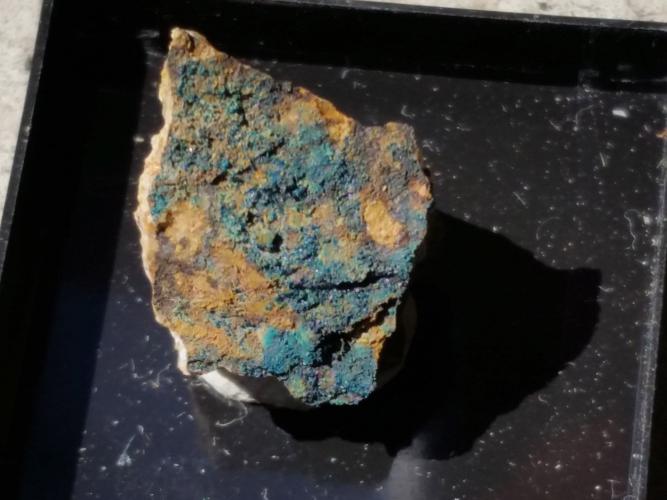
Saginaw Hill was one of only a few known locations in the world to produce cornetite, an uncommon, peacock-blue-in-appearance, copper-bearing mineral that is a hydrous phosphate of copper.
Other noteworthy minerals recovered in the mine dumps on the Saginaw Hill property included brochantite, cuprite, cerussite, libethinite and galena.
Other minerals exposed in mine tailings throughout the Tucson Mountains included chrysocolla, chalcopyrite and malachite. All are ores of copper.
Chrysocolla is bluish in appearance. Chalcopyrite is composed of copper and pyrite. This soft and brittle mineral is an important copper ore that appears as a tetragonal crystal system that is both metallic and yellow.
Both malachite and chrysocolla function as a gemstone. Chrysocolla was once used as a material to solder glue, henceforth the Greek derivative chrysos, meaning “gold,” and “kolla,” defined as “glue.” Malachite is derived from the Greek term “mallow,” in reference to its green appearance.
Mine tailings in the Tucson Mountains containing these minerals are striking after a rainstorm. That’s because the application of water causes a shiny gloss that brings out vibrant hues of the minerals.
Mining operations in the Amole Mining District never proved exemplary. The total profits garnered in the early years of production in the district came to only $289,000.
Encroaching property lines and environmental concerns, coupled with the volatile price of low-grade ore extraction, reduced the profitability of mining in the district.
Production in the district from 1901 through 1962 shows 10,000 tons of metals mined, including 286,000 pounds of copper; 472,000 pounds of lead; 34,000 pounds of molybdenum; 10,000 pounds of zinc; 600 ounces of gold and 11,000 ounces of silver.
By the 1950s, mineral exploration for economic purposes in the Tucson Mountains had mostly ceased.
The exception for mineral collecting is evidenced by beautiful mineral specimens — including wulfenite and vanadinite — from the Old Yuma Mine, displayed today at the Arizona-Sonora Desert Museum and the University of Arizona Mineral Museum.

