



The University of Arizona, one of Southern Arizona's two largest employers and responsible for more than $4 billion in economic impact, is implementing furloughs and pay cuts for nearly all of its employees that are set to last through June 2021.
The unprecedented steps, made as the UA braces for "extreme" economic fallout from the coronavirus pandemic, go into effect on May 11 and require employees making $150,001 or more to take at least a 17% pay cut, while those making less to take unpaid work days resulting in at least a 5% salary reduction.
Those cost-saving efforts come as the UA has already seen $66 million in losses — and is projected to lose as much as $250 million — as a result of the coronavirus, according to UA president Robert C. Robbins, who told the Arizona Daily Star on Friday that the furloughs will be reviewed each month to ensure they're hitting their savings goals.
“This is incredibly, incredibly difficult and painful to do. I have great empathy for everyone. At the same time, we’re not firing anybody. We’re just asking people to take reduction in time at work," Robbins said. "My hope is it doesn’t last the year. We’re fully expecting our students to come back on campus. If we have to go to all digital, remote learning like we are now, the number will be dramatically higher because the tuition that we would offer would probably reduced."
Robbins said the salary furloughs are expected to save the UA between $90 and $95 million. An additional $50-60 million is expected to come from their already imposed hiring freeze, halting $7 million in three building projects, withholding $22 million investment in the strategic plan, delaying merit increases, and a 20% reduction in executive leadership pay that went into effect in March.
Robbins told the Star those losses are expected to come from decreases in tuition, which makes up 30% of their annual revenue. He said domestic and international students make up about 60% of that, which could pose issues as international students might have trouble getting to Tucson as a result of world-wide travel restrictions, while many out-of-state students may opt to stay closer to home. They're projecting a 25% decrease in out-of-state tuition.
The $250 million number accounts for those expected decreases, as well as decreases in other revenue generators like parking and residence halls, as well as infrastructure costs to account for moving to digital and reimbursement to some on-campus residents who had to leave early when the university moved to remote learning.
It also accounts for some money from the federal CARES act to help offset those losses, of which Robbins said they've already received $30 million, $15 million of which went straight to students.
Asked if this precludes the university from layoffs down the line, Robbins said they remain "possible going forward."
"If this is as bad as we're projecting it to be, we still got $100 million we've got to make up from somewhere," he said, adding that the losses could reach as high as $500 million should the students not be able to return to campus.
Arizona Board of Regents policy states that any of its presidents that wish to implement furloughs are required to receive approval from the board chair and executive director. The university said it received approval from both board Chairman Larry Penley and Executive Director John Arnold earlier Friday.
In a prepared statement, Penley said the approval was done with a "heavy heart."
“COVID-19 is impacting Arizonans in so many ways, and universities can’t easily escape the economic impact of the virus," he said. "The board sincerely appreciates the dedication and commitment of all University of Arizona employees who will endure the financial hardship of the furlough and pay cuts. … Universities are drivers of the economy, and I know that Pima County and Tucson will sadly suffer alongside the UA family. I have confidence in President Robbins, and I trust the Wildcat spirit will prevail and, in some measure, help guide us through these unprecedented challenges.”

University of Arizona President Robert Robbins in 2018.
The furloughs were announced to faculty and staff in an email from Robbins Friday morning.
Employees making at least $200,000 have to take a 20% pay-cut, while those making between $150,001 and $199,999 have to take a 17% pay-cut.
Those making between $75,001 and $150,000 will be required to take 39 furlough days, or 1.5 days per pay period, equivalent to a 15% salary cut; those making between $44,500 and $75,000 are required to take 26 furlough days, or one day per period, equivalent to a 10% cut; and those making $44,449 and under must take 13 furlough days, or a half-day per pay period, equivalent to a 5% cut.
Some employees are not required to participate in the furloughs and pay reductions, including grant-funded positions in order to keep continuing research, which is one of three main revenue sources for the UA, and student workers and grad assistants, according to Robbins. The furloughs and cuts will also be adjusted for employees whose roles are less than one full-time equivalent and contracts are less than one year.
"The task ahead is not easy, and it depends largely on the resolution of our public health crisis. Along with our entire leadership team, I am grateful for the tremendous sacrifices you already have made, especially as more will be required of all of us at the University," Robbins wrote in the letter, which was obtained by the Arizona Daily Star, and noted the decreases in projected revenue.
"While significant, those savings are not enough, and an appropriate furlough (unpaid time away from work) and pay reduction program is required," he wrote. "With this plan, employees will retain their employment and health care benefits. We all will share in this as a team and we all will sacrifice as a team, but in a manner that respects your work, your contributions and your compensation and benefits, to the highest extent possible."
The university had more than 15,000 employees in fiscal year 2017, with wages and other compensation totaling just under $1.2 billion, according to a study commissioned by the Arizona Board of Regents and issued last year.
The UA's most-recent salary database, which provides information for all employees from fiscal year and was obtained by the Star earlier this year through an open-records request, shows 1,150 employees made at least $150,001, 3,400 employees made between $75,000 and $150,000, and 14,604 students made under that in fiscal year 2019.

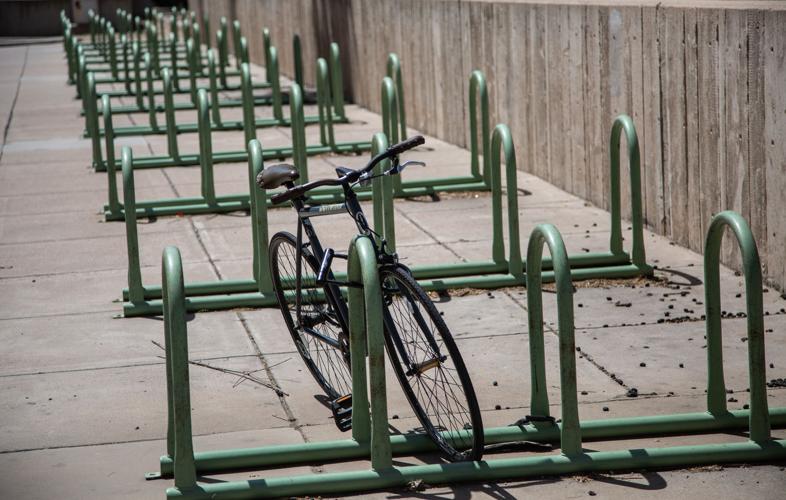
A lone bicycle outside the Harvill Building on the campus of the University of Arizona, on April 17, 2020.
The study also showed the university's economic impact for that fiscal year topped $4.1 billion.
Robbins acknowledged the impact the furloughs will have on the local economy.
"Everybody is being hit. I understand how big a deal this is to individual people and families and how much they’re hurting," he said. "But at the same time, if we did nothing we would run out of the money. The university would go bankrupt. We couldn’t continue to run the university.”
He also acknowledged what effect that could have on students, if their professors are unable to work at least one day each week.
“It’s really going to be tough for everybody. Deans, department heads and managers are going to figure out how to get the work done," said Robbins, who added they might have less students to teach. “The consequences of managing this are complex and that’s why we didn’t go into this decision lightly.”
Robbins said that the UA has previously done furloughs, but nothing ever on this magnitude. They instituted furloughs to save about $5 million during the 2008 economic recession, and actually had instituted 1.5% budget reductions and 3% reductions in administrative costs at the start of this year totaling $30 million.
"This is 8-10 times that. … This is orders of magnitude greater," he said.
Robbins said that all projections were made with the understanding that students would be on campus in the fall, but that they will make that decision "based on science," taking things into consideration like promised widespread antibody testing, a potential vaccine, and unforeseen second wave of cases.
“I very much wish we weren’t having this conversation but I think we’ll get through all this," he said.
Robbins' decision comes days after Dave Heeke, UA's athletic director, wrote an open letter to fans and boosters that he's anticipating a $7.5 million revenue loss this fiscal years, which ends on June 30, as a result of Pac-12 and NCAA revenue losses, a lack of ticket sales and what he called "a decline in other revenue projections."
The $7.5 million represents 7.3% of Arizona's last reported revenues of $102.3 million.
Heeke wrote that he's been working with others in the department to forecast next year's financial picture, and that the department "must have a plan" for reduced spending in a number of areas, including future contracts.
Then and Now: UA campus in 50s, 60s, 70s and today
University of Arizona campus, 1965
Updated
The Park Avenue Food Services and Bookstore Center on the west side of campus is under construction on May 18, 1965. Bruce Hopkins / Tucson Citizen
University of Arizona campus, 2016
Updated
The Park Student Union at the University of Arizona offers an array of food choices plus a bookstore, gaming center, meeting rooms and the home of the KAMP Student Radio station in Tucson, on August 8, 2016. A.E. Araiza / Arizona Daily Star
University of Arizona campus, 1965
Updated
Arizona Stadium starts to take shape as 10,000 new seats are added to the west side along Vine Street as part of the University of Arizona's $1.4 million addition to structure on April 16, 1965. The completion date for the addition to the stadium was extended a month to October 2, 1965. Ralph Dohme / Tucson Citizen
University of Arizona campus, 2016
Updated
Likens Residence Hall, left, is a four to six-story hall that offers numerous sustainability features and the latest in green energy at the University of Arizona in Tucson, on August 8, 2016. A.E. Araiza / Arizona Daily Star
University of Arizona campus, 1966
Updated
The brand-spanking new Space Sciences Center at the University of Arizona was complete by September 11, 1966. Note that North Warren Avenue went all the way through to Third Street and the UA Mall. Mark Godfrey / Tucson Citizen
University of Arizona campus, 2016
Updated
The Gerard P Kuiper Space Sciences building on the mall of the University of Arizona campus in Tucson on July 26, 2016. A.E. Araiza / Arizona Daily Star
University of Arizona campus, 1965
Updated
A previously empty lot is becoming the foundation to the University of Arizona's new Administration building on May 18, 1965. Bruce Hopkins / Tucson Citizen
University of Arizona campus, 2016
Updated
The west side of the Administration Building at the University of Arizona campus while looking south in Tucson on July 26, 2016. A.E. Araiza / Arizona Daily Star
University of Arizona campus, 1971
Updated
The Student Union at the University of Arizona had just been renovated by June 23, 1971. The addition of 130,000 square feet in the new sections of the building more than doubled the previous space. The cost for the renovation was $3.5 million. Art Grasberger / Tucson Citizen
University of Arizona campus, 2016
Updated
The new Student Union Memorial Center at the University of Arizona campus in Tucson on July 26, 2016. It is one of the largest student unions in the country sitting on around 10 acres and offering food, shopping, studying, banks, a bookstore, hair salon and more. It also pays tribute in design and memorabilia to the USS Arizona. A.E. Araiza / Arizona Daily Star
University of Arizona campus, 1972
Updated
Arizona Stadium is off in the distance looking south along North Cherry Avenue on February 9, 1972. At the time the UA was proposing an addition to its football stadium adding another 10,600 seats to the east side of the structure that would involve permanently closing Cherry Avenue. It was also considering a 3,600-unit parking lot, all of which could cost around $11 million. Bruce Hopkins / Tucson Citizen
University of Arizona campus, 2016
Updated
North Cherry Avenue looking south toward the football stadium at the University of Arizona campus in Tucson on July 26, 2016. A.E. Araiza / Arizona Daily Star
University of Arizona campus, 1976
Updated
From the patio of the new University of Arizona Main Library, students hang out as construction on the east side of the football stadium, on the left, continues on April 21, 1976. Arizona Stadium's seating capacity was to increase to a total of 57,000 seats for its season opener against Auburn on September 11. P.K. Weis / Tucson Citizen
University of Arizona campus, 2016
Updated
The Lowell-Stevens Football Facility is at the north end of Arizona Stadium at the University of Arizona campus in Tucson on July 26, 2016. It is the new home of football operations and it provides club seating, concessions and it increased the seating capacity of the stadium. A.E. Araiza / Arizona Daily Star
University of Arizona campus, 1968
Updated
The new Optical Sciences building at the University of Arizona was part of a $2.6 million project on December 27, 1968. The US Air Force pledged $5.2 million in support of optical sciences research at the university. Art Grasberger / Tucson Citizen
University of Arizona campus, 2016
Updated
The back side of Optical Sciences building at the University of Arizona campus in Tucson on August 14, 2016. The college is one of the premier educational and research institutions in optics and photonics. A.E. Araiza / Arizona Daily Star
University of Arizona campus, 1966
Updated
Drivers travel around the University of Arizona campus as dirt is piled up in the center of the mall near Cherry Avenue looking towards Bear Down Gym in the background and the baseball field on September 11, 1966. Mark Godfrey / Tucson Citizen
University of Arizona campus, 2016
Updated
The Mall at the University of Arizona near the Main Library, left and Bear Down Gym in the middle in Tucson on August 15, 2016. A.E. Araiza / Arizona Daily Star
University of Arizona campus, 1971
Updated
The Student Union at the University of Arizona had just been renovated by June 23, 1971. The addition of 130,000 square feet in the new sections of the building more than doubled the previous space. The cost for the renovation was $3.5 million. Art Grasberger / Tucson Citizen
University of Arizona campus, 2016
Updated
The new Student Union Memorial Center at the University of Arizona campus in Tucson on August 10, 2016. It is one of the largest student unions in the country sitting on around 10 acres and offering food, shopping, studying, banks, a bookstore, hair salon and more. It also pays tribute in design and memorabilia to the USS Arizona. A.E. Araiza / Arizona Daily Star
University of Arizona campus, 1972
Updated
Arizona Stadium is on the left looking north along North Cherry Avenue at East Sixth Street on February 9, 1972. At the time the UA was proposing an addition to its football stadium adding another 10,600 seats to the east side of the structure that would involve permanently closing Cherry Avenue. It was also considering a 3,600-unit parking lot, all of which could cost around $11 million. Bruce Hopkins / Tucson Citizen
University of Arizona campus, 2016
Updated
A woman crosses Sixth Street along the east side of Arizona Stadium at the University of Arizona in Tucson, on August 8, 2016. A.E. Araiza / Arizona Daily Star
University of Arizona campus, 1965
Updated
The University of Arizona's Civil Engineering building nears completion on May 18, 1965. Bruce Hopkins / Tucson Citizen
University of Arizona campus, 2016
Updated
The University of Arizona Civil Engineering Building at 1209 E 2 St., A.E. Araiza / Arizona Daily Star
University of Arizona campus, 1982
Updated
University of Arizona students take time out from their classes to relax at the pool located on the north side of the Student Union on March 9, 1982. Tucson Citizen file
University of Arizona campus, 2016
Updated
The north side of the Student Union Memorial Center at the University of Arizona looking towards the Second Street parking garage in Tucson on August 16, 2016.
University of Arizona campus, 1965
Updated
The University of Arizona Speech and Hearing Sciences building at 1131 E 2nd St. in Tucson in 1965. Bruce Hopkins / Tucson Citizen
University of Arizona campus, 2016
Updated
The University of Arizona Speech and Hearing Sciences Building at 1131 E 2nd St. in Tucson on July 25, 2016. A.E. Araiza / Arizona Daily Star
University of Arizona campus, 1966
Updated
The University of Arizona Mall off East Third Street (left) and North Cherry Avenue on September 21, 1966. Note the baseball field on the left of the photo. Art Grasberger / Tucson Citizen
University of Arizona campus, 2016
Updated
The mall at the University of Arizona from North Cherry Avenue near University Boulevard in Tucson on August 16, 2016. A.E. Araiza / Arizona Daily Star
University of Arizona campus, 1966
Updated
A view of North Highland Avenue looking north toward the University of Arizona's Administration building on September 11, 1966. Mark Godfrey / Tucson Citizen
University of Arizona campus, 2016
Updated
North Highland Avenue at Sixth Street looking north toward the mall at the University of Arizona campus in Tucson on August 14, 2016. A.E. Araiza / Arizona Daily Star
University of Arizona campus, 1965
Updated
The foundation of what is going to be the University of Arizona's Administration building is underway on June 29, 1965. Art Grasberger / Tucson Citizen
University of Arizona campus, 2016
Updated
Arizona Stadium on the west side of the structure looking south at the University of Arizona in Tucson, on August 10, 2016. A.E. Araiza / Arizona Daily Star
University of Arizona campus, 1971
Updated
The Student Union at the University of Arizona had just been renovated by June 23, 1971. The addition of 130,000 square feet in the new sections of the building more than doubled the previous space. The cost for the renovation was $3.5 million. Art Grasberger / Tucson Citizen
University of Arizona campus, 2016
Updated
A portion of the new Student Union Memorial Center at the University of Arizona campus in Tucson on July 26, 2016. It is one of the largest student unions in the country sitting on around 10 acres and offering food, shopping, studying, banks, a bookstore, hair salon and more. It also pays tribute in design and memorabilia to the USS Arizona. A.E. Araiza / Arizona Daily Star
University of Arizona campus, 1965
Updated
Cranes ease giant sections of the concrete supports in place along Vine Street as part of the University of Arizona's $1.4 million addition to Arizona Stadium on March 24, 1965. Art Grasberger / Tucson Citizen
University of Arizona campus, 2016
Updated
Arizona Stadium on the west side of the structure looking north at the University of Arizona in Tucson, on August 10, 2016. A.E. Araiza / Arizona Daily Star
University of Arizona campus, 1959
Updated
University of Arizona students walk around campus mixing occasionally with traffic in front of the Social Sciences building in 1959. Tucson Citizen file.
University of Arizona campus, 2016
Updated
From the Social Sciences building looking north towards Old Main at the University of Arizona campus in Tucson on July 26, 2016. A.E. Araiza / Arizona Daily Star
University of Arizona campus, 1965
Updated
The foundation of what is going to be the University of Arizona's Administration building is underway on June 29, 1965. Art Grasberger / Tucson Citizen
University of Arizona campus, 2016
Updated
The Administration Building at the University of Arizona campus in Tucson on July 26, 2016. A.E. Araiza / Arizona Daily Star

