


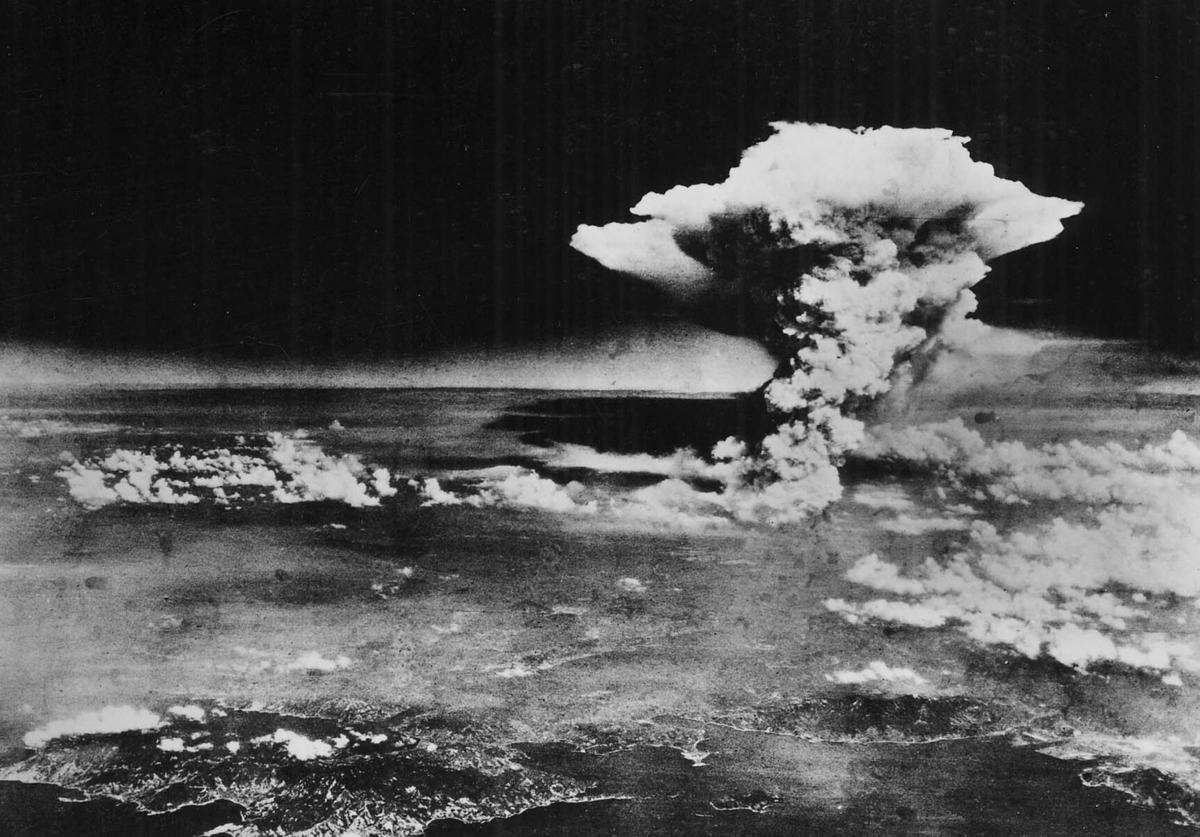
Just twenty-one days after a successful, top-secret atomic bomb test in New Mexico shook Tucson seismograph instruments with force, a 9,700-pound uranium nuclear bomb was dropped on Hiroshima, Japan on Aug. 6, 1945, effectively ending the war.
It was a Monday, the night humid and breezy at the U.S. Army Air Force base on the Pacific Island of Tinian. A pale crescent moon backlit the horizon and cotton-ball clouds filled the Pacific night sky.
At 0245 dark time, Dimples Eight-Two was cleared for takeoff. The pilot, U.S. Army Col. Paul Tibbets, used the entire two-mile runway for the over-loaded B-29 to power up. He could see Tinian Island's jagged coral edge with white caps lapping up as six wheels lifted off the airstrip at 155 mph.
Six hours later he was 6 miles above Hiroshima, at 30,700 feet, flying 330 mph. In Hiroshima, it was 8:15 a.m. when the 9,700-pound "Little Boy" tumbled out of the bomb-bay doors.
Just 44.4 seconds after the drop, the bomb exploded with atom-splitting wrath. The arresting flash dimmed the shimmering morning sun as a bright, florid cloud fumed upward above the smudge of a dying city.
Nearly 5 square miles had been laid waste. The blinding glare of the bomb blast was equal to the intensity of 10 suns. The inner temperature was calculated at one hundred million degrees Fahrenheit.
The shock wave took nearly a minute to sluice over the bomber at the speed of sound, approximately 9 miles from the explosion. And there it was, the monstrous, plum-tinted mushroom cloud rising to 45,000 feet. It boiled up into the heavens alive, clawing for air.
Before dropping the bomb, Truman believed that the Japanese military government should have one last chance to avoid the incredible power of the bomb. The President issued a global ultimatum: "Surrender unconditionally or face prompt and utter destruction." The Imperial Japanese Military government ignored the demand and chose to fight on. Three days later, a 21-kiloton plutonium bomb, known as "Fat Man," was dropped on Nagasaki.
"It was my decision," President Truman told Col. Tibbets in the Oval Office, following his decisive mission. "You didn't have a choice. I'm the guy that sent you to do it!"
To the end of his 92-year life, Paul Warfield Tibbets Jr. considered the presidential order to drop the bomb on Hiroshima a legitimate and justified means of concluding World War II.
In that moment, our world changed forever.

