



Hiking in the searing heat of a Southern Arizona summer is dangerous — in some cases deadly.
A Tucson teacher and his 12-year-old grandson were found dead along a sun-scorched trail near Gila Bend July 8 — just a day after a European tourist lost her life while hiking in midday heat on Camelback Mountain in Phoenix. On July 11, a sheriff’s helicopter rescued three overheated hikers in separate incidents on desert trails near Tucson. Then, on Wednesday, a 29-year-old woman died of apparently heat-related causes while hiking near Picacho Peak northwest of Tucson.
Such tragedies are “preventable events,” said an expert in heat-related illness with the Pima County Health Department.
The critical factors: knowing when to hike in the desert — and, more importantly, when not to — and knowing what vital precautions to take if you decide to venture out in the summer heat.
Should you hike on a hot summer day in the desert — or not? Public health and safety officials say it’s critically important to consider that question carefully before setting out.
“Heat-related illness is preventable, particularly in the context of recreation. Most heat-related hiking emergencies are due to poor decision-making,” said Michele Manos, senior consultant in the office of the director at the Pima County Health Department.
One option: Simply don’t go for a desert hike on a hot summer day.
But if you decide to go, “It’s a poor choice to hike at any time other than the cool, early-morning hours in the summer,” Manos said. “A summer afternoon is no time for a hike in the desert, even if your destination is a swimming hole.”
“I plan my summer hikes in the early morning hours, and carry lots of water,” she said. “I’m out around sunrise, when the birds and wildlife are active. And I finish up by mid-morning. It’s all about adapting to our Sonoran Desert seasons.”
Deputy Tracy Suitt, a spokesman for the Pima County Sheriff’s search and rescue unit, hammered home the point. “Think twice before setting out on a hike during the summer,” he said. “But if you do, go out very early, make it a short hike and get back before it gets hot. After 9 o’clock, it gets hot.”
County rescue statistics from 2014 suggest that more than a few people haven’t heard such warnings — or have ignored them.
- The Sheriff’s Department carried out 31 rescues for heat-related illness.
- Almost half of the rescues involved more than one victim of heat illness.
- The average high temperature on the days with rescues was 99 degrees.
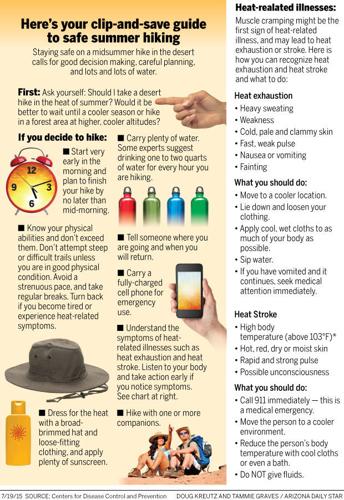
If you do decide to trek a desert trail on a summer day, here are some critical safety factors:
STAY IN TOUCH
“Make sure someone knows your plans,” said Capt. Adam Goldberg, a spokesman for the Northwest Fire District and its technical rescue team. “Tell a family member or friend of the specific trail or information about your outdoor adventure. Let them know a ‘last possible time’ that you will be home, and if they don’t hear from you, or can’t reach you, they should alert the local authorities via 911.”
DON’T GO SOLO
“Definitely don’t go hiking by yourself,” said Richard Kunz, a member of the Southern Arizona Rescue Association. The volunteer group regularly participates in search and rescue operations in desert and mountain areas around Tucson.
“We’ve picked up (rescued) many people who have gone out by themselves and had problems,” Kunz said. “If you’re alone, you have nobody to discuss things with” and nobody to help if you’re injured.
CARRY A PHONE
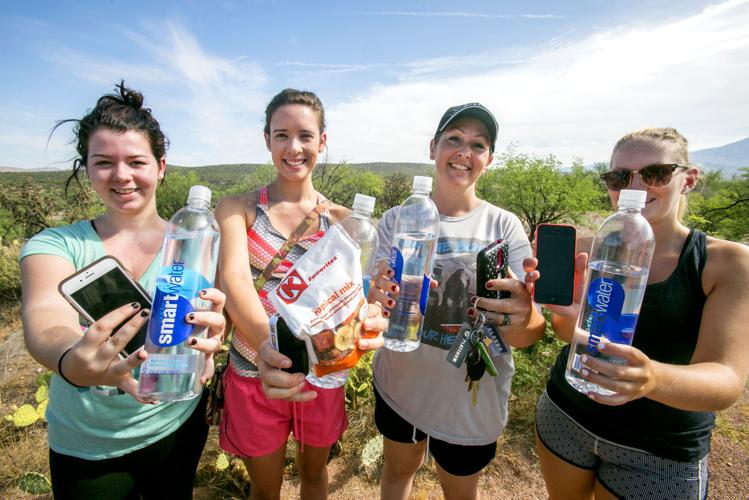
“Make sure you have a charged cellphone with you,” Suitt said. “If you’re lost, if you’re out of water, call 911 first — before you call your loved ones.”
Rescue units can often pinpoint a hiker’s location based on phone information and GPS coordinates. Sometimes rescuers will respond on foot, and in other cases the sheriff’s helicopter may come to the rescue.
“We don’t charge for the helicopter rescues, Suitt said. “It’s part of our mission to go out there and rescue.”
DRINK UP
Many of us have heard the advice: Carry plenty of water. But how much is plenty?
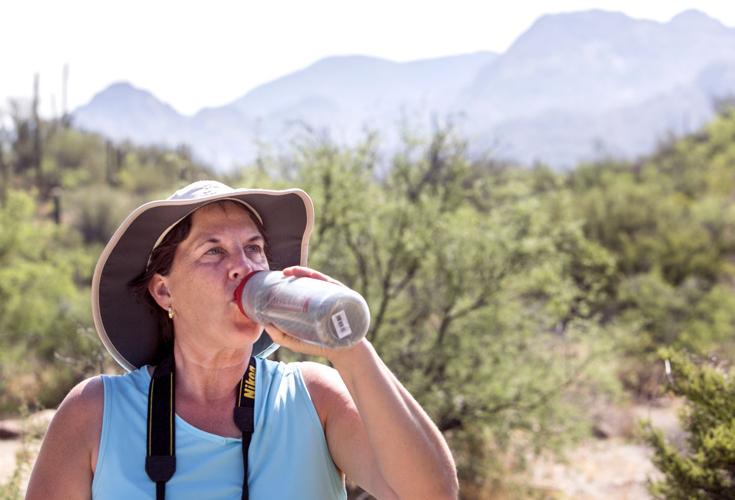
“Make sure you have at least a quart of water for every hour you’ll be out” hiking, said Suitt of the Sheriff’s Department.
Others recommend even more.
“Take a gallon of water for every two hours you’ll be out,” Kunz said. “When your water is half gone, turn around and go back the way you came.”
Suitt and Kunz emphasized that it’s important to drink plenty of water even before starting a hike.
“People often don’t prepare properly,” Suitt said. “If you’re hiking on a Saturday, all day Friday start hydrating.”
Said Kunz: “Hikers should be drinking a quart or two of water before they even arrive at the trailhead. That’s water that’s inside your body and that you don’t have to carry.”
DRESS FOR THE DESERT
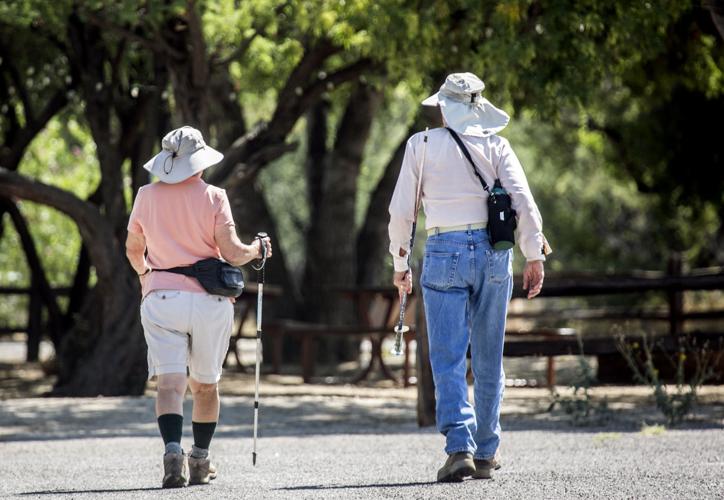
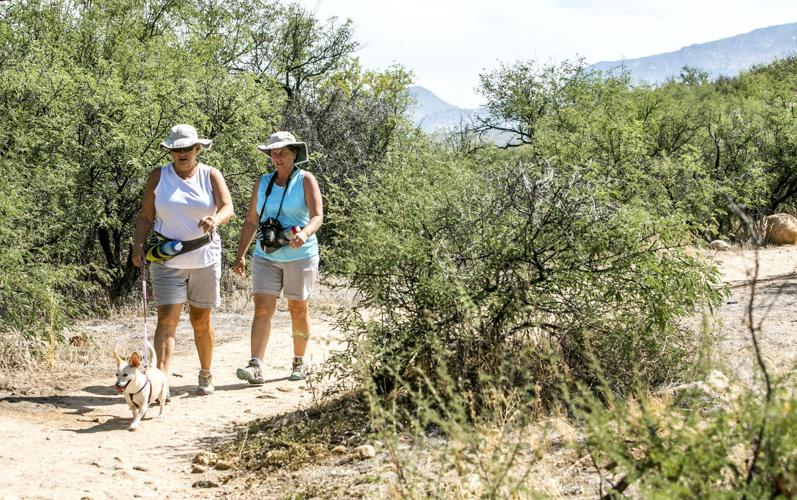
Wear lightweight, light-colored clothing to reflect heat and sunlight, Goldberg urged.
“Broad-brimmed hats are ideal for keeping the sun off your face,” he said. “And be generous with the sunscreen. Reapply it often.”
KNOW YOUR LIMITS
“Never out-hike your physical capabilities or experience levels,” said Goldberg. “Anyone enjoying the hiking trails of Southern Arizona needs to know the difficulty level of the trail they plan to hike. Do your homework, and understand if the trail is designed for beginners, the intermediate level or experienced hikers.”
RECOGNIZE SYMPTOMS
Learn to recognize the symptoms of heat exhaustion and heatstroke — and know what to do if you experience them. See the chart at left for details on symptoms and appropriate responses.

