

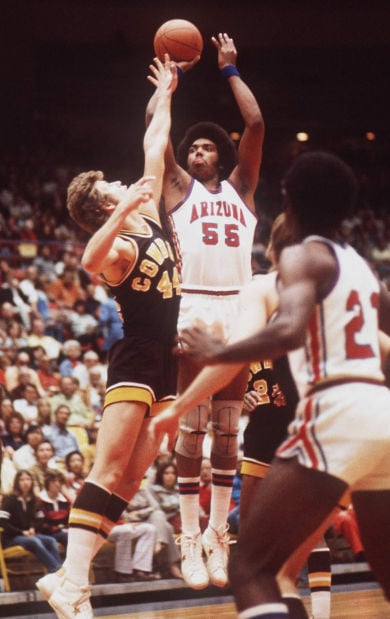

Bob Elliott is still the BMOC.
More than 35 years after leaving the University of Arizona as one of the Wildcats’ most acclaimed basketball players, helping elevate the school’s stature in the sport and having spent nearly 30 years broadcasting televised games — many of them UA — Elliott remains the big man on campus.
He’s a popular figure, as evidenced by the large number of fans who turned out to see him at last week’s Tucson Festival of Books, where he autographed his new book “Tucson: A Basketball Town,” which he co-wrote with Eric Money, his teammate from the 1970s.
But this column is not about UA basketball or Elliott’s athletic achievements, although they are integral. I’ll leave the sports commentary to my colleagues Greg Hansen and Bruce Pascoe. Instead, this is about Tucson, culture, acceptance and learning to adapt.
It’s about a young, African-American kid from Ann Arbor, Mich., who grew up playing basketball in Detroit, and who came to a small desert city where tacos were more popular than the sport. It’s a story about how a white and brown town embraced the 17-year-old with the big ‘fro.
“This book was done to tell a story that I believe has never been told,” said Elliott, 58, who started playing at the newly built McKale Center in 1973. We talked in his accounting office in the foothills Friday, just about the time the Wildcats began their latest push toward the Final Four.
When Elliott joined the ‘Cats, it was the second year after the UA made the bold hire of Fred Snowden from Detroit, the first African-American coach for a major university.
Snowden immediately recruited black players from the Detroit area and Pennsylvania. Tucson was probably as unsure of the new Kiddie Corps as it was of Tucson.
In the book, Elliott recounts how some of his teammates were uneasy making the transition.
“I had never been that much of a minority before,” he quotes his East Coast teammate, Len Gordy. “In Tucson there were more Latinos, more Native Americans and more whites. That was the first thing I noticed when I came here. I hated it. I was calling home every day. I wanted to leave. A lot of us did. We were just homesick kids doing a lot of talking.”
Most of them stuck around, with Elliott staying long after his playing days. Here he married his high school girlfriend, raised four children and founded an accounting firm. He and his wife, Beverly, made lasting friendships.
So how did Elliott make his adjustment to Tucson? He made it through food.
“Our chitlins is your menudo,” he said laughing. He recounted his early encounters with our Mexican food, which he found appealing. He learned to love tacos, burros, chile rellenos and chimichangas. Tucson’s Latino community also shared values he learned.
“You take care of business first, but you have fun,” he said.
Fun it was for Elliott and his teammates. McKale became a crowded venue on game nights after Motown came to mariachi town.
Elliott and those Wildcats were popular beyond Tucson. They were a hit in Nogales, Sonora, too, Elliott wrote.
In those days, the UA games were broadcast on KZAZ, the old Channel 11. The transmitter was in Nogales, Ariz., so in both border towns the transmissions were clean and many new Gatos fans were born, Elliott wrote.
On a shopping trip to Nogales, Sonora, Elliott wrote, “The kids and adults were coming from all directions, out of stores, everywhere. It was crazy like I was a rock star, except could not understand what they were saying.”
His Spanish-speaking fans were calling “pajarito” — Spanish for little bird — and “pajaro grande.”
They knew his basketball nickname was Big Bird.
Elliott is still in love with his desert town and longtime UA fans are still his cheerleaders.

