



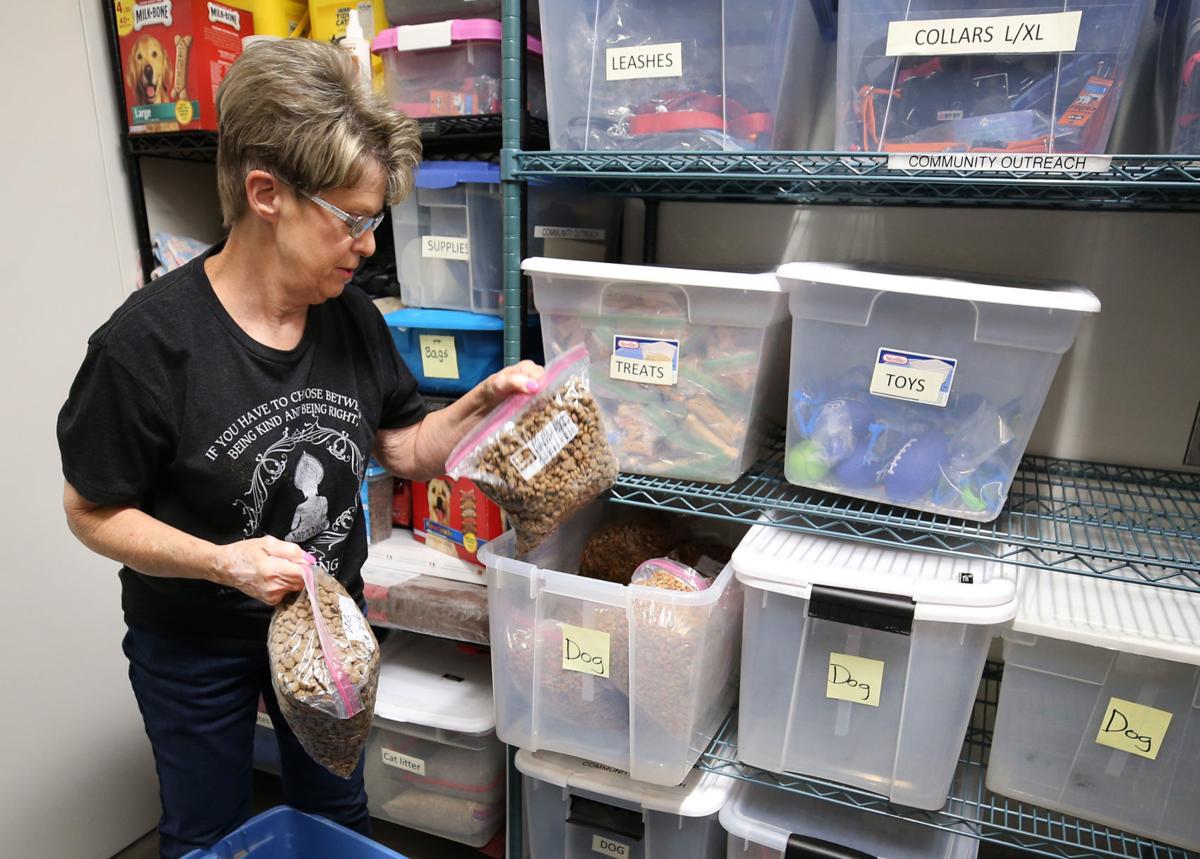
Building relationships with Pima County’s homeless and their pets has become a growing effort for Tucson’s Pima Animal Care Center despite concerns about a lack of policy preventing homeless people from adopting pets in the first place.
PACC takes in 17,000 animals a year and as with all high-volume, open-admission shelters, employees do their best to make good matches between pets and people, PACC director Kristen Hassen-Auerbach told the Star.
“We adopt out pets to people from all backgrounds and we operate from the belief that people that come into this building want to do the right thing and help an animal,” Hassen-Auerbach said. “They can go get an animal off Craigslist or from a breeder or from the street any day, but people who come here come here because they want to help. Anytime we can make that possible we do.”
Hassen-Auerbach said the shelter has restrictions in place that allow them to refuse adoption to people they suspect are using substances, have a known history of harming or attempting to harm animals, or if they feel that person truly isn’t able to care for an animal.
“We don’t knowingly adopt to people without homes. People do put an address on their form,” Hassen-Auerbach said. “But whether we sort of drill down and push them on their housing status, we don’t feel that’s appropriate in our role and very quickly we can get into territory where we’re actually discriminating against groups of people.”
PACC has potential adopters fill out a two-page survey and answer questions about their experience with dogs, what type of pets they currently own, whether the dog will live inside or outside, and where the dog will spend time when the owner isn’t home.
“We’re interested, of course, in contact information, name and address, but just as much as that we want to understand people’s lifestyle,” Hassen-Auerbach said. “The vast majority of people we adopt to, and by vast I mean virtually everyone, they have addresses.”
OUTCRY
The lack of a firm policy on adopting dogs to homeless people became a hot-button issue after a community member shared her concerns over a situation in which a dog with a medical condition was adopted to a homeless man.
The dog was later “saved” by someone, returned to PACC and the homeless man was allowed to adopt another dog, which was also returned to the shelter, the community member, Mariana Parker, said in a letter to the editor published in the Arizona Daily Star.
The letter was shared on social media, provoking a widespread response from PACC volunteers and concerned community members. In a response to one of the posts, someone noted that the dog named Roadkill was in and out of the shelter, with PACC returning the dog to his owner more than once.
“That’s what we have to do legally with every animal unless we believe there’s cruelty or neglect,” Hassen-Auerbach said, adding that there were no medical issues noted during the dog’s various stays at the shelter. “If we had noted any bruising, soreness or anything, it would have been in the records.”
The information in the letter to the editor and subsequent social media posts weren’t entirely accurate, Hassen-Auerbach said, adding that the dog’s owner did have an address on file and when the two adoptions occurred there was nothing in the man’s history that would have justified preventing him from being able to do so.
“I think very recently it was indicated that he was homeless and he’s been put on a do-not-adopt list as of February 25,” Hassen-Auerbach said. “Given that he just adopted a dog and didn’t hold on to it, along with this previous history, he’s now not able to adopt from us.”
Hassen-Auerbach said she understands that people might disagree with PACC not having more adoption restrictions in place, but she hopes they can also understand the complexity of these situations and what PACC can legally do.
During a March 14 meeting of the PACC Advisory Committee, a similar story was shared during the call to the audience, detailing a homeless man who wasn’t able to care for his dogs, despite PACC’s outreach efforts.
“Not everyone is as responsible as the feel-good stories we are told,” Gail Spahr said, reading from a letter written by a PACC volunteer.
The letter went on to say that PACC needs to consider the risks to pets, including inadequate medical care or being hit by a car, when deciding whether it’s appropriate to adopt to homeless people.
OUTREACH
While PACC doesn’t have a policy regarding adopting pets to homeless people, shelter staff members know that many homeless people do have pets and have worked to create programs to assist those owners.
Hassen-Auerbach became acutely aware of the issue when she moved to Tucson in July 2017 and noticed how many pets were on the street with bare paws during sweltering temperatures.
She teamed up with volunteers from the group Friends of PACC to try to make an immediate difference, creating the Pup in Boots project, which initially sought to collect money for booties to distribute to dogs living with owners who don’t have a home.
“Within a month, we’d gotten the funds to buy 300 pairs and all of a sudden I’m driving around on a hot day and I’m seeing all these dogs in tennis shoes,” Hassen-Auerbach said. “That was kind of the beginning of what turned into a much larger partnership with Primavera, working with Gospel Rescue Mission and with the Z Mansion of just providing some basics.”
The project expanded last year and now provides kits that include basic supplies like collars; leashes; bags of food; collapsible bowls; flea and tick prevention; and booties or sweaters, depending on the season.
The kits are handed out by PACC’s Animal Protection Officers and distributed by staff at Primavera Foundation’s drop-in center every day, on Wednesdays at Gospel Rescue Mission and at Z Mansion during Sunday’s Workship events.
“We want to make sure that when people come to get go-kits for themselves they can also get stuff for their pets, so that they don’t have to make that choice between caring for their pet and caring for themselves,” Hassen-Auerbach said.
The Workship Methodist Church provides additional services at Z Mansion for people experiencing homelessness, but on the second Sunday of every month, Workship partners with a local nonprofit to provide on-site veterinary care for pets on the street. The Woofs Without Roofs event brings two vets, along with support staff, to provide checkups, shots, chip implants and other services, free of cost.
Last year, Friends of PACC assisted 1,370 pet owners through the Pups in Boots program, providing 6,000 bags of dog food, 500 pounds of cat food, 500 treat bags, 375 leashes and 400 collapsible bowls, according to PACC’s annual report.
Also in 2018, PACC expanded its Pet Support center and started an initiative to help pets owned by people living in poverty or facing homelessness. Earlier this year, PACC teamed up with several local organizations to host its first Tucson Homeless Pet Connect, which served 150 pets in a single day.
LONG-TERM IMPACT
Even when people have stable housing situations, finding the right match between pets and owners can be a complicated process, and putting adoption restrictions in place won’t make it easier, Hassen-Auerbach said.
“We have to treat every animal and person as an individual,” Hassen-Auerbach said. “It’s really easy for animal shelters to make blanket statements like, ‘If you’re not home eight hours a day you shouldn’t own a pet, or if you rent you shouldn’t own a pet, or if you’re under 21 you shouldn’t own a pet.’”
In previous years, those were common restrictions and they led to many animals not leaving shelters and being euthanized, Hassen-Auerbach said.
“We adopt all the time to people who have housing in the moment, but three months later they may come back to us and all of a sudden their apartment complex has put up pet restrictions and they have nowhere to live with their animal,” Hassen-Auerbach said. “We see PACC as kind of the starting point of a relationship. The vast majority of people walk in here trying to help and it’s our job to help them and, once they get the pet, to be their lifelong partner in taking good care of it.
“It’s never simple and people’s lives are never as simple as their housing or age or ability or their work status. They can never be chalked up to that. We’re always trying to get to know the person and animal so that we can figure out, ‘This animal’s probably going to do really well with you and if it doesn’t, we’re here seven days a week and you can bring it back and we can help you find one that is.’”
There have been a lot of debates about running background checks on potential adopters, but Hassen-Auerbach said because they start with the idea that people are coming to PACC to help, they “feel that those resources could be better invested.”
PACC has its own records based on animal control officers’ involvement, so they’re able to see if someone has been convicted of crimes involving animals.
At PACC and around the nation, conversations about animal welfare have shifted in recent years to recognizing that there are two ends of the leash and advocates have to think about what’s happening at both ends.
“If I just turn you away and say ‘no’ and don’t have a conversation, you’re going to go to Craigslist or the street or Facebook to find a pet,” Hassen-Auerbach said. “But if we have a conversation and we connect you to social services and we get you some support that you may need, then we can build a relationship with you and eventually help you become a pet owner.”
PACC is always looking for volunteers for its homeless outreach event and Hassen-Auerbach hopes that more people will come out to help so they can see what she’s seeing.
“I think there’s a misconception of how these animals live,” Hassen-Auerbach said. “We invite people to sign up to be volunteers and help at these events because it’s really heartening to see the care and love. Oftentimes people that are experiencing homelessness, they’re going to feed their pet first.
“By building these pet-support programs that our community is building, we’re able to be a safe haven for them. It’s helping us create a truly humane community.”

