

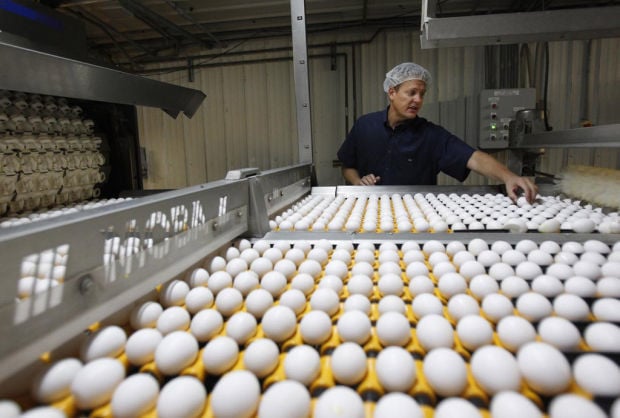
PHOENIX — Arizona shoppers could end up paying more for eggs, as state lawmakers look to protect the state’s major producer from a possible animal-rights initiative drive.
Legislation given preliminary approval Tuesday by the state House would mandate that, beginning next year, major egg-laying operations must provide at least 1 square foot — 144 square inches — of space for each hen.
The current standard is 66 square inches, said Rep. Tim Dunn, R-Yuma.
But the real change under the measure would come in 2025, when the affected companies would have to become cage-free operations. That can — but does not have to — mean allowing hens to be outdoors.
More significant, House Bill 2724 would then preclude the sale of eggs in Arizona that did not come from cage-free hens.
That prospect concerns Chelsea McGuire, who lobbies for the Arizona Farm Bureau Federation.
She told lawmakers that a local grocery chain was charging $2.59 a dozen for cage-free eggs. By contrast, eggs without that designation were selling for $1.49.
“That is the kind of price increase that Arizona consumers will not have a choice to avoid if this legislation goes forward,” McGuire said.
But her organization found itself up against Hickman’s Family Farms, the state’s largest egg producer.
Company president Glenn Hickman said it’s not that he particularly wants new state regulation of how he does business.
But he said the potential alternative is worse: the threat of an initiative by the Humane Society of the United States which, if approved by voters, would mandate cage-free production — and on a much more aggressive schedule. (The Humane Society of the United States is unrelated to local humane societies.)
“We don’t want to see a proposition come to this state and leave us out of the process,” Hickman said.
This is not a far-fetched possibility, he said.
His prime exhibit was a 2006 ballot measure pushed by the Humane Society of the U.S. that outlawed the use of “gestation crates” to confine calves and pigs.
Hickman called it just “pure luck” that his laying hens weren’t part of that successful initiative.
Kellye Pinkleton, Humane Society of the U.S. senior state director, said Hickman’s concerns are not misplaced. She told Capitol Media Services her organization worked with Hickman’s firm to come up with this compromise.
“And if this bill were to become law, we would have no interest in pursuing new Arizona legislation regarding egg-laying hens,” she said.
“This is a truce,” said Hickman’s lobbyist Joe Sigg.
Rep. Travis Grantham, R-Gilbert, wasn’t buying it. He had a warning for Hickman and others who are backing the bill based on promises of the Humane Society.
“It’s very dangerous for us to cow to an organization that is not going to stop, by trying to insert into law their demands and then hope they go away,” he said.
Grantham also worried about costs to consumers.
Hickman told lawmakers the price is set by retailers. But during a committee hearing he provided no specifics on the price difference he charges retailers between cage-free and other eggs.
Rep. Gerae Peten, D-Goodyear, said she feared the law would create a de facto duopoly for Hickman’s and Rose Acre Farms with the prohibition against the sale of eggs from caged hens.
But Hickman said eggs “travel very well” and out-of-state operations with cage-free operations would remain free to ship their eggs here.
Small egg producers — those with fewer than 3,000 hens — would be locked out of the Arizona commercial market unless they went cage-free.
While they would be exempt from the requirement for cage-free operations, they would not be able to sell their eggs to commercial groceries if they didn’t go cage-free.
McGuire, the farm bureau lobbyist, took issue with the whole premise that cage-free hens are happier hens.
She said conventional cages “make sure that chickens are safe and healthy.” She argued that the mortality rate among cage-free hens is twice that of those confined to cages.

