


She’s more than two centuries old, give or take a few years. When she arrived to Mission San Xavier del Bac, no one’s sure.
What Matilde Rubio and Tim Lewis were sure of, however, was that the statue of the Immaculate Conception needed lots of detailed attention.
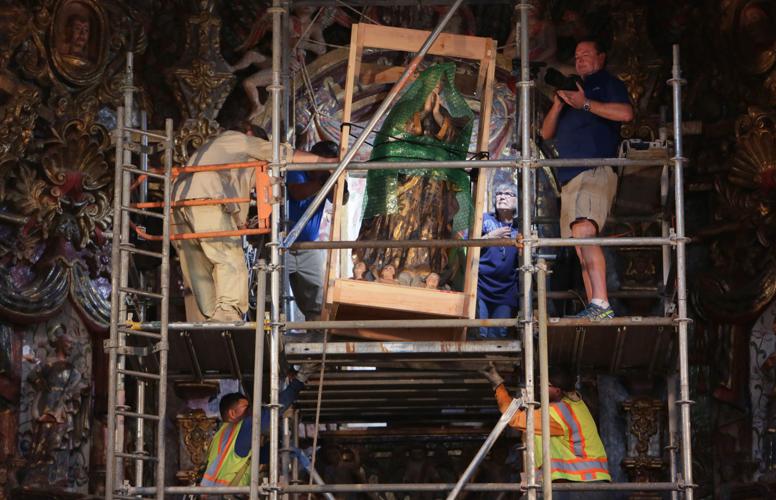
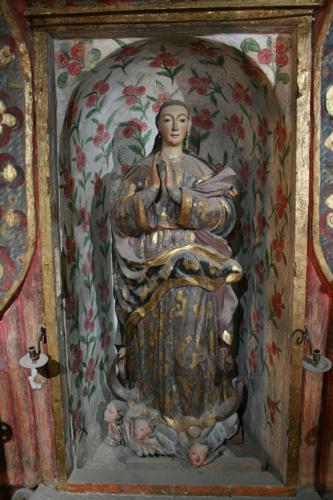
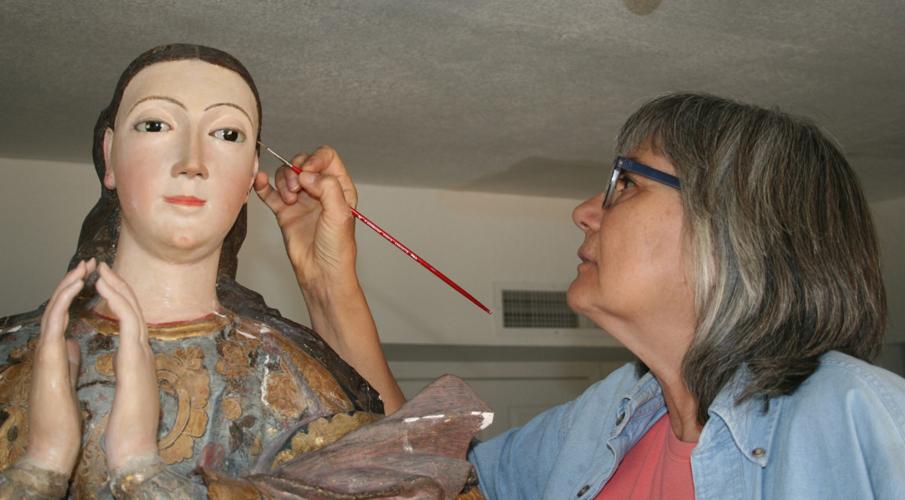
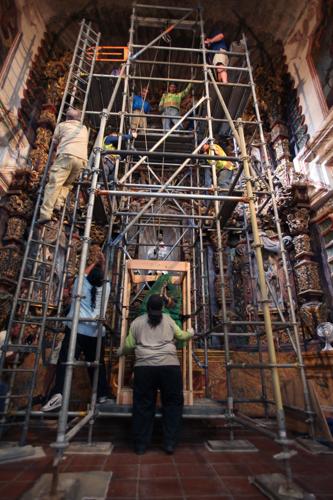
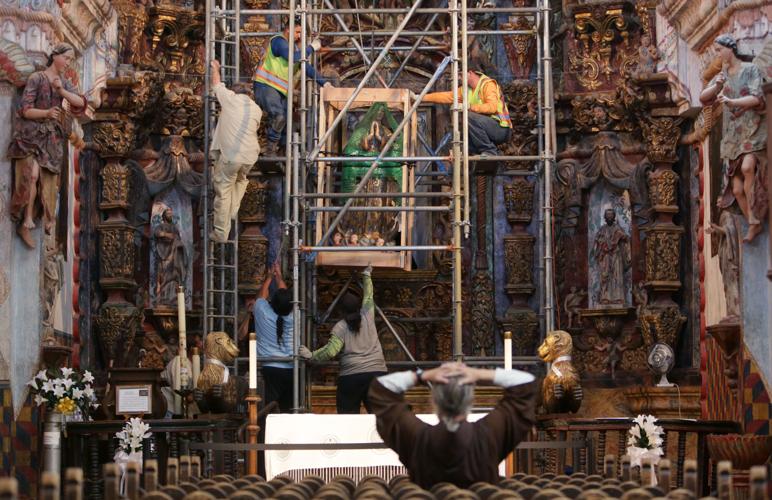
The statue of the Virgin Mary, as the Immaculate Conception, occupies a niche, high above the retablo mayor of the 200-year-old plus mission on the Tohono O’odham Reservation. When she came down on Jan. 4, Lewis and Rubio, who have been restoring various interior statues and paintings off and on since 2002, went to work.
Sunday the “new” Immaculate Conception will be on display by the high altar throughout the day. Monday evening, after the church doors close, the statue will be hoisted back up to its nicho with its commanding view of the richly ornate Baroque interior.
“No one had ever taken care of her,” said Rubio, the Spanish-born conservator. “She has to be as old as the mission.”
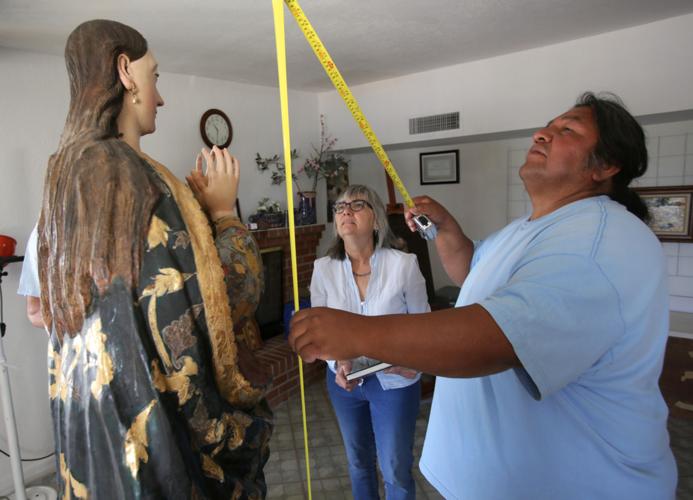
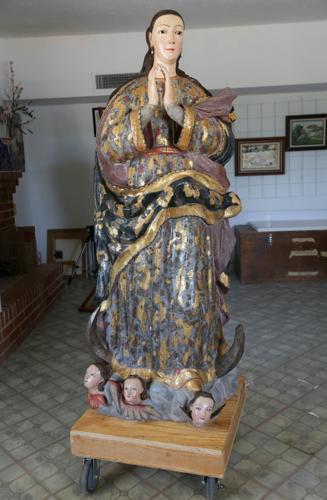
It is believed that the 5-foot, 2-inch tall statue was made in Querétaro, Mexico, north of Mexico City, where in colonial days the Franciscan order, whose missionaries built San Xavier in 1797, was centered. The wife and husband conservators know, through documentation, that the statue was located above the high altar in the 1940s.
When Rubio and Lewis took the dust covered statue to their home, which doubles as a work studio on the reservation, they realized the figure’s deteriorated condition. Portions were missing or broken. Cracks ran up and down the wooden body which was riddled with wasps’ mud daubers, mice nests, and the paint “was like corn flakes,” said Rubio.
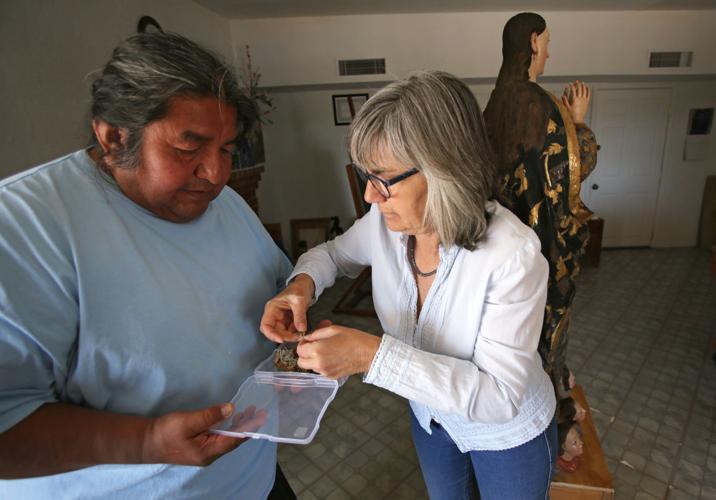
One of the most “fun finds” was a mouse hole at the bottom. From inside they removed seeds, bits of cloth and string, dung, confetti and what looked like a mouse jaw.
An X-ray of the statue showed where the pieces were connected with pegs and nails. The statue is hollow but top heavy. It may have been carried by the early faithful in religious celebrations.
Curiously, two small nails, on each side of the statue’s neck, are seen.
“Like Frankenstein,” joked Lewis.
What was no joke, in their trained eyes, was that a crude paint was applied to portions of the statue, probably at the beginning of the 1900s. Removal of the repainting was the most difficult challenge.
“I was mad,” Rubio said.
It nearly ruined the statue whose face was dabbed with red paint. Whoever painted portions of the statue did not know what they were doing, they added.
But Lewis and Rubio do. She was trained as a conservator in Spain and Lewis, who is a member of the Tohono O’odham Nation and grew up on San Xavier, acquired his skills first as an apprentice at the mission in the 1990s with European conservators and later in Europe where he and Rubio met. They married in 1995 and have worked together on restoration projects in Europe and at St. Augustine Cathedral.
Their work at the mission is under the auspices of the Patronato San Xavier, the nonprofit group that oversees the maintenance, restoration and preservation of Mission San Xavier del Bac, which last year was placed on the 2016 World Monuments Watch, a list of fragile cultural heritage sites in need of international attention.
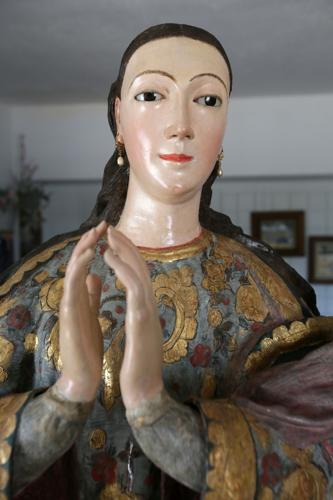
Lewis and Rubio removed the paint to expose as much as possible the original colors of the dark blue robe highlighted with silver and gold leaf, red belt and gray tunic, and the long brown tresses. At times they applied various grades of solvent on the spot to be cleaned.
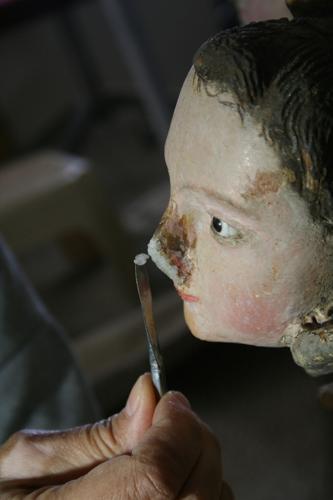
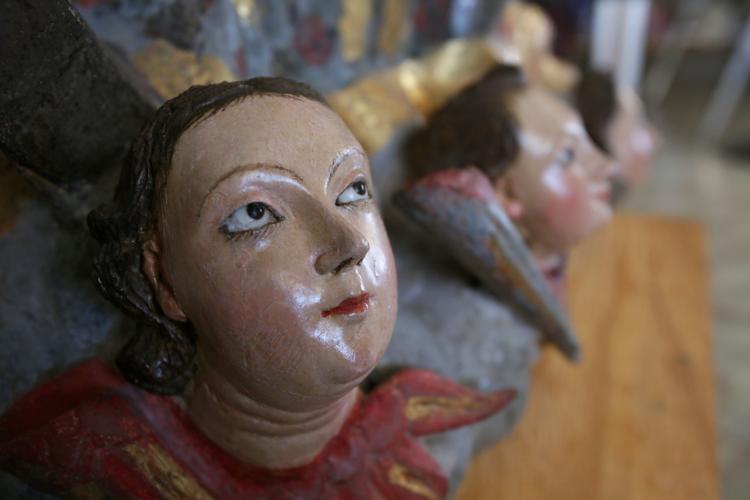
They reconstructed, with microcrystalline wax, the broken nose of one of the three cherubs whose faces peer from the covered feet of the Immaculate Conception. A missing earring was replaced with a pearl, almost identical to the original Venetian glass earring.
What they did not do — intentionally — was to paint over or remove the original colors.
The refreshed look of the statue shows a glimmering face, thin red lips, long brown eyebrows and a slight dimple on the chin. On the back of statue, the pattern of tiny indentations, which the conservators call punched border, are slightly different than on the front. Lewis speculated that the artists tried different patterns then selected the best for the front.
With the completion of the Immaculate Conception, Lewis and Rubio return to Spain for part of the summer and will return to consider other projects. There is so much to do.
Rubio said Mission San Xavier is a living church. As such, it requires continued and constant attention, Lewis said.
One statue and painting at a time.

