




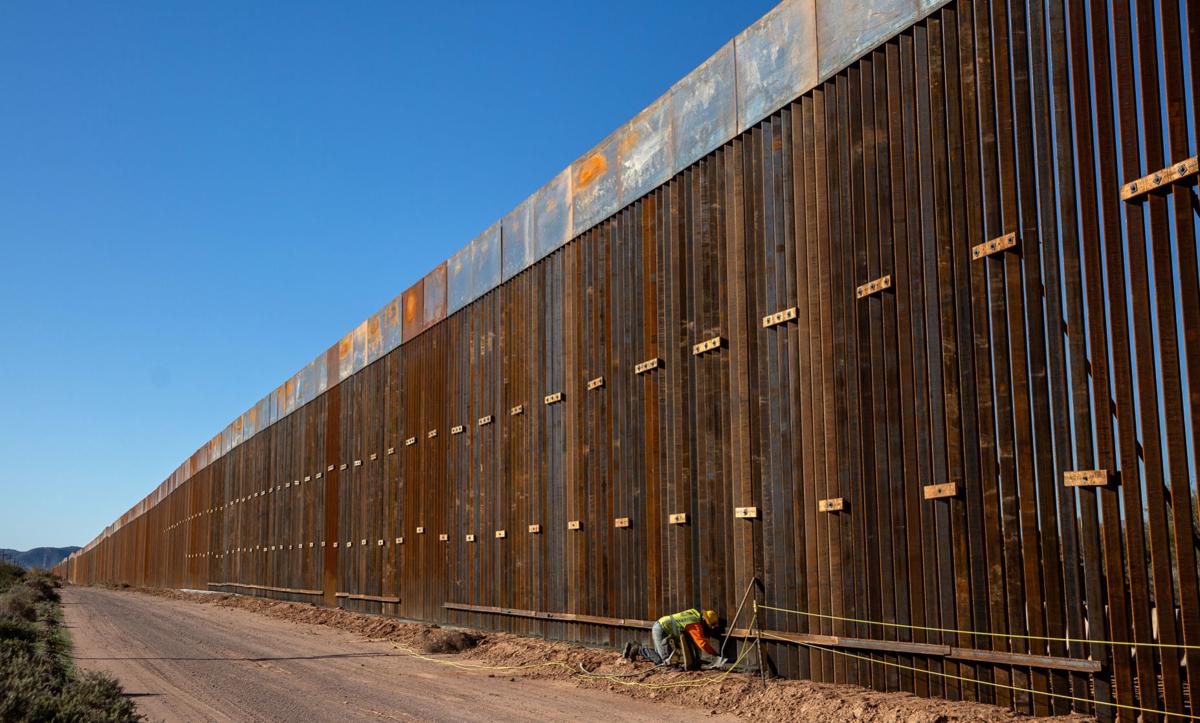
The coronavirus pandemic ended the daily bustle at ports along the Arizona-Mexico border, and apparently some of the cover it provided to drug smugglers.
Drug-smuggling busts “dropped quite a bit” when U.S. travel restrictions took effect last month and are now “less than half” of what they were, said Scott Brown, special agent in charge of the Phoenix field office of Homeland Security Investigations.
U.S. officials blocked nonessential travel from Mexico on March 21 in response to the virus’s spread, leading to a sharp drop in tourists, shoppers and others who legally cross the border every day and inadvertently give cover to smugglers trying to sneak past customs officers. In desert areas, Border Patrol agents are quickly expelling migrants to avoid the spread of the coronavirus and overall illegal crossings have slowed in recent weeks.
With less legitimate traffic at ports of entry like Nogales and Douglas, smugglers now have a harder time blending in with other travelers, Brown said. Beyond the declining traffic at the ports, people generally are staying home to avoid the coronavirus.
In Sonora, the Mexican state directly south of Arizona, officials recently instituted stay-at-home measures to slow the spread of the coronavirus. Photos posted on social media by a reporter for Radio XENY in Nogales, Sonora, show deserted streets that normally would be bustling with people.
The travel restrictions were in place for just 10 days in March, but they had a swift impact. Legal crossings in passenger vehicles along Arizona’s border with Mexico in March were 22% lower than they were in March 2019. Legal crossings on foot were down 26%, according to Customs and Border Protection.
The total crossings for April likely will be even lower, judging by the frequently empty lanes leading up to the Mexican sides of ports of entry in Nogales, which can be viewed online via cameras run by the Sonoran newspaper El Imparcial.
Shortly after the travel restrictions were put in place, drug-smuggling prosecutions plummeted in Tucson’s federal court. However, court records now show a much narrower view of drug smuggling than they did before the pandemic.
A federal judge shut down grand juries in mid-March to avoid the spread of the coronavirus at federal courts in Arizona. He also delayed trials until at least June and gave prosecutors more time to file charges. Officials at federal agencies, including HSI and the Border Patrol, also are concerned about transporting and holding prisoners without knowing whether they are infected with the coronavirus.
In normal times, most drug busts would lead to prosecutions within a few days. Now, some prosecutions are delayed until “we get back to some semblance of normalcy,” Brown said. Suspects may see their prosecution delayed if they do not have a criminal history and authorities are confident they can find them later.
As federal authorities navigate the new situation caused by the pandemic, they are setting up procedures they say will ensure “nobody gets a free pass” when it comes to drug smuggling.
The U.S. Attorney’s Office is working with the courts and “taking into consideration the health and safety of prisoners, law enforcement personnel, and the public at large, all of which has an impact on custodial decisions and the timing of charges,” the U.S. Attorney’s Office said in a statement to the Star.
“One thing is for sure, though, if you are caught illegally bringing drugs into the United States, you will be held accountable,” according to the statement.
Drug couriers caught by Border Patrol agents at highway checkpoints in Southern Arizona continue to face federal charges, as do marijuana backpackers caught in the desert, court records show.
Prosecutions of drug smugglers in the desert and on highways dropped by about half in late March, according to court records. Drug smuggling cases at ports of entry, on the other hand, have almost entirely disappeared from court records. Only one drug bust at a port led to a prosecution since March 21.
Instead of appearing in court records, port busts can be found among news releases and social media posts from CBP officials, who tout seizures as large as 66 pounds of meth and as small as one-tenth of a pound of fentanyl.
Taken together, court records and CBP announcements showed about 20 drug busts along the border near Tucson from March 21 to April 17, compared with about 40 drug busts from Feb. 22 to March 20. Those tallies may be an undercount because CBP officials do not announce every bust they make. CBP referred questions to HSI.
One byproduct of the new situation is that fewer U.S. citizens are being prosecuted for drug smuggling, compared with citizens of Mexico, Honduras and other countries, court records show.
In the weeks before the travel restrictions, U.S. citizens made up about half of the suspected drug smugglers who faced federal charges, court records show. Since then, only two were prosecuted, out of 19 total defendants.
In the case of marijuana backpackers, their cases often go to court as they normally would because most of them are not U.S. citizens and don’t have ties to Arizona, which means they likely will be harder to track down later, Brown said.
So far, federal prosecutors are not leaning on state courts to handle drug busts at ports of entry. The Santa Cruz County Attorney’s Office, which prosecutes some cases from the Nogales ports, said federal agencies had not sent them a port bust case since March 19.
Beyond local factors, the coronavirus may be slowing down drug smuggling from the other side of the Pacific Ocean. Drug cartels in Mexico depend on Chinese companies to supply precursor chemicals for meth and fentanyl. But those companies reportedly were hit hard by the coronavirus and are cutting off some of the supply of those chemicals.
Photos for April 11: Tucson gets by during Coronavirus Pandemic
Tucson in photos, coronavirus pandemic
Updated
Susan Hillman chats with her mother Betty Hillman via telephone, April 9, 2020, Tucson, Ariz. Eighty-five year old Betty Hillman is in long term skilled care and Susan is unable to visit due to COVID-19 restrictions on nursing home facilities.
Tucson in photos, coronavirus pandemic
Updated
Susan Hillman chats with her mother Betty Hillman near a photo of Betty and her husband, Susan's dad, Bill, circa 2105, April 9, 2020, Tucson, Ariz. Eighty-five year old Betty Hillman is in long term skilled care and Susan is unable to visit due to COVID-19 restrictions on nursing home facilities.
Tucson in photos, coronavirus pandemic
Updated
Ben Forbes, left, owner of Forbes Meat Company, helps Jeronimo "Mo" Madril, right owner and executive chef of Geronimo's Revenge, wrap up tortilla's for to-go carnitas for Forbes Meat Company and Geronimo's Revenge's "Carnitas for the community" at Thunder Canyon Brewery, 220 E. Broadway Blvd., in Tucson, Ariz., on April 6, 2020. Forbes Meat Company and Geronimo's Revenge partnered to help the restaurant community by offering free carnitas to those affected by the Coronavirus Disease (COVID-19). They will be making to go carnitas every Monday in April starting at 2pm until all the to go packs, roughly 60, are all gone. Forbes wanted to find a way to help out the restaurant community. "They are struggling and my business is exploding," said Forbes.
Tucson in photos, coronavirus pandemic
Updated
David Clark, left, out of work bartender, and Jeronimo "Mo" Madril, owner and executive chef of Geronimo's Revenge, practice social distancing while waiting to give out carnitas for Forbes Meat Company and Geronimo's Revenge's "Carnitas for the community" at Thunder Canyon Brewery, 220 E. Broadway Blvd., in Tucson, Ariz., on April 6, 2020. Forbes Meat Company and Geronimo's Revenge partnered to help the restaurant community by offering free carnitas to those affected by the Coronavirus Disease (COVID-19). They will be making to go carnitas every Monday in April starting at 2pm until all the to go packs, roughly 60, are all gone.
Tucson in photos, coronavirus pandemic
Updated
Steve Tracy, Thunder Canyon Brewery co-owner and brewer, fills up 16oz bottles of locally made hand sanitizer at Thunder Canyon Brewery, 220 E. Broadway Blvd., in Tucson, Ariz., on April 6, 2020. Thunder Canyon Brewery, along with a few other local distilleries, are making United States Food and Drug Administration approved hand sanitizer for hospitals, first responders and the public in response to Coronavirus Disease (COVID-19). "Whatever I have, I am turning into hand sanitizer," said Tracy. "We are going to keep making it as much as we can."
Tucson in photos, coronavirus pandemic
Updated
Steve Tracy, Thunder Canyon Brewery co-owner and brewer, fills up 16oz bottles of locally made hand sanitizer at Thunder Canyon Brewery, 220 E. Broadway Blvd., in Tucson, Ariz., on April 6, 2020. Thunder Canyon Brewery, along with a few other local distilleries, are making United States Food and Drug Administration approved hand sanitizer for hospitals, first responders and the public in response to Coronavirus Disease (COVID-19). "Whatever I have, I am turning into hand sanitizer," said Tracy. "We are going to keep making it as much as we can."
Tucson in photos, coronavirus pandemic
Updated
David Sbarra, a psychology professor at the University of Arizona, points his webcam at his children Margot, 9, and Mateo, 12, as he begins his introduction of his office hours for a class he now conducts over Zoom in his living room while teaching from home, on April 7, 2020.
Tucson in photos, coronavirus pandemic
Updated
Ben Elias, manager at Westbound, center, helps Dustin Schaber with his pickup order on April 8, 2020. Due to the coronavirus disease (COVID-19) only two customers are allowed in the shop, located at the MSA Annex, at the same time and all orders are to-go.
Tucson in photos, coronavirus pandemic
Updated
Laura Tanzer, a local fashion designer, posted on Facebook that she will make masks for $5.00 each on April 5. Tanzer thought she would receive a couple of dozen orders, but, within 24 hours she heard from over 200 people. Tanzer is now working out of her shop in downtown Tucson making masks that also has a filter sowed into them. Tanzer is wearing one of her masks as she sows on April 8, 2020.
Tucson in photos, coronavirus pandemic
Updated
Oro Valley Hospital chief administration officer Erinn Oller talks with Fang, a local organizer with the Chinese-American COVID-19 Relief AZ group, which donated 6,000 masks, on April 9, 2020. Additional mask donations are planned as soon as shipments arrive.
Tucson in photos, coronavirus pandemic
Updated
Healthcare workers line up for their 2 free Sonoran hot dogs and a drink from BK Carne Asada & Hot Dogs in the parking lot of St. Mary's Hospital on April 10, 2020. The owner, Benny Galaz, is giving free food to healthcare workers at Tucson area hospitals for the next several weeks as a way to say thank you for their hard work during the coronavirus disease (COVID-19) outbreak.
Tucson in photos, coronavirus pandemic
Updated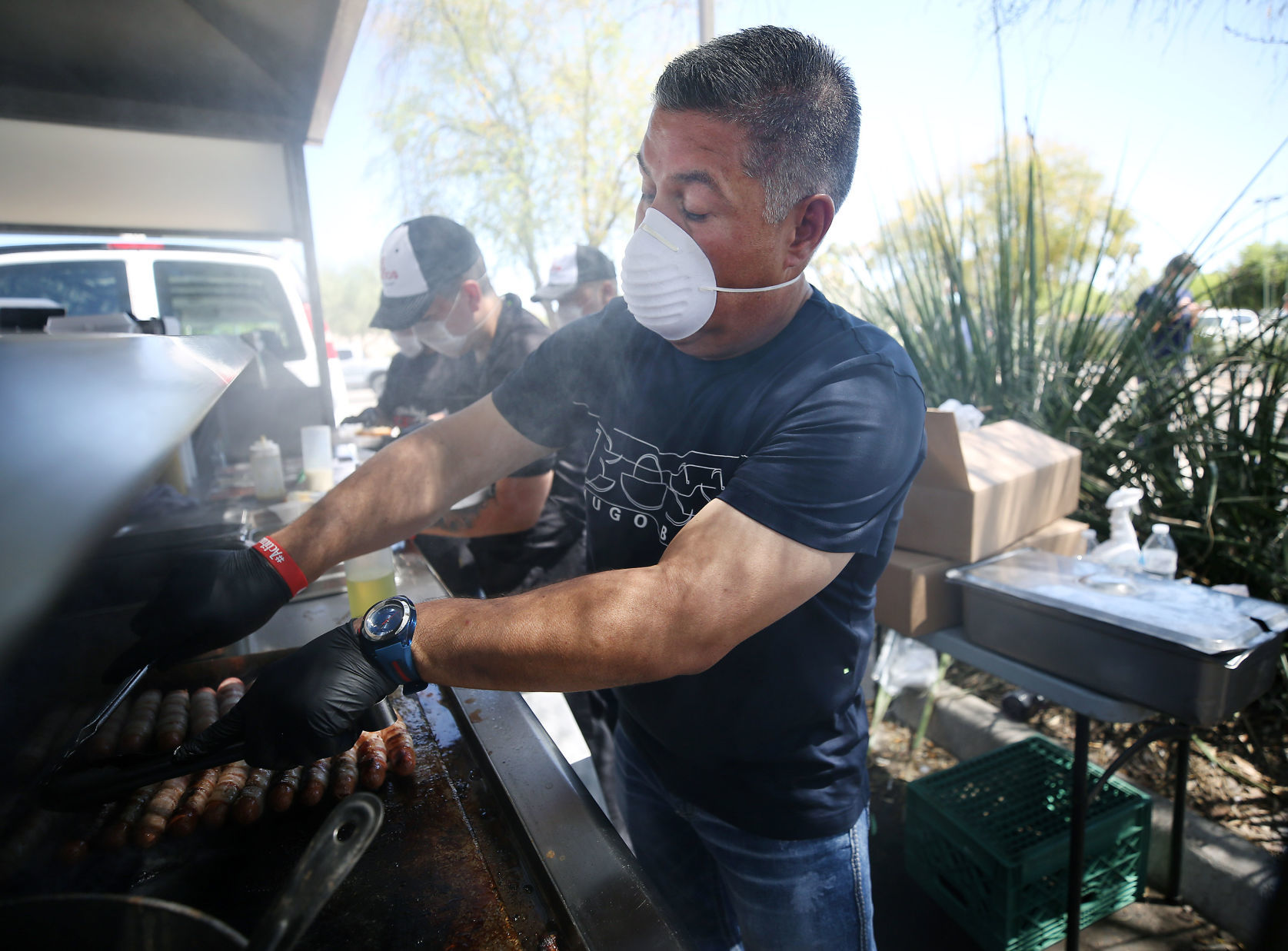
Benny Galaz, owner of BK Carne Asada & Hot Dogs, cooks up Sonoran hot dogs in the parking lot of St. Mary's Hospital on April 10, 2020. Galaz is giving free food to healthcare workers at Tucson area hospitals for the next several weeks as a way to say thank you for their hard work during the coronavirus disease (COVID-19) outbreak.
Tucson in photos, coronavirus pandemic
Updated
Healthcare workers line up for their 2 free Sonoran hot dogs and a drink from BK Carne Asada & Hot Dogs in the parking lot of St. Mary's Hospital on April 10, 2020. The owner, Benny Galaz, is giving free food to healthcare workers at Tucson area hospitals for the next several weeks as a way to say thank you for their hard work during the coronavirus disease (COVID-19) outbreak.
Tucson in photos, coronavirus pandemic
Updated
A man uses the taped off exercise station in Reid Park as an anchor for his band workout, April 8, 2020, Tucson, Ariz.
Tucson in photos, coronavirus pandemic
Updated
Alicia Roseanna, 9, fourth grader at Esperanza Elementary School, grabs a sheet of paper while listening to her teacher, Rachel Watson, and her classmates inside her home in Tucson, Ariz. during Watson's online class on April 7, 2020. Due to the Coronavirus Disease (COVID-19) closing down schools and universities, teachers and students have been forced to schedule and participate in classes online for the remainder of the school year.
Tucson in photos, coronavirus pandemic
Updated
COVID-19 survivor, Glen Reed, poses for a photo looking out from the room he's using for isolation from his family in his home, April 10, 2020, Tucson, Ariz. Reed spent nearly a month in the hospital including weeks in ICU on a ventilator.
Tucson in photos, coronavirus pandemic
Updated
ER and EMS workers run through a drill practicing how to process an incoming patient experiencing a respiratory emergency at the Tucson Medical Center's Emergency Room, on April 10, 2020.
Tucson in photos, coronavirus pandemic
Updated
Tucson Fire Paramedic personnel prepare to run a drill at the Tucson Medical Center's Emergency Room, on April 10, 2020.
Tucson in photos, coronavirus pandemic
Updated
The CDC recommends Americans wear a facial covering when out in public, part of an effort to reduce the spread of the virus that causes COVID-19. Above, shopping for spring blooms at Tucson’s Green Things Nursery.
Tucson in photos, coronavirus pandemic
Updated
Coronavirus disease (COVID-19) signs taped onto dorms at the Babcock Dorms. The rooms located at 1717 E Speedway Boulevard may be used to house hospital workers from Banner - University Medical Center if they need to be quarantined due to COVID-19.
Tucson in photos, coronavirus pandemic
Updated
Alex Swain, a member of Beloved in the Desert - Tucson's chapter of the Episcopal Service Corps, packs the trunk of his housemate's SUV in the parking lot of Fry's on 2480 N Swan Road after grocery shopping for an elderly man, on April 3, 2020. Swain and his housemates have volunteered to shop for elderly and at risk populations as people quarantine and stay at home during the Coronavirus (COVID-19) pandemic.
Tucson in photos, coronavirus pandemic
Updated
Julisa Montano, a bus driver with Sunnyside Unified School District, gathers up the last few meals to hand out to students outside of Gallego Primary School, on April 7, 2020. The school district is distributing meals and has wifi available for students to use for school.
Tucson in photos, coronavirus pandemic
Updated
A table is taped off at Fred Enke Golf Course, 8251 E. Irvington Rd., in Tucson, Ariz., on April 5, 2020 due to Coronavirus Disease (COVID-19). With a rise in the amount of people participating in golf, due to Coronavirus Disease (COVID-19), Tucson City Golf is taking extra measures to keep people safe such as sanitizing golf carts after each use and social distancing.
Tucson in photos, coronavirus pandemic
Updated
Rich DelVecchio, a Fred Enke Golf Course employee, sanitizes a golf cart. Course revenues at Tucson’s city-owned golf properties are up nearly 28% from the same period last year.
Tucson in photos, coronavirus pandemic
Updated
Golfers practice social distancing while on the driving range at Fred Enke Golf Course, 8251 E. Irvington Rd., in Tucson, Ariz., on April 5, 2020. With a rise in the amount of people participating in golf, due to Coronavirus Disease (COVID-19), Tucson City Golf is taking extra measures to keep people safe such as sanitizing golf carts after each use and social distancing.

