


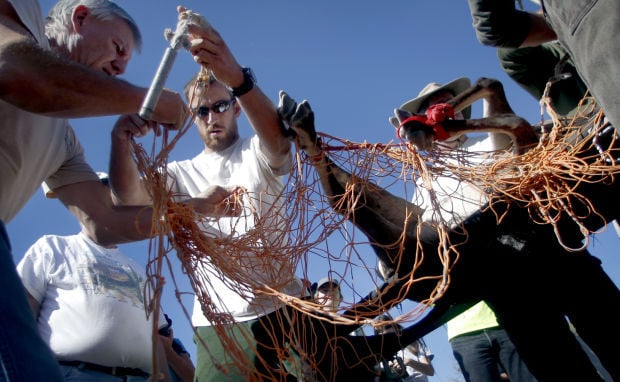

YUMA — Wildlife officers — swooping out of the sky in helicopters and wielding net guns — snared fleet bighorn sheep in rugged mountains northeast of here Saturday.
It was the first vital step in a plan to transplant bighorns from healthy herds near Yuma to the Catalina Mountains north of Tucson — where a native bighorn herd died out in the 1990s.
“It’s going well and the sheep are looking good,” said Anne Justice-Allen, wildlife veterinarian with the Arizona Game and Fish Department.
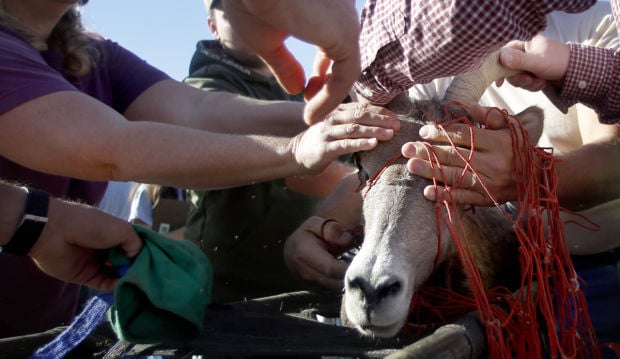
By midday, the net-gunners had captured nearly a dozen animals and taken them to a staging area on the Imperial National Wildlife Refuge for veterinarian exams and installation of Global Positioning System collars.
BUILDING A NEW HERD
The department planned to collect 15 bighorns from one herd Saturday and take an additional 15 from another herd today.
The sheep are to be carried by trailer to Tucson and released at Catalina State Park Monday morning.
Thirty more animals are to be moved to the Catalinas next year, followed by 30 more the year after that, said Raul Vega, regional supervisor for the Game and Fish Department in Tucson.
“We’re real excited,” Vega said. “This has been a long time coming, and lots of people have been involved” — including an advisory group made up of members of conservation and wildlife organizations.
“If we can get the population up to 100 animals, we consider that a pretty good population for the Catalinas,” Vega said.
Mike Quigley, of the Wilderness Society, one of the advisory organizations, was at the wildlife refuge staging area Saturday to watch the captured sheep brought in
“We’ve been working for the better part of a year to make this a success, and this is the first major milestone,” Quigley said. “We look forward to seeing the sheep start their journey to Tucson.”
The bighorns are expected to roam at first on craggy Pusch Ridge on the southwestern end of the Catalinas, but biologists said some might later move farther east
The new herd’s survival isn’t certain. Some of the factors that might have led to the demise of the previous herd remain — including encroaching urban construction, possible disruption of the herd by hikers, and predation by mountain lions.
Heidi Schewel, spokeswoman for the U.S. Forest Service, which is a partner in the project, emphasized that dogs — which can also threaten bighorn survival — are not permitted in the sheep habitat at any time. Hikers will be limited in off-trail travel during the bighorn lambing season from January through April.
CAPTURE TECHNIQUES
Chris Bedinger, a spokesman for the Game and Fish Department’s Yuma office, said the helicopter capture team includes a pilot, an officer wielding the net gun, and a person known as a “mugger.”
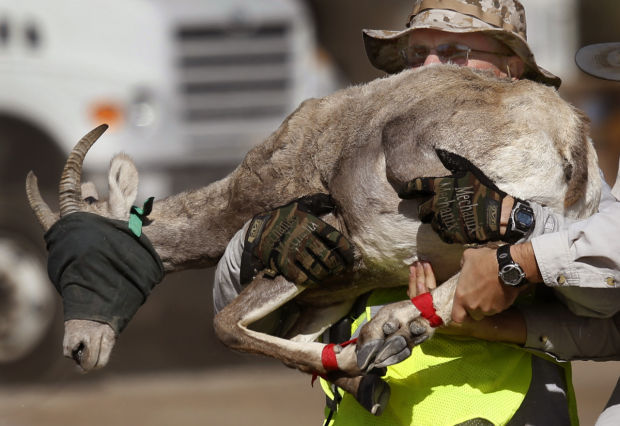
“Once the animal is netted and lowered to the ground, the mugger jumps from the helicopter and secures the animal,” Bedinger said.
The bighorn is loaded onto the helicopter and flown back to the staging area, where workers put the animal on a stretcher and rush it to an examining area.
Justice-Allen said arriving bighorns are checked for temperature and any injuries.
“We give them treatment to bring the temperature down” if it is too high, she said. “Pouring cold water over them to prevent overheating is what works best.”
Workers also collect blood samples from the sheep and attach ear tags and the GPS collars, which will allow biologists to monitor bighorn movement and mortality in the Catalinas.
MORE EWES THAN RAMS
Capture teams seek to catch more females than males.
“We try for two to three ewes for each ram,” Justice-Allen said. “The ewes are the ones that make the population grow.”
In fact, there could be bighorn births next spring in the Catalinas.
“The breeding season is past,” Justice-Allen said, “so ewes are in the early stages of pregnancy.”

