




Smack in the middle of Tucson’s hottest summer on record, researchers at the University of Arizona have made a new discovery about Southern Arizona’s last big cold snap.
A team led by paleo-climatologist Jessica Tierney has produced the most accurate estimate yet for global temperatures during the last ice age, some 20,000 years ago.
The period known as the Last Glacial Maximum saw massive ice sheets covering large portions of North America, South America, Europe and northern Asia, while cold-adapted plants and animals thrived.
The average global temperature at the time was about 46 degrees Fahrenheit, roughly 11 degrees cooler than it was during the 20th century, according to the new paper published Aug. 26 in the journal Nature.
“It’s a question that climate scientists have been studying for a long time,” said Tierney, an associate professor in the UA’s Department of Geosciences and the study’s lead author.
The team’s findings fall within the range predicted by earlier research, which estimated an average global temperature of between about 43 and 52 degrees Fahrenheit.
Using the past to predict the future
Nailing down the temperature from 20,000 years ago is important because of what it tells scientists about how the climate might respond in the future to changes in atmospheric carbon dioxide, a major greenhouse gas.
Carbon dioxide levels during the ice age were about 180 parts per million but rose to about 280 parts per million before the Industrial Revolution. Today they have reached 415 parts per million.
Based on their new, more refined calculations, Tierney and company project an increase of about 6 degrees in the average global temperature for every doubling of carbon dioxide levels.
That’s in the middle of the range predicted by the latest generation of climate models, but it’s still grim news for places like Tucson and Phoenix, which already rank among the fastest warming cities in the U.S.
“Especially around here,” Tierney said, “we don’t need it to be any hotter than it already is.”
A difference of 11 degrees over the past 20,000 years might not sound like much, but Tierney said it actually represents a massive change in the global average.
And some places were much colder than others during the last ice age.
“The eastern U.S. would have been covered in a giant ice sheet,” Tierney said, while much of the West was probably about 25 degrees cooler on average than it is today.
Lions and mammoths and wolves, oh my
The Tucson valley was a very different place back then.
Instead of desert, the landscape featured an open woodland of oak, juniper and even Joshua trees, said Ben Wilder, director of UA’s Desert Laboratory on Tumamoc Hill.
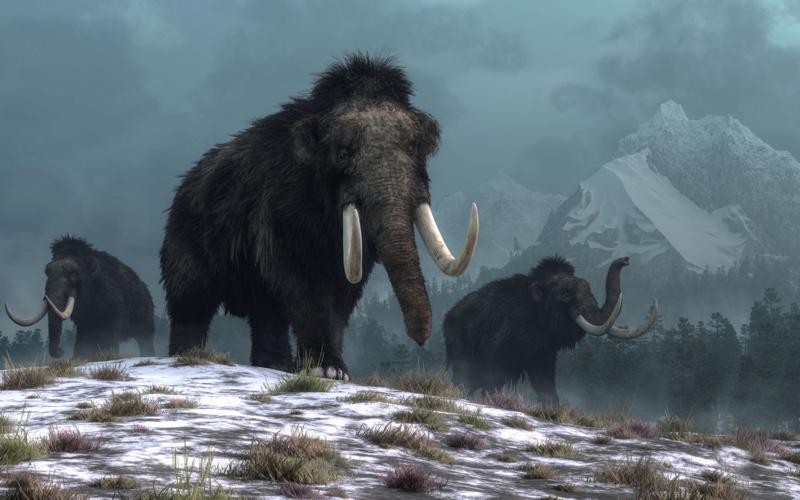
The contents of fossilized pack rat nests and other ancient evidence suggest a much cooler and wetter place, populated by a wide array of now-extinct ice age creatures, including giant ground sloths, long-horned bison, camels, primitive horses, mammoths, mastodons, dire wolves, lions and saber-toothed cats.
“We’re talking dozens of species,” said Wilder, who was not involved in the study by Tierney and her team.
Trademark Tucson plants such as the saguaro, the palo verde and the ironwood tree wouldn’t arrive here for another 10,000 to 12,000 years, as the climate warmed.
“They each came up from the south, kind of independently,” Wilder said.
As its name suggests, the Last Glacial Maximum marked the beginning of the end for both the ice age and its cold-loving menagerie of “megafauna.”
Tierney said the global climate warmed in “fits and spurts” over the next 10,000 years — a period marked by disruptions and abrupt changes that likely helped drive some animal species to extinction.
That should sound familiar to anyone who is paying attention.
“It’s what’s happening now,” Wilder said. “Species are moving in response to changes in the environment.”
Forecasting technique used to produce a “hindcast”
The effort to pin down just how cold it was during the last ice age also involved researchers from the University of Washington and the University of Michigan. Their work was funded by the National Science Foundation and the San Francisco Bay-based Heisings-Simons Foundation.
It took the research team about four years to compile and analyze as many ancient climate clues as possible, with a particular focus on ocean temperatures. Because there were no thermometers back then, Tierney and her team used “proxy measurements” gathered by other scientists from fossilized plankton and other geologic records.
The resulting cache of about 1,800 data points were then plugged into cutting-edge computer models at the National Center for Atmospheric Research in Boulder, Colorado, usually used to predict the weather.
But instead of a forecast, they got what Tierney called a “hindcast.”
“Using this technique to look this far back in time is new and unusual,” she said.
The team plans to use the same method to reconstruct climate conditions during warm periods in the Earth’s past, when carbon dioxide levels were extremely high.That could give researchers an extended preview of what’s to come.

