

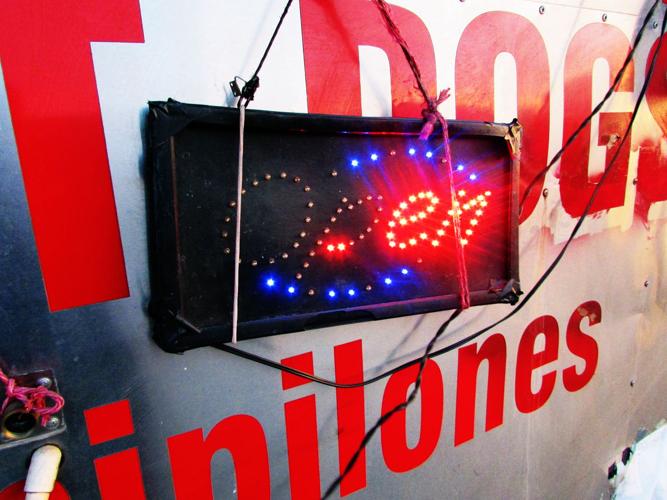

Held together by electrical tape and hung from strings and wire, the half-lit open sign beckons and deters in almost equal measure, mirroring the uncertainty that fills deferred action recipients.
That uncertainty grew Thursday, after a 4-4 split by the Supreme Court all but killed President Obama’s efforts to expand the deferred action program to more young immigrants and the parents of U.S.-born children.
The photo of the open sign, taken by a deferred action recipient outside a Tucson food trailer, is part of an exhibit that begins Friday and seeks to capture what life is like for these immigrants and their families.
“Deferred action has been a dramatic change, but it’s not enough,” said Miguel Moreno, who took the photo. “It’s a step in the right direction, but let’s not kid ourselves that this temporary relief is anything but limited.”
While the Deferred Action for Childhood Arrivals program comes with many benefits — relief from deportation, the ability to get a driver’s license, get a job and more easily pursue higher education by allowing in-state tuition in some states — it does not provide legal status.
This leads to complicated dynamics within many families, where the parents are in the country illegally, their older children have deferred action and younger kids are U.S. citizens.
“You can see what I call this ‘hierarchy of deservingness’ within the family. They talk about their younger siblings very differently, in terms of opportunity that they themselves do not have,” said Sofia Gomez, who spearheaded the exhibit.
Gomez, a doctoral candidate in public health at the University of Arizona, recruited seven young immigrants to explore the intersection of immigration and access to health care through photography.
DACA recipients do not qualify for the Affordable Care Act nor most federal and state public services. Locally, they can take advantage of service for low-income patients at places like El Rio, Clínica Amistad and the Shubitz Family Clinic.
But the photos participants came back with went beyond the original topic.
“They speak about not only the health concerns they’re currently facing, but the transition between being undocumented and having DACA status, about living in mixed-status families,” she said.
Miguel Moreno, 24, was brought to the United States when he was 2 years old. His parents couldn’t find work, he said, and he needed medical care that wasn’t readily available in Mexico.
Along with his shot of the malfunctioning open sign, his photos include one of his U.S.-born sisters standing in the light — “We allocate all these resources on the younger folks because they’re the hope, I guess, they’re future,” he said.
Perla Rojas, 18, just graduated from Sunnyside High School and plans to start at the University of Arizona this fall. Her parents brought her to Tucson when she was 3 years old.
In one of her photos, she uses a sunset as a metaphor for ignoring problems — “The sun is always there, even when it goes down in the evening,” she said — while in another, a Band-Aid covers a small crack on a shattered window.
Both Rojas and Moreno said they are grateful for deferred action but more has to be done to take them and their families out of immigration limbo. Even so, although they are worried what may happen with the upcoming presidential election, neither is ready to give up.
“I’m hoping for the best. And even if things don’t work out in our favor, that’s never stopped us before,” Moreno said.

