



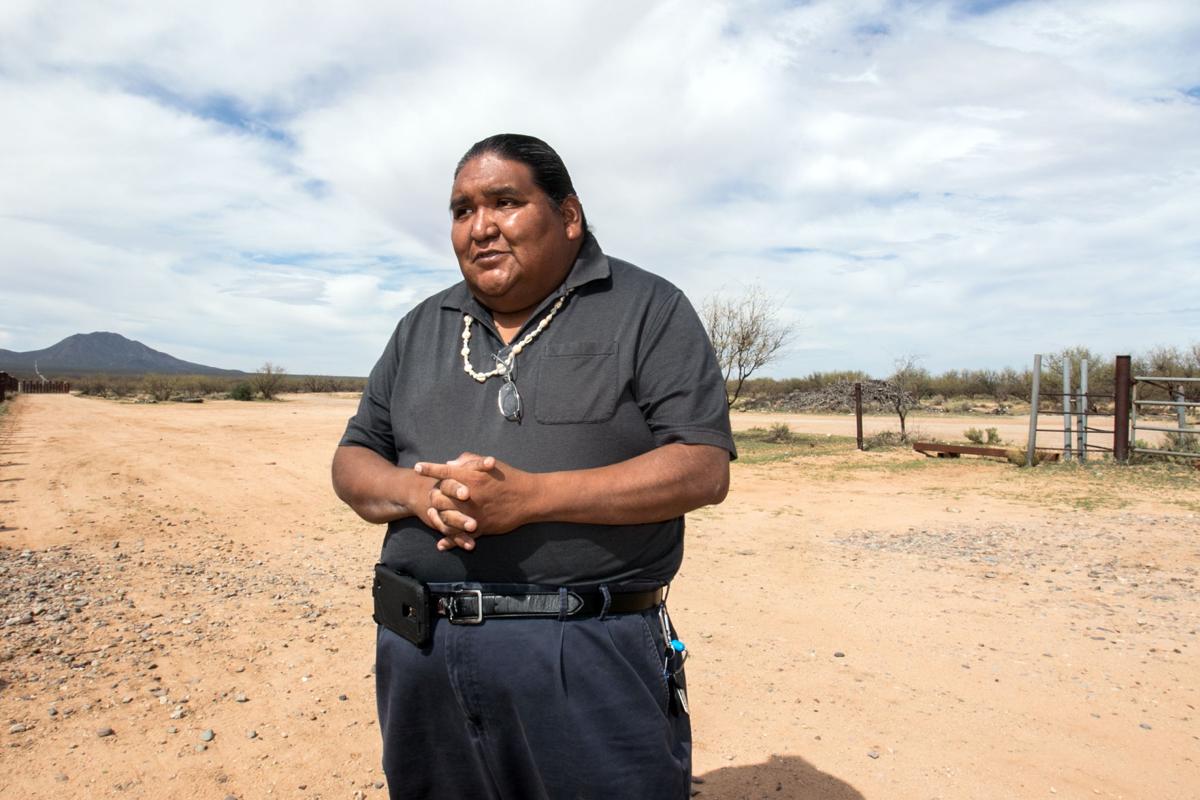
As migrants continue to arrive in unusually large numbers on Tohono O’odham Nation lands that border Mexico, the tribal chairman is calling for a more robust response from U.S. border enforcement agencies, which he said have only sent a “handful” of agents to manage thousands of recent arrivals.
Since the start of last weekend, about 3,000 more migrants have arrived at or near the San Miguel gate, a traditional crossing point used by tribal members to access ancestral lands in Mexico, said Tohono O’odham Chairman Verlon Jose on Wednesday.
The San Miguel gate, about 90 miles southwest of Tucson, typically only sees small groups of migrants. The recent arrivals follow a surprise influx of about 2,500 migrants in the same area during a single weekend at the end of October.
Until recently, “we have seen nothing of this magnitude of migrants crossing in our area,” Jose said in a Wednesday interview with the Arizona Daily Star. “We know this is not going to stop anytime soon.”
The U.S. Department of Homeland Security has an obligation to scale up staffing to reasonable levels in response to large groups of migrants, Jose said. The handful of agents in San Miguel aren’t sufficient for the number of people that must be processed, he said.
“They have other sector (agents) throughout the country they could deploy to these areas to assist at this time,” he said. “It’s basic common sense: Triage the area that is bleeding the most.”
Data from U.S. Customs and Border Protection show that the Tucson sector has become the busiest of Border Patrol’s nine border sectors in recent months, in terms of border agent encounters with migrants between official ports of entry.
“Customs and Border Protection stands ready to respond to shifts in migration patterns along the border continue to occur,” a CBP spokesman said Wednesday. “When a shift occurs, the Border Patrol will quickly deploy agents and transportation resources as required to respond to changes in traffic.”
At the end of October, migration patterns noticeably shifted westward from Sasabe, Arizona, toward the San Miguel gate, in part due to human smugglers responding to changing conditions on the ground. That includes an outbreak of violence in Sasabe, Sonora, resulting from armed conflict between criminal groups, and the closure of gaps in the border fence east of Sasabe, migrant aid workers said.
Jose emphasized that migrants don’t represent a threat to tribal members’ safety. They are not drug traffickers but primarily families seeking asylum, he said, who are not pushing further north than the San Miguel gate area.
“They cross and they sit down” to await border agents, he said.
“We’re monitoring this closely and there is no immediate threat to the community. We have no indication that any of these migrants are carrying any type of contraband, illegal drugs, weapons, cash, anything like that. We want to make sure the public is receiving accurate information on that.”
The Border Patrol’s own data show that most illicit drugs pass through official ports of entry, rather than through the desert, Jose said. To suggest otherwise is fear-mongering, he said.
“It’s a political ploy, to say, ‘That’s why we should build a wall there,’” Jose said. On Tohono O’odham lands, the border fence is a low-lying vehicle barrier, as opposed to the 30-foot wall in other parts of the border.
“The Nation will never approve a wall” on tribal lands, he said. “The wall that’s built now hasn’t done its job to begin with.”
But the arrivals are a humanitarian and environmental crisis for the Nation, whose members have a responsibility to care for their lands and people, Jose said.
Most of the migrants are traveling as families, he said, with mothers and fathers carrying toddlers in their arms or on their shoulders. Many are camping out under trees or any shade they can find as they wait for border agents to receive them. Some are building small campfires to keep warm.
Human waste is becoming a health concern in the area, not to mention the trash and belongings that migrants must leave behind when they’re processed by border agents, he said.
“Who is going to pay for it (the clean-up)? It’s the Tohono O’odham Nation who’s going to foot the bill,” he said.
Border agents are not releasing migrants onto tribal lands, Jose said. Those who are processed as asylum seekers will be released to migrant-aid shelters like Casa Alitas in Tucson and they usually only stay a night or two before joining family or sponsors in other states, advocates say.
The U.S. Congress must either undertake comprehensive immigration reform, or provide more resources to the border communities suffering due to legislators’ decades-long failure to address the root causes of the migration crisis, Jose said.
“We know we’re not the only area having an influx of migrants, but we’re doing our part. You do your part,” he said.
Get your morning recap of today's local news and read the full stories here: tucne.ws/morning

