


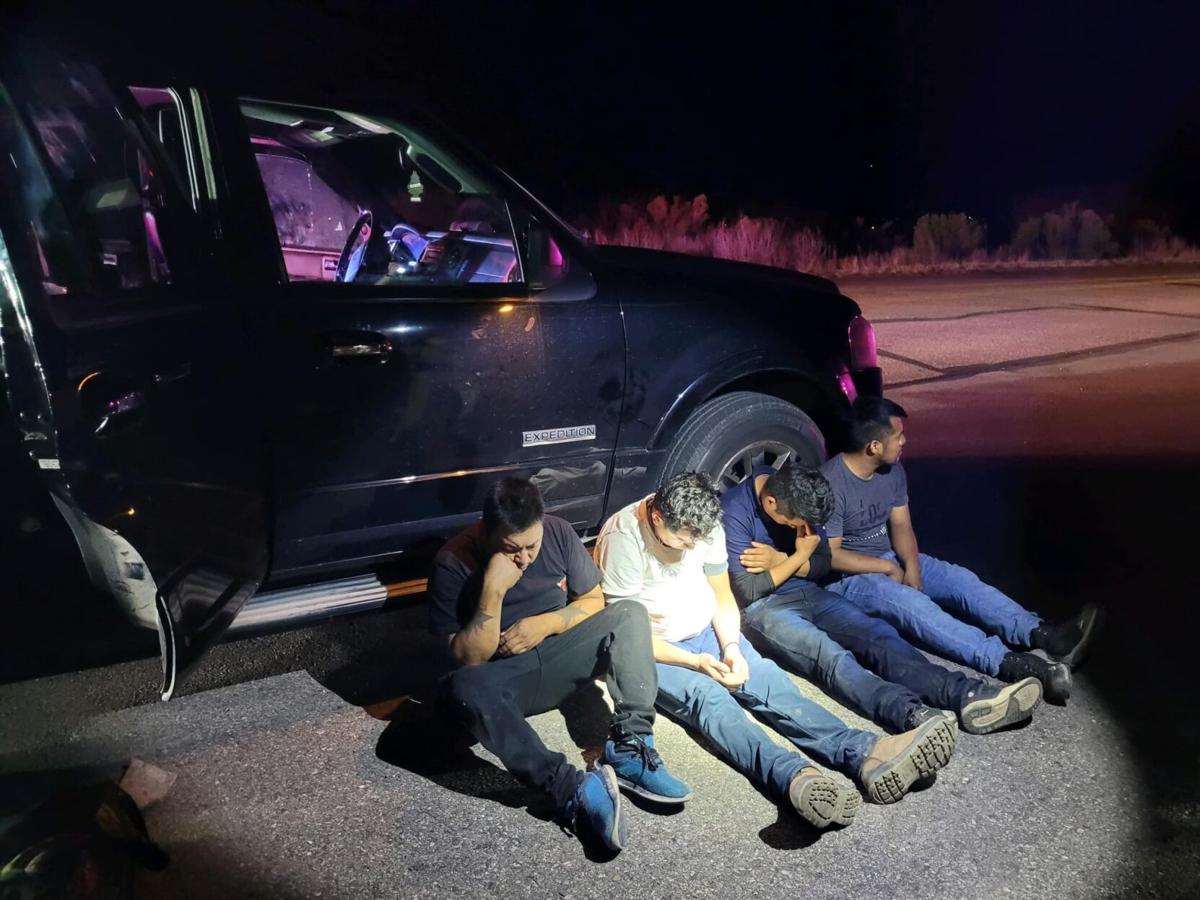
PHOENIX — A proposal allowing Arizona police to arrest and state judges to deport people who entered the country illegally was approved by a Senate committee Wednesday.
The vote came despite testimony that it runs afoul of U.S. Supreme Court precedent that says only the federal government can enforce immigration laws. That ruling struck down key parts of Arizona’s Senate Bill 1070 more than a decade ago.
Republicans on the panel unanimously approved Senate Bill 1231 while all Democrats opposed the measure.
The sponsor of the bill, Sen. Janae Shamp, R-Surprise, argued that her measure is not about immigration but is aimed at protecting Arizona from what she called “an invasion.’’
“There are not any portions of (SB1070) in this bill, because this bill’s not about immigration and that bill was,’’ Shamp said. “This is just saying you can’t come into our state unless you come through a lawful port of entry.’’
The bill is modeled after a Texas law enacted last year, Senate Bill 4, that has already prompted the U.S. Justice Department to sue the state. The Justice Department specifically referred to the Supreme Court’s decision in the federal government’s challenge to SB1070.
“The Supreme Court, in ‘Arizona v. United States,’ has previously confirmed that decisions relating to removal of noncitizens from the United States touch ‘on foreign relations and must be made with one voice,’’’ said a January news release from the Justice Department announcing its lawsuit. “SB 4 impedes the federal government’s ability to enforce entry and removal provisions of federal law and interferes with its conduct of foreign relations.’’
Shamp heaped blame on the federal government, saying its inaction on immigration has directly led to a surge of immigrants pouring over the border in the last several years.
“Thanks to the Biden administration’s refusal to secure our border, the illegal activity, including unprecedented amount of human smuggling, drug smuggling, ladies and gentlemen, we’re in the thick of an invasion,’’ Shamp told the Arizona Senate Committee on Military Affairs and Public Safety.
“Our law enforcement is overwhelmed by the chaos created by Biden’s open border policies,’’ she continued. “They don’t have the resources or the support needed to combat the magnitude of criminal activity going on. And our communities are in danger.’’
Shamp’s proposal allows local police and sheriffs to arrest anyone who entered the country anywhere but a port of entry who has not been granted asylum or other legal right to stay in the country. And it lets — and in some cases requires — local judges to order those arrested to be returned to Mexico, regardless of their home nation.
The measure would lead to widespread racial profiling if enacted, said Marilyn Rodriguez, a lobbyist for the American Civil Liberties Union of Arizona.
“Unfortunately, Arizona has gone down this dark road before,’’ she told the panel.
“In the past we have seen Arizonans stopped by police because of their skin color or the languages they speak, family members arrested by local police because they can’t prove their immigration status, mixed-status families reluctant to call the police when they’re victimized due to the threat of detainment or deportation,’’ Rodriguez said. “The division and anger that sprang from that period are still with us and we shouldn’t be traveling through that dark path again.’’
Sen. Eva Burch, D-Mesa, said she does not disagree that there are serious issues at Arizona’s southern border and that there may be a role for the state Legislature.
“But we have to get this right, and there should be a robust bipartisan collaboration that includes voices and participation from our border personnel and from law enforcement as well as from civil rights advocates and people in the humanitarian space,’’ Burch said. “That’s not what this bill is the result of.”
But Republicans on the panel praised Shamp’s proposal, saying that since the federal government hasn’t stopped illegal immigration, the state has a duty to act.
“And it’s high time that we rose to that occasion,” said Sen. Wendy Rogers, R-Flagstaff.
Rogers also pushed back at the idea that racial profiling would result from the law’s passage.
“This is out of control, we all know it, and to have these casting aspersions that is race motivated, or that we’re going to be sorry for whatever image we may portray because we’re trying to protect ourselves is ludicrous,’’ she said.
The measure now goes to the full Senate for consideration. If it passes there and at the House it will be up to Democratic Gov. Katie Hobbs to decide whether to sign or veto the bill. A former state senator herself, Hobbs is unlikely to approve the measure.
Get your morning recap of today's local news and read the full stories here: tucne.ws/morning

