


Politicians stand united on a basic premise: The border must be secured to keep out terrorists and illegal entrants.
They stand miles apart on how to achieve that.
Forget the logistical nightmare agents face in trying to outsmart illegal entrants at the border. It could prove even more difficult to unite politicians who have taken hard-line stances behind their proposals.
Continued political wrangling could delay or prevent efforts to seal the border, a Star investigation found.
"It's a game of chicken with the Senate, and we are waiting to see who blinks," says U.S. Rep. Tom Tancredo, R-Colo., one of the most vocal supporters of enforcement-only measures.
Last week, the Senate announced it would consider a bill reintroduced by the House to build 700 miles of fencing. It's more likely an attempt by Republicans to show a unified party and gain points with voters in the November elections than a step toward compromise, says David Shirk, director of the University of San Diego's Trans-Border Institute, which studies border issues.
Whether they pass the bill or not, politicians remain divided on what to do about illegal immigrants in the country. Until they find common ground, experts say, wholesale immigration-law overhaul will remain elusive.
"Those are very wide chasms that perhaps cannot be bridged," says Deborah Meyers, senior analyst for the Migration Policy Institute, a nonpartisan think tank in Washington, D.C.
The House and Senate drew lines in the sand by passing divergent measures. In late 2005, the House passed an enforcement-only bill that calls for 700 miles of fencing — eight times what exists now.
The Senate passed a bill that includes border-enforcement provisions as well as a guest-worker program and a path to citizenship for those who qualify among the estimated 12 million people living illegally in the United States.
With illegal immigrants settling in across the nation, the issue hits home for people in the South, East and Midwest as well as in border states. That's made it a volatile issue.
"The border has moved to Main Street, and that's something that is fueling a lot of public debate and discussion," Shirk says. "It is a complex set of issues to try to tackle."
When — and if — lawmakers reach a consensus, they'll have to deal with reaction from Mexico, the country's second-largest trade partner.
And as demonstrated in New Mexico, political cooperation doesn't always produce success.

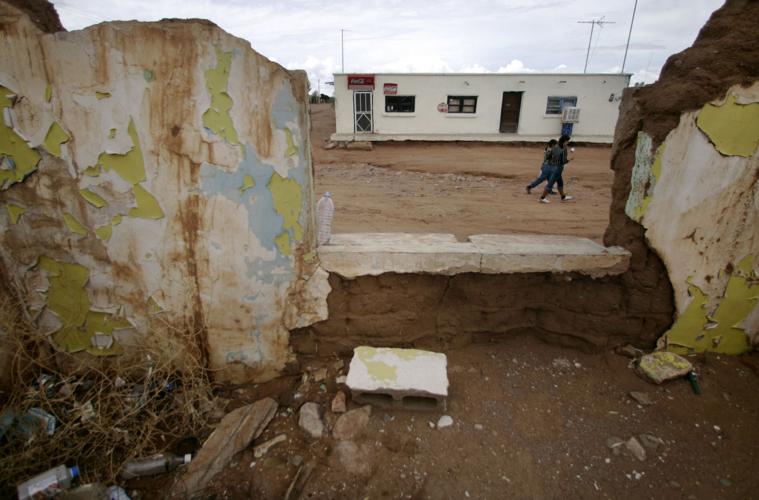
NOWHERE TO HIDE: Passing a crumbling adobe house, two girls walk along a street in the Mexican border town of Las Chepas, where officials razed 31 abandoned buildings last year in an attempt to stem the tide of people who use the town as a hide-out before crossing into the United States.
Last resort to stop crossings
The small mountain that overlooks the Mexican village of Las Chepas offers ideal trails for sneaking into the United States.
Busloads of would-be illegal entrants come daily to the town on an 18-mile dirt road that follows the border from Puerto Palomas, the sister city of Columbus, N.M. They usually stay for a few hours in the dusty, quiet town or in its many abandoned buildings, says Jose Ortiz, 76, a longtime resident. Then they go to the mountains to cross into the United States.
Illegal entrants have always come through Las Chepas, but more so in recent years, Ortiz says. Six months ago, he and his wife counted 506 in one day.
A year ago, officials bulldozed 31 abandoned buildings to try to eliminate hide-outs for people preparing to cross. New Mexico Gov. Bill Richardson and Chihuahua Gov. Jose Reyes Baeza brokered the deal, making national news for the unusual cooperation of governments.
How well it's worked depends on whom you ask.
Apprehensions have fallen in the southern New Mexico corridor near Las Chepas from as many as 300 a day in October 2005 to about 50 a day last summer, says Doug Mosier, a U.S. Border Patrol spokesman for the El Paso Sector, which includes New Mexico.
He attributes the drop to more agents and technology in the area, the presence of the National Guard and a very wet season. The razing may or may not have played into it, he says.

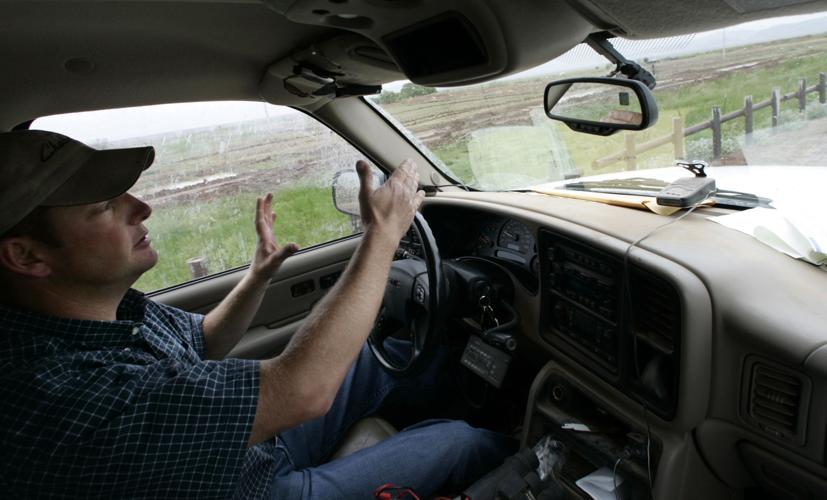
FED UP: New Mexico onion farmer James Johnson, who says illegal entrants steal his water, is tired of outsiders imposing policies that don't work. "You've got to be on the border to understand the border," he says.
But locals on both sides of the border say the same number of entrants are coming through the area. "It wasn't anything more than Bill Richardson's publicity stunt," says James Johnson, who owns a 3,000-acre onion farm across the border from Las Chepas.
Illegal entrants and smugglers still trespass on his farm. He's lost $40,000 since Aug. 1 due to ruined crops, dehydrated and sick cattle, and lost water, which he blames on illegal entrants.
"I'm tired of him sitting up in Santa Fe talking about the border," Johnson says. "You've got to be on the border to understand the border."
The government bulldozed the abandoned buildings closest to the mountains, but there are still enough to make it look like a paintballer's dream. Would-be illegal entrants stay with people who let them in or in remaining abandoned houses, town Sheriff Reydecel Reyes says.
Las Chepas residents, including Ramon Ruiz, 43, who owns one of the three general stores in town, say authorities never asked them their opinions.
"It doesn't seem right. The migrants aren't ours; they are the entire country's," Ruiz says in Spanish. "They shouldn't destroy what is ours."
The National Guard presence slowed traffic in the short term but won't stop it, says Teodoro Martinez, a local politician who owned one of the razed buildings. "As long as the Mexican pueblo is hungry, they are going to look where they can get nourishment," he says.
Old issue gains new steam
The fever pitch that surrounds the illegal immigration debate today traces its roots to several key events in the '90s.
A new wave of illegal immigration began in 1992. By 1994, more than 500,000 were arriving yearly and settling in nontraditional states such as Colorado, North Carolina and Iowa.
In 1993, a shooting at CIA headquarters, a bombing at the World Trade Center and plots to blow up landmarks in New York and California were linked to separate terrorists. One entered with no papers, another with a false passport and the third with a valid visa.
The political reaction began in California, where voters in 1994 approved Proposition 187, which denied social services, health care and public education to illegal immigrants.
The public and political sentiment gained steam throughout the decade. After the 2001 terrorist attacks, the nation focused even more on border security.
The terror threat changed public perception of the border and the way the government patrolled it. U.S. Customs and Border Protection launched a national strategy in 2004 that made preventing the entry of terrorists its top priority. Terrorists could use the same routes as smugglers, the agency says.
"We cannot reduce or eliminate illegal entry by potential terrorists without also dramatically reducing illegal migration," the 2004 plan reads.
Nationwide since Oct. 1, the agency has arrested 416 illegal entrants from countries of "special interest" — 35 nations identified by the U.S. State Department as potential terrorist threats, says Todd Fraser, a Border Patrol spokesman.
Through the same date in fiscal year 2005, the agency had arrested 628. Officials don't break down the numbers for the southern border or say if any had terrorist links, Fraser says.
In the Tucson Sector, 15 illegal entrants from those countries have been arrested since Oct. 1, Border Patrol spokesman Sean King says. Agents apprehended 20 in fiscal year 2005, he says. Officials didn't find links to terrorism for any of the 35.
Beyond terrorists, the public worries about the money spent to educate, medicate and jail illegal entrants, Tancredo says.
"You have communities that have never seen an illegal immigrant before or seen, frankly, an immigrant before," he says. "Now they are seeing their schools inundated, their hospitals overrun and their prison systems housing far more people than should be the case."
There are no definitive studies on the economic gains and losses from illegal immigration, but Arizona schools and hospitals have estimated the impacts.
In 2003, hospitals in the state reported an estimated $152 million in unpaid bills from illegal entrants. And in late 2005, Tom Horne, state superintendent of public instruction, asked Congress for $750 million to cover the cost of educating children who are in Arizona illegally.
But the confluence of terrorism concerns with worries about the economic and social impact of illegal immigration has muddied the issues, says David Spener, a sociologist at Trinity University in San Antonio. And Meyers, the migration analyst, says stopping terrorism and illegal immigration require separate, distinct plans.
It's a complex problem, but politicians often give Americans the simple answer people like to hear, says Neville Cramer, an Immigration and Naturalization Service special agent for 26 years who wrote "Fixing the INSanity: America's Immigration Crisis."
"What the politicians want to do is sum it up in a 30-second sound bite," he says. "And there is no better sound bite than, 'We must secure our borders.' "
Politicians historically have used the issue to their advantage, says Shirk, the political scientist: "It's always been an issue that politicians have been able to manipulate to stoke the fires of nativist outrage."
A few politicians understand the complexity of the immigration issue, says outgoing U.S. Rep. Jim Kolbe, R-Ariz. But they cater to fears, he says.
"They are playing on the fears people have about terrorism, the fears people have about immigration, and the fears people have about their jobs being safe," he says.

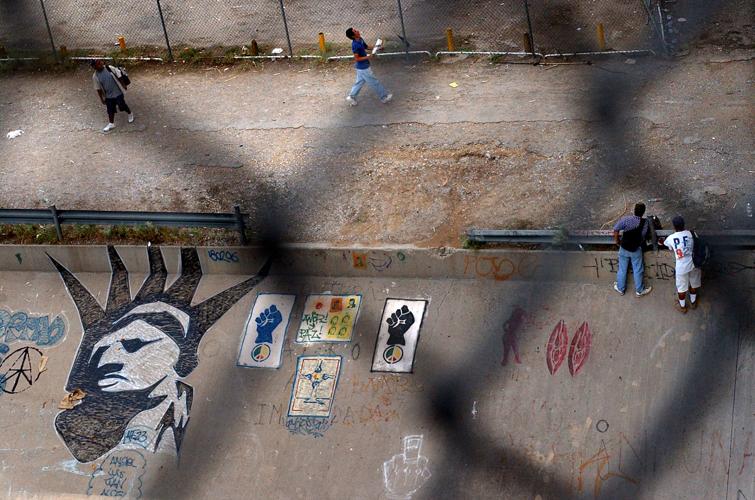
POLITICAL STATEMENTS: Graffiti - some as confrontational as "USA = death and destruction" - run along the Rio Grande in Ciudad Juarez, Mexico. Critics say a border fence would be a slap to the face of a major trading partner.
Wall a "slap" to Mexico
The Great Wall of China, the Berlin Wall and Israel's West Bank barrier had one thing in common: They separated confrontational neighbors.
If the nearly 2,000-mile U.S.-Mexican border were sealed with a combination of fences, cameras and agents, it would be the first of its kind between friendly neighbors and trade partners, Spener says.
"Where movement has been halted is where countries are hostile to one another and have little economic and social interaction," he says.
It would be a slap in the face of the nation's second-largest trading partner, says Kathleen Staudt, a professor of political science at the University of Texas-El Paso who has written books on the border.
"Do we want to humiliate the country by turning it into a type of East Berlin?" she asks.
Most politicians, excluding the president and those on foreign-relations committees, worry more about their constituents, Shirk says.
Tancredo fits that bill. "I couldn't care less what Mexico thinks about my immigration plan for America," he says.
While it appears Congress won't address any major immigration-overhaul bills before it adjourns for the Nov. 7 elections, the 700-mile-fence bill now has a chance of becoming law.
Even if passed, the plan could prove merely symbolic if the government doesn't find the money to pay for it. Congress hasn't devoted enough money to hire 2,000 new Border Patrol agents during the next five years as called for in an intelligence bill passed in 2004. The current bill wouldn't provide enough to cover the fencing, an estimated $2 billion to $5 billion.
About $1 billion for fencing likely will be included in a Department of Homeland Security bill Congress is expected to approve before its scheduled adjournment next week.
"We're famous for sounding like we are going to do something and then not funding it," says Judy Gans, immigration policy program manager at the University of Arizona's Udall Center for Studies in Public Policy.
Someday, though, legislators will have to discuss changes that address not only the border but the estimated 10 million to 12 million illegal immigrants living here, Shirk says.
"When you have 10 million people living in your country without authorization, something has to happen," he says. "Something has to give."