

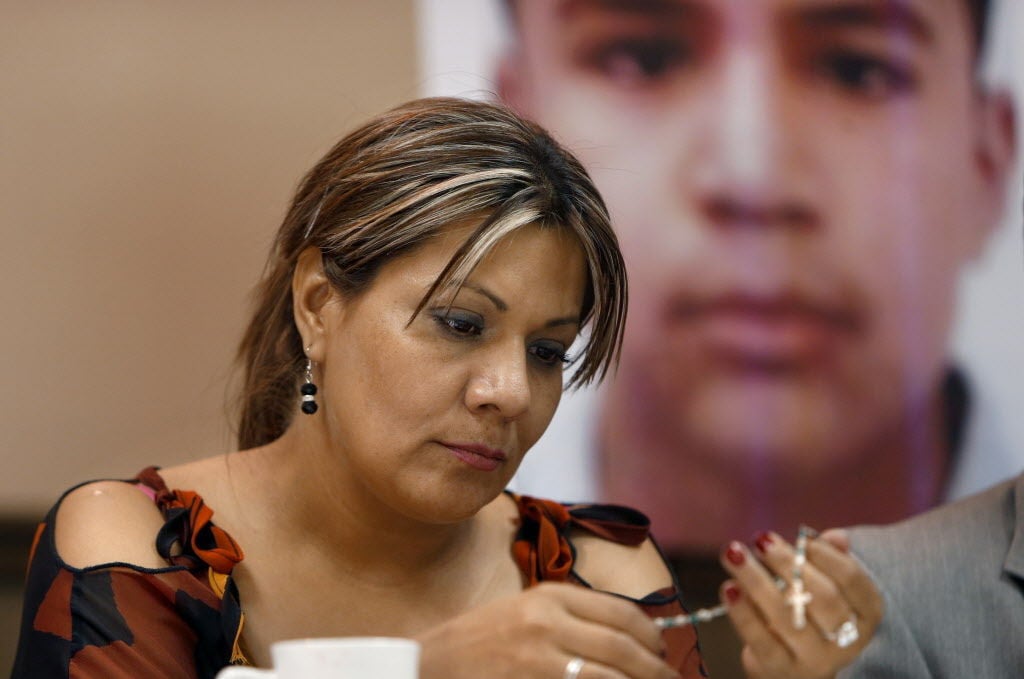
A civil lawsuit from the family of a Mexican teen killed by a Border Patrol agent in a cross-border shooting can proceed, a Tucson federal judge has ruled.
"The court finds that, under the facts alleged in this case, the Mexican national may avail himself to the protections of the Fourth Amendment and that the agent may not assert qualified immunity," U.S. District Judge Raner C. Collins wrote in a 21-page decision Thursday.
On the night of Oct. 10, 2012, Border Patrol agent Lonnie Swartz shot through the border fence into Nogales, Sonora, and hit José Antonio Elena Rodríguez, who was walking across the street and about 30 feet from the fence.
An autopsy report showed the 16-year-old was shot about 10 times, mostly in the back.
The Border Patrol has said Elena Rodríguez was among a group of rock-throwers, but the family's attorneys say he was walking to his nearby home after playing basketball.
Last year, the teen's mother, Araceli Rodríguez, sued the agent, saying Swartz violated the Fourth and Fifth amendments by using "excessive and unjustified" force.
Sean Chapman, representing Swartz, argued in May that the case should be dismissed because Elena Rodríguez was a Mexican national shot on Mexican soil and therefore not protected by the U.S. Constitution.
For the purpose of the motion to dismiss the suit filed by Swartz, Collins had to accept as true the allegations made by the plaintiffs that Elena Rodríguez was simply walking back home.
In determining whether the Fourth Amendment applied, Collins considered, among other factors, Elena Rodriguez's strong family connections — his grandparents, then legal residents and now U.S. citizens, lived in Nogales, Ariz. — and that he and his family lived within Ambos Nogales, "once adjacent cities flowing into one-another, now divided by a fence."
The judge dismissed the Fifth Amendment argument, he said, since the excessive force claim should be looked at under the Fourth Amendment.
He added that Swartz cannot assert qualified immunity when he found out "after-the-fact that he had exerted deadly force upon a noncitizen."
"For over 30 years, law enforcement officers have been well-aware that it is unlawful (and in violation of an individual’s Fourth Amendment rights to be free from unreasonable seizures) to use deadly force against an unarmed suspect to prevent his escape," as established by the Supreme Court, Collins wrote.
Swartz alleged that at the time he shot Elena Rodriguez it was not clearly established whether the Constitution applied extraterritorially to a non-citizen standing on foreign soil.
But Collins said when Swartz shot Elena Rodríguez he was "an American law enforcement officer standing on American soil and well-aware of the limits on the use of deadly force against U.S. citizens and non-citizens alike within the United States."
Luis Parra, one of the attorneys representing the Rodriguez family, said the decision was well thought out.
"It really focused on the factual scenario pertinent to Jose Antonio and his family," he said.
"The decision comes down to the court recognizing well established principles of constitutional rights that state they do not end at the border," he said. And means, “Border Patrol agents cannot continue to shoot Mexican nationals with constitutional impunity and be free from judicial oversight."
During the May hearing both sides cited multiple legal cases, included Supreme Court decisions, to explain why the case should or shouldn't be dismissed.
Chapman had cited a recent decision out of Texas, in which the Fifth Circuit Court of Appeals found that the family of another Mexican teen killed by a Border Patrol agent who shot across the border could not sue the federal government because the Fourth and Fifth amendments cannot apply extraterritorially.
In June 2010, Border Patrol agent Jesús Mesa shot and killed Sergio Hernández Guereca, 15, near a bridge between El Paso and Ciudad Juárez, Chihuahua. Officials said Hernández Guereca was among a group throwing rocks at Mesa as he tried to arrest border crossers.
A three-judge panel said the family could sue Mesa, but the full court overturned the decision in April.
Collins wrote he "respectfully disagreed" with that decision.
"At its heart, this is a case alleging excessive deadly force by a U.S. Border Patrol agent standing on American soil brought before a United States Federal District Court tasked with upholding the United States Constitution," he wrote, "that the deceased was a Mexican national standing on Mexican soil at the time the violation occurred is but one of the many practical considerations and factors the Supreme Court of the United States has ordered the lower courts to consider."
Chapman was not immediately available for comment, but in May both sides had indicated that an unfavorable decision by the judge would be appealed.

