


Economists at the University of Arizona cite government, education and health-care sectors as Tucson’s strong points in the face of a possible national recession. But they also say the current political uncertainty at the federal level, about tariffs and government funding cuts, is bound to have an adverse impact.
George Hammond, director and research professor at the UA’s Eller College of Management, said he is seeing forecasts of a 35-40% chance of a U.S. downturn probably towards the end of 2025, and that it could mean a moderate recession, not as severe as the country faced during the COVID-19 pandemic.
“While we do face some serious headwinds caused by macroeconomic policy uncertainty and tariffs, the labor market has been healthy, income and consumer spending has been solid,” Hammond said.
“I expect health services jobs to continue to grow, even if there’s a recession,” he said. “Since Tucson has a slightly higher (employment) share in that sector, it should also help stabilize Tucson a bit more than the U.S.”

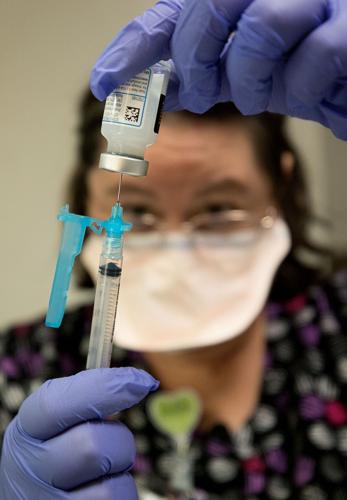
“I expect health services jobs to continue to grow, even if there’s a recession,” said UA economist George Hammond. “Since Tucson has a slightly higher (employment) share in that sector, it should also help stabilize Tucson a bit more than the U.S.” In this 2021 photo, Heather Aplas, a licensed practical nurse with El Rio Community Health, fills a syringe with the Moderna vaccine.
According to data from Making Action Possible for Southern Arizona, Tucson’s employment share in private education and health services is 17.5%, in comparison to the U.S. share of 16.6%. “It’s really health care that’s been adding the most jobs these days, and that does tend to be the most resilient,” said Hammond.
Tucson’s biggest employment share also lies in government jobs at 19.5%, and since the government is considered to be more of a recession-proof sector, this bodes well for the Tucson region, according to Eller economists.
“The big differences in employment mix, however, are in government and professional and business services,” Hammond wrote to the Arizona Daily Star last week. “Government tends not to be associated with recessions, but professional and business services tends to be quite sensitive to the business cycle (recessions). It is good from a stability perspective that this sector is a much smaller share of Tucson’s job mix (at 10.8%).”
Mark Stegeman, an associate professor of economics at the Eller College, said the Tucson economy has an “unusual amount” of military and government spending support, which usually doesn’t change much in an ordinary recession.
However, Stegeman noted, in the face of current cuts in federal government spending, there is going to be a negative impact regardless of a recession.
In terms of sectors sensitive to the business cycle and recession-like circumstances, Hammond pointed to Tucson’s manufacturing sector, which has an employment share in Tucson of 7.1%.
“Tucson has a smaller share of jobs in manufacturing than the U.S. and the jobs we have are concentrated in aerospace and defense, which is more dependent on U.S. defense spending than interest rates or growth in private sector demand,” he said. “We’ll have to wait and see if federal spending cuts hit defense.”

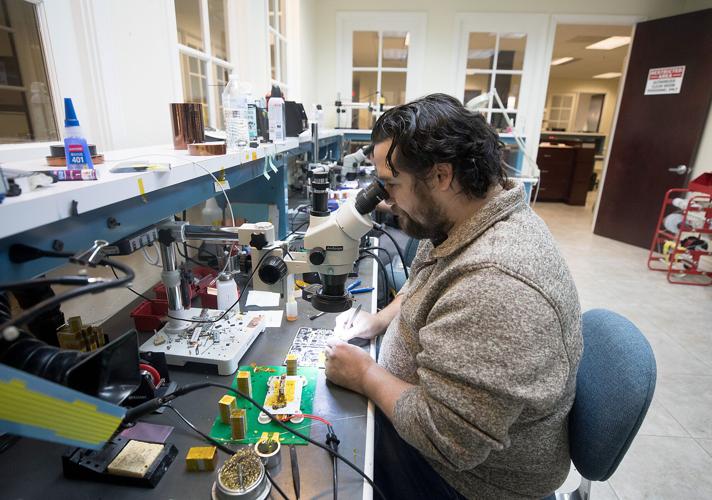
A lab manager at Electronic Design & Development Corp. (ED2) in Tucson works on a transmitter board. “Tucson has a smaller share of jobs in manufacturing than the U.S. and the jobs we have are concentrated in aerospace and defense, which is more dependent on U.S. defense spending than interest rates or growth in private sector demand,” said UA economist George Hammond. “We’ll have to wait and see if federal spending cuts hit defense.”
Stegeman said tourism and construction are two sectors sensitive to a recession, points also emphasized by Evan Taylor, an associate professor of economics at the Eller College.
Taylor said restaurants, hotels and tourism in general would possibly suffer the most in comparison to industries like health care and education. Generally, people will spend less money on travel and dining out when the economy is in recession, whereas people still need health care and education even in recession, so those tend to suffer less, he said.

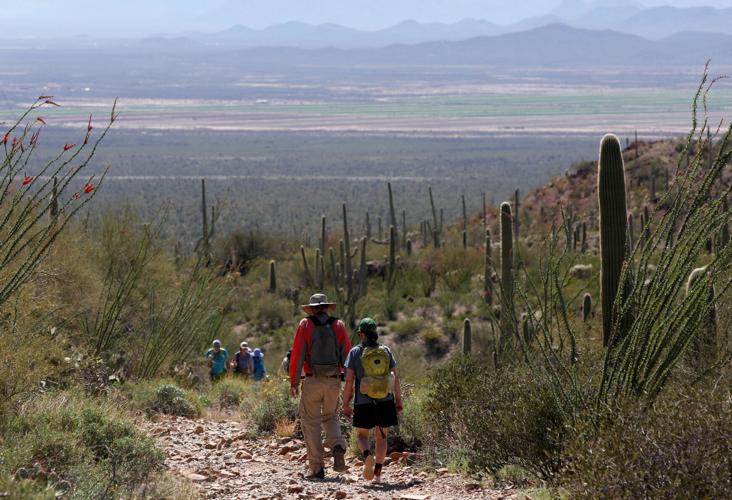
Tourism in general, including restaurants and hotels, would possibly suffer the most in case of a national recession, in comparison to industries like health care and education, said UA economist Evan Taylor. In this photo, people hike King Canyon Trail in Saguaro National Park West.
“On the negative side, Tucson has a slightly higher poverty rate than the rest of the nation,” said Taylor. “Social services would likely be strained in Tucson more relative to the rest of the country. Tucson’s labor force has slightly lower rates of college education, and workers with lower levels of education tend to do relatively worse in recessions.”
According to Hammond, a national recession would adversely impact the Tucson region, but the intensity of the impact would depend on how big the national recession is and what drives the recession. He said Tucson would be less responsive to a U.S. downturn than a city like Phoenix, which has a larger share of professional and business services, a smaller share of government, and a smaller share of private education and health services.
“Right now, the national scenarios that include a recession are envisioning that the primary driver of a U.S. recession would be the significantly increased policy uncertainty at the federal level,” Hammond told the Star in an interview.”Going back and forth on tariffs; causing businesses to hold off on investment plans. … Policy uncertainty is one cause.”
Of President Donald Trump’s enacted and threatened international tariffs, “Tucson would be impacted by each of those, but Tucson is particularly vulnerable to federal (government cuts) compared to the rest of the state,” said Hammond. There are “about 13,000 federal jobs in the Tucson metropolitan area — that’s about 3.3% of all of our jobs.”
Tucson’s fairly large government sector — because of federal activities, military activity, and the University of Arizona — keeps it insulated from a national recession, he said. He listed federal civilian jobs with agencies such as Homeland Security, the Justice Department and Veterans Affairs.
An additional advantage for the Tucson region is it is an attractive place to live, with people wanting to move here due to its relatively low cost of living, especially from major metropolitan areas like Southern California, said Hammond. So in case of a moderate recession, the population will continue to rise and help stabilize the Tucson economy, he expects.
Stegeman agreed the economy in Tucson is more recession-resistant than many other places, just because a lot of the economic activity isn’t particularly driven by the business cycle — health care, education, military.
Over the last 20 years, Tucson’s unemployment rate is almost always within a percentage of the national unemployment rate — Tucson’s current unemployment rate is 4.0% compared to 4.2% nationally, Taylor said last week.
Under normal circumstances, the way UA operates tends to insulate the Tucson region in the event of a national recession, said Hammond. However, in the current political climate where the Trump administration is cutting research funding for the UA, this may not hold true.
Unless the university finds a way to reinstate steady sources of funding for employment and activities that support the broader Tucson economy, the UA will not be able to protect the Tucson region from a national recession, the Eller economists said.

