


If your Tucson Electric Power bill is shockingly high this summer, it might be worth looking at switching to a rate that rewards you for shifting your power usage.
The vast majority of TEP’s residential customers are on the company’s basic rate plan, which features a $13 monthly service charge plus tiered, usage-based summer and winter rates.
But the company also offers rate plans that can save customers money if they can apply a little discipline to when they consume power, limit their monthly power demand peaks, or both:
TEP’s residential Time-of-Use (TOU) plan offers a lower monthly service charge of $10 and discounts for using power during off-peak hours. For example, the usage-based energy charge during the summer on-peak hours of 3 to 7 p.m. weekdays is just over 14 cents for the first 500 kilowatt-hours of usage, but that drops to about 10.6 cents during off-peak hours on weekdays, and all weekends and major holidays.
The company’s Peak Demand rate plan features much lower energy usage rates but include a monthly “demand charge” based on a customer’s highest single hour of demand during on-peak hours for each billing period. For example, energy charges on the plan are about 7 cents per kWh, but the demand charge costs $10.18 per kilowatt (not kilowatt-hours) of peak demand, so a peak demand reading of 5 kW would result in a demand charge of just over $50.
TEP’s Demand TOU plan combines elements of both lower usage-based rates for off-peak hours with a monthly demand charge.
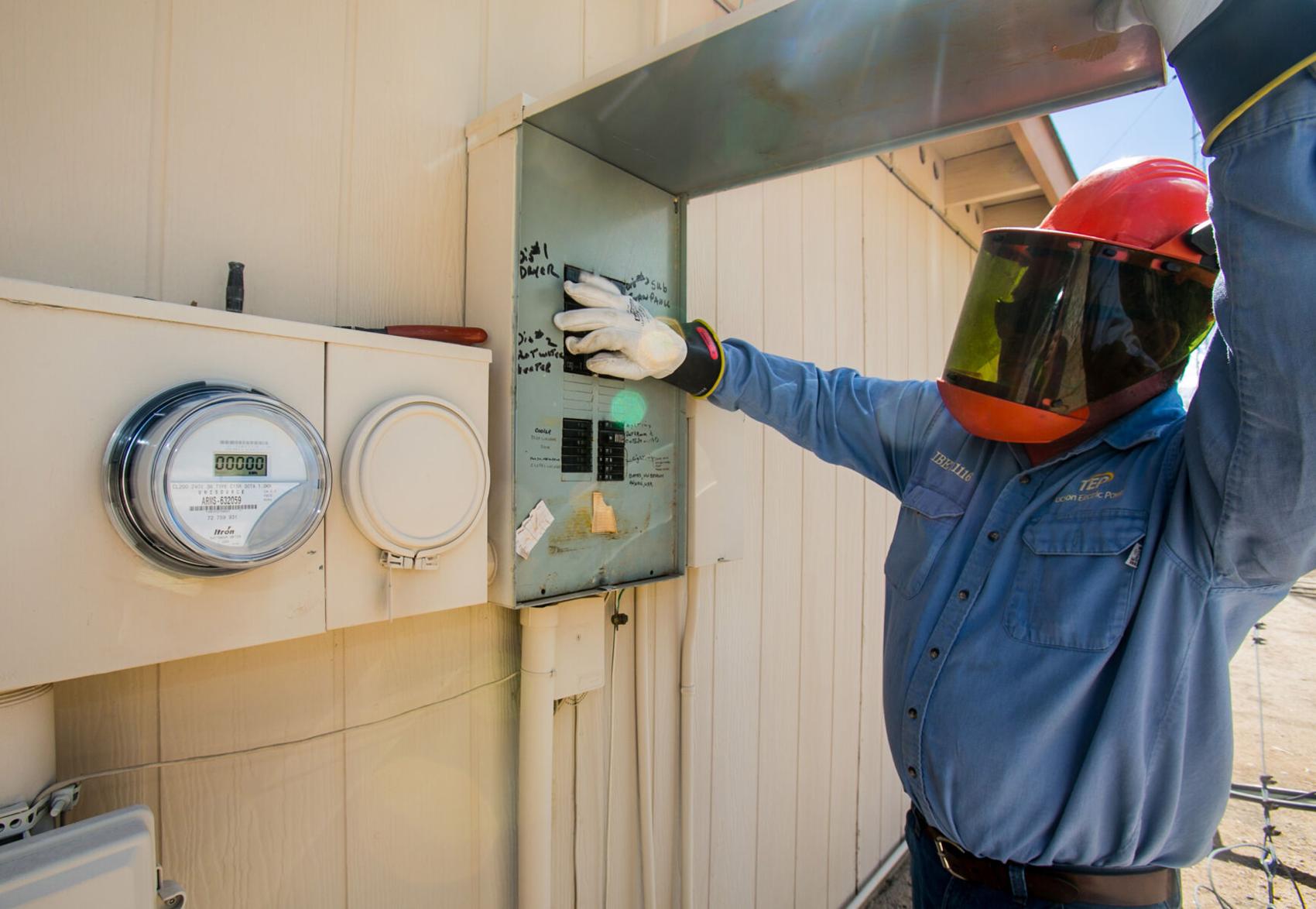
A Tucson Electric Power technician turns on the power to a home after installing a new meter to work with TEP’s Time of Use rate plan.
Besides the summer peak hours, TEP’s time-of-use and demand rates also include winter peak hours of 6-9 a.m. and 6-9 p.m. weekdays, excluding major holidays, and all carry a $10 monthly basic service charge.
TEP, which serves about 400,000 residential customers and 42,000 business accounts, also offers several TOU and demand rates to business customers.
Shaving the peak
TEP spokesman Joe Barrios said time-of-use pricing plans offer benefits beyond potential money savings for customers and the company’s power grid.
“For both TEP and our customers, shifting use to off-peak hours supports reliable electric service for everyone,” he said. “It reduces the pressure on our local energy grid, especially during the summer, reducing the threat of energy supply shortages.”
TEP also pays more for supplemental energy it buys to meet customer demand during peak summertime hours, Barrios noted.
TEP customers last month began paying an average of about $10 per month more due to an increase in a surcharge that covers excess costs for fuel and purchased wholesale power. TEP does not make a profit on the pass-through charge.
In a general rate case pending before the Arizona Corporation Commission, TEP is seeking a 12% rate increase that would boost the average home bill by $14 per month starting in September, though regulators have proposed cutting that to about $4 monthly.
Shifting your power usage to certain off-peak hours also can make good use of the company’s clean energy resources, Barrios noted.
“For example, by using more energy in the morning and early afternoon when solar arrays are most productive, more of the energy they use comes from the sun,” he said.
Fostering tech
TEP, with state regulators’ approval, also is using new rate plans to help foster adoption of rooftop solar, home energy storage and electric vehicles.
In 2021, TEP began offering a Residential Demand Time-of-Use Tech, or R-Tech, rate that offers time-of-use and demand rates to customers with combinations of qualifying technologies, including photovoltaic systems, battery storage and EVs, as well as variable-speed motors on pool pumps and air-conditioning units, grid-connected electric water heaters and automated load controllers.
Barrios said TEP is looking to restructure its R-Tech rate offering to better meets customers’ needs as part of its pending general rate case.
“The rate was intended to incentivize the adoption of specific technologies,” he said. “What we’ve seen are customers investing in solar, electric vehicles and storage while participating in our other pricing plans and using other incentives available to them.”
One of those other plans is TEP’s new Super Off-Peak TOU rate and Demand Super Off-Peak rate plan for owners of plug-in electric vehicles, offering low usage rates for power usage between 10 p.m. and 5 a.m. daily to encourage overnight EV charging.
At the end of June, 360 TEP residential customers were on the Super Off-Peak plan, and 114 EV owners were on the Demand Super Off-Peak plan, Barrios said.
Growing options
TOU and demand rates have been around for decades, though demand rates in particular have been used mainly by commercial and industrial customers.
About half of investor-owned utilities offered time-of-use or some other “time-varying” rates in 2019, according to The Brattle Group, a Boston-based consulting firm.
Overall, about 53,000 or 13% of TEP’s residential customers are on one if its TOU or demand rates, up from about 4% in 2017, according to TEP.
TEP customers with interconnected rooftop solar systems must choose among TOU plans.
The Brattle study cited Arizona Public Service Co. as a leader in residential TOU rate adoption, with 51% of its residential customers on such rate plans.
Only about 4.5% of all U.S. residential customers are enrolled on one of those time‐varying rates, but that is expected to rise to 15% by 2025, Brattle said in a follow-up study in 2021.
Doing homework
Consumer advocates say ratepayers can save money on time-of-use and demand rates, but they must be careful to understand their plan and alter their energy use to avoid big bills.
Low-income and fixed-income ratepayers also are typically less able to alter their energy usage to take advantage of time-of-use rates, they say.
Giving customers access to accurate rate information is critical, as APS found out.
After a major rate increase and rollout of all-new home rate plans in 2017, APS was hit with complaints that the company steered customers to rate plans that were more expensive than other plans, including a flawed online rate-comparison tool.
In 2021, APS reached a $24 million settlement with the Attorney General to reimburse more than 200,000 customers about $99 each for excess costs if they weren’t on the best plan, while about 15,000 customers steered to costlier plans also got $25 payments for their inconvenience.
TEP posts detailed information on its website about each of its rates at tep.com/rates, and company representatives are always available to answer questions by phone at 520-623-7711, Barrios said.
TEP has an online rate-comparison tool, the Price Planner (tep.com/compare-pricing-plans), that reviews each customers’ actual usage over 12 months to determine which pricing plan is right for them, he said, noting that the utility checks the results of the planner quarterly to assure the results are “accurate and instructive.”
Barrios said the company hasn’t conducted any studies of average savings on its TOU and demand rate plans.
“It really depends on the customer,” he said. “Time-of-use and demand rates offer terrific opportunities for many customers to save money, but they aren’t a good fit for everyone. Typically, customers who have some flexibility in their schedule to change how and when they use energy may benefit by moving to a time-of-use or demand plan.”
An analysis Brattle conducted in 2020 for major power companies in Maryland found that TOU customers reduced their summer peak demand in the range of 10% to 14% and experienced bill savings of up to 10%.
TEP’s sister rural utility serving Santa Cruz and Mohave counties, UNS Electric, offers TOU and demand rates similar to TEP’s.
New TOUs for Trico
Trico Electric Cooperative, which serves about 46,000 members in communities surrounding Tucson, doesn’t currently offer a TOU rate after it stopped offering such rates several years ago.
But Trico is developing several experimental time-of-use options and expects to file for approval of the rates with the Arizona Corporation Commission in the next few months, spokeswoman Roberta Lopez-Suter said.
The nonprofit co-op recently launched an experimental electric-vehicle time-of-use rate that offers a 45% discount on up to 400 kWh of charging between 10 p.m. and 5 a.m., Lopez-Suter noted.
Beyond TOU
Interest also is growing in so-called demand-response programs, which offer customers an financial incentive to allow their utility to adjust their smart thermostats to conserve power during critical demand peaks, for example.
TEP has a new pilot program offering customers an initial $50 MasterCard e-gift card for each smart thermostat (up to two) they enroll if they agree to allow their thermostat provider to make small, temporary automatic adjustments to their thermostats during peak energy demand June through September.
Customers will get another $40 e-gift card per thermostat if they stay enrolled at the end of the season.
TEP also has a program for commercial customers offering quarterly bill credits if they agree to cut their power usage when asked during times of peak power demand.

