



Arizona’s economy is chugging along with solid gains in jobs, income and sales this year, but it is expected to slow along with the national economy next year, University of Arizona economists say.
“Overall, Arizona is well positioned to grow next year, but at a reduced pace,” George Hammond, director of the UA’s Economic and Business Research Center and research professor in economics, said in the center’s latest economic outlook unveiled Friday at a luncheon event at the Westin La Paloma Resort & Spa.
A major bank economist told a packed crowd of about 500 at the event he expects the nation to fall in to a mild recession in mid-2024.
“I do think the most likely outcome is we get a mild recession starting in the middle of 2024,” said Gus Faucher, chief economist for Pittsburgh-based PNC Bank.
But Hammond said Arizona and Tucson are in a good position to continue slow but steady economic growth amid a mild nationwide recession.
The UA center’s baseline outlook calls for Arizona job growth to slow as past interest-rate increases reduce national employment gains.
The state’s population growth also is projected to slow as net migration returns to more normal levels after a pandemic-driven surge, and sales growth is expected to decline as consumers react to slowing job growth and higher interest rates, Hammond said.
Slowing jobs
Job growth has already slowed significantly across Arizona and the nation this year, the UA economist said.
Over the year in October, Arizona added 51,100 jobs for a 1.6% increase, while the U.S. saw an increase of 1.9%.
Phoenix metro-area jobs were up 1.7% in October, and Tucson jobs were up 1.1%.
The latest UA forecast calls for the number of Arizona jobs to rise by 2.2% in 2023 on an annual average basis, with the growth rate falling to 1.9% in 2024 and to 1.8% in 2025.
While Arizona’s job growth will be close to the U.S. rate in 2023, the forecasted growth in 2024 and 2025 is well above what is expected nationally, Hammond noted.
Job growth in the Tucson area is expected to drop from 3.2% in 2022 to 1.6% this year and to 1.5% in 2024.
Statewide employment growth will be buoyed somewhat by Phoenix, which saw growth of 4.4% in 2022 and is forecast to grow 2.4% in 2023 and 2.2% in 2024, according to the UA outlook.
Through October, jobs in almost all major industry sectors of the state were above February 2020 levels, with the exception of the information sector, Hammond noted.

In the front lobby of Hotel McCoy, 720 W. Silverlake Road, guests can check in and enjoy a drink at the bar. In Tucson, leisure and hospitality remained below its February 2020 peak employment levels.
Information lags
Employment in information industries, including book and software publishing, internet service providers, telecommunications and data processing, grew rapidly to top pre-pandemic levels nationwide by mid-2022 but has trended downward since, U.S. Bureau of Labor Statistics data show.
In Tucson, leisure and hospitality, professional and business services, private educational and health services, and information remained below their February 2020 peak employment levels.
In the Phoenix area, the government, “other services,” and information sectors were below pre-pandemic levels.
Meanwhile, Hammond said Arizona’s tight job market shows signs of softening.
Arizona’s seasonally-adjusted unemployment rate ticked up to 4.2% in October, from 4.0% in September and 3.4% in April and May, and modestly above the U.S. at 3.9%.
Arizona’s quit and hire rates — the rates at which people leave their jobs and are hired — have been trending down this year, Hammond said, citing raw data suggesting that those rates are back to pre-pandemic levels.
Housing run-up
A run-up in home prices has moderated in the Phoenix area but is reducing affordability and tamping down demand for new homes statewide.
And in contrast to Phoenix, the median home price in Tucson has increased since mid-2022, Hammond noted.
The median house price in Phoenix was $468,000 in October, up 0.6% over the year but down 8.2% from its recent peak of $510,000 in May 2022.
The median home price in Tucson was $379,500 in October, down from $381,000 in May but up 5.4% over the year.
Meanwhile, rent remained well above pre-pandemic levels, especially in Tucson, the UA economist noted.
Over the year in October, the median monthly rent cost was up 2.0% in Tucson, at $1,359, while rent was down 1.2% nationally at $1,354, and Phoenix rent was down 4.3% to $1,547.
Housing pinch
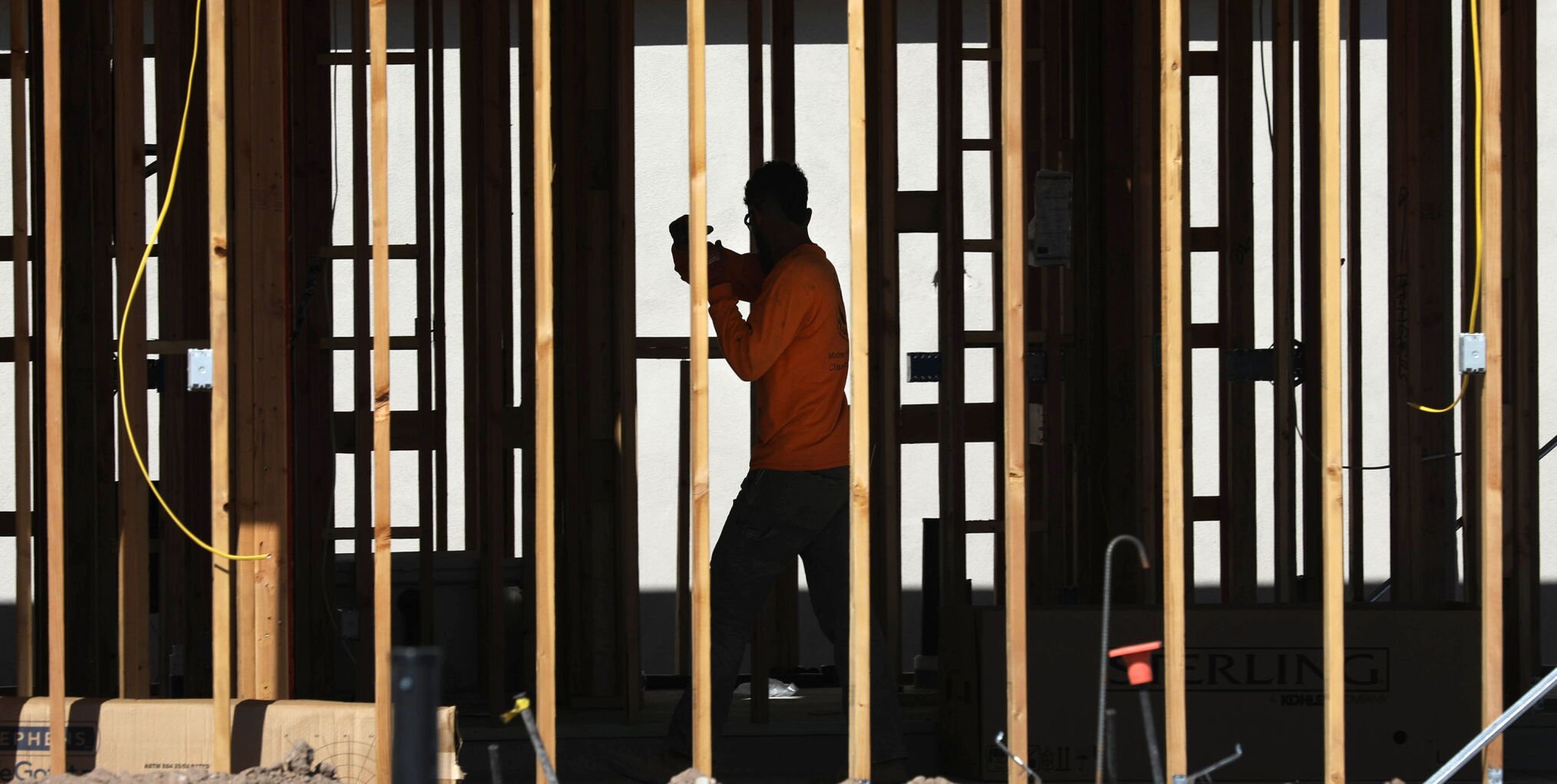
Slowing population gains as well as significantly reduced housing affordability will weigh on homebuilding through 2024, the UA outlook says.
For the third quarter of 2023, 37.4% of the homes sold were affordable for a family making the median income nationally, down from 63.2% in the last quarter of 2019, according to data from the National Association of Home Builders and Wells Fargo cited by the UA.
The drop was bigger in Phoenix, where 24.9% of homes sold were deemed affordable last quarter, down from 64.9% in 2019, and in Tucson, where 33.8% of homes sold were affordable, down from 71.2% pre-pandemic in 2019.
Housing permits are on track to drop about 11% this year, from 60,994 in 2022 to 54,468, and fall again in 2024 to 44,260.
Phoenix housing permits declined 8.9% over the year through October, with single-family activity down 12.0% and multi-family activity down 4.4%.
The situation was similar in Tucson, with total permits down 11.1%, single-family permits down 4.6% and multi-family permits down 24.3%.
People and money
The latest UA outlook forecasts that Arizona’s population growth will slow from 1.7% in 2022 to 1.4% in 2023 and 1.2% in 2024 as net migration falls from its pandemic surge.
Hammond said the aging of the baby boom generation weighs on the natural increase — births minus deaths — which leaves net migration as the major source of population gains.
Personal income growth is forecast to accelerate in 2023 to 6.0% over the year, up from 4.9% in 2022. Growth slows modestly in 2024, reflecting softer gains in dividends, interest, and rent, as well as transfer income, according to the UA outlook.
For the complete UA outlook, go to tucne.ws/outlook.
National outlook
PNC's Faucher said the U.S. economy seems strong now, with low unemployment, sustained job and wage growth and economic output that has outstripped pre-pandemic levels.
PNC’s own semi-annual survey of small businesses in the third quarter showed that 75% of small business owners were “strongly optimistic” about their company’s prospects over the next six months, Faucher noted.
But higher interest rates and a global economic slowdown will likely lead to a mild recession in the middle of next year as higher interest rates crimp off spending and investment, he said.
Faucher noted that long-term U.S. Treasury debt instruments like 30-year bonds normally carry higher yields than short-term instruments. But that so-called yield curve has been inverted since mid-2022 — with short-term debt higher than long-term debt with the same risk profile — and historically, such an inverted yield curve has always preceded a recession, he said.
Slow economic growth in China, which was expected to recover from COVID-19 much more quickly, will also weigh on the world economy, he said.
“We do see that they have taken some measures recently to implement stimulus in China, but we expected China to be the big driver of global economic growth in 2023 and 2024,” Faucher said.
Globally, central banks in Canada, the United Kingdom and the Euro zone have also raised interest rates to cool down their economies and also will see the impact of higher rates and possible recession.
“We do have a global economy that is at risk of recession as we enter into 2024, but there are some very big positives for the U.S. economy at the end of this year,” Faucher said.
Based on gross domestic product and various other measures, economic activity in the U.S. economy is now 5% to 7% higher than before the pandemic, after contracting between 7% and 9% between late 2019 and the second quarter of 2020 as much of the economy shut down, Faucher said.
The PNC economist said he believes that with inflation moderating, the Federal Reserve is done raising interest rates and will be looking to cut rates next year.
“I think that given slowing inflation to be expected (and the) softening in the economy, the Fed will not raise that fed funds rate anymore,” Faucher said. “And then I think once it becomes apparent that the economy is slowing down and inflation is moving decisively towards the 2% (annual inflation) objective, they start to cut rates in the middle of 2024 and that supports an economic recovery beginning toward the end of next year or the beginning of 2025.”

