

Photos: OSIRIS-REx Mission
- Updated
The joint University of Arizona/NASA mission to send a spacecraft to gather samples from asteroid Bennu and return to the Earth for study.
Asteroid Chase
- Craig Rubadoux / Florida Today
- Updated
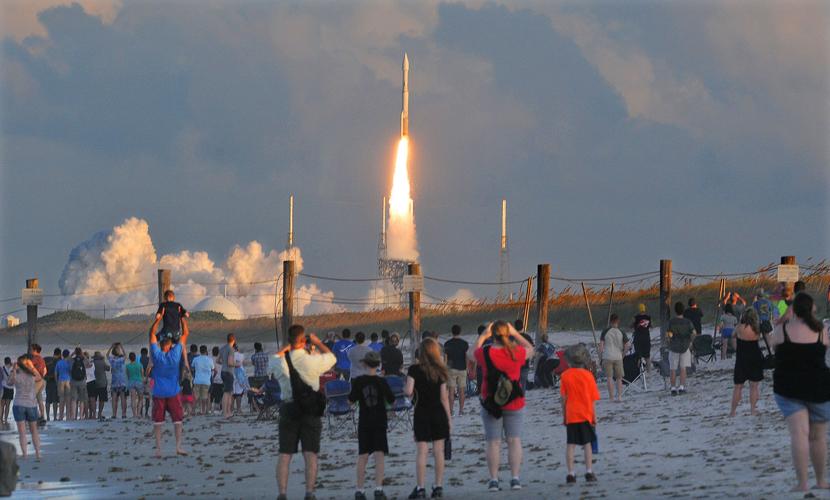
Hundreds of people pack the Canaveral National Seashore in Cape Canaveral, Fla., Thursday, Sept. 8, 2016, to witness the launch of a United Launch Alliance Atlas V rocket as it lights up the sky during liftoff from Launch Complex 41 at the Cape Canaveral Air Force Station on the OSIRIS-REx mission,NASA first asteroid sample return mission.

OSIRIS-REx Mission
- Kelly Presnell / Arizona Daily Star
- Updated
Seven year-old Claire Meador and her aunt Korie Birkholz celebrate along with the several hundred others gathered on the University of Arizona mall to watch the successful launch of the OSIRIS-REx mission, Thursday, Sept. 8, 2016, Tucson, Ariz. Kelly Presnell / Arizona Daily Star
OSIRIS-REx Mission
- Kelly Presnell / Arizona Daily Star 2016
- Updated
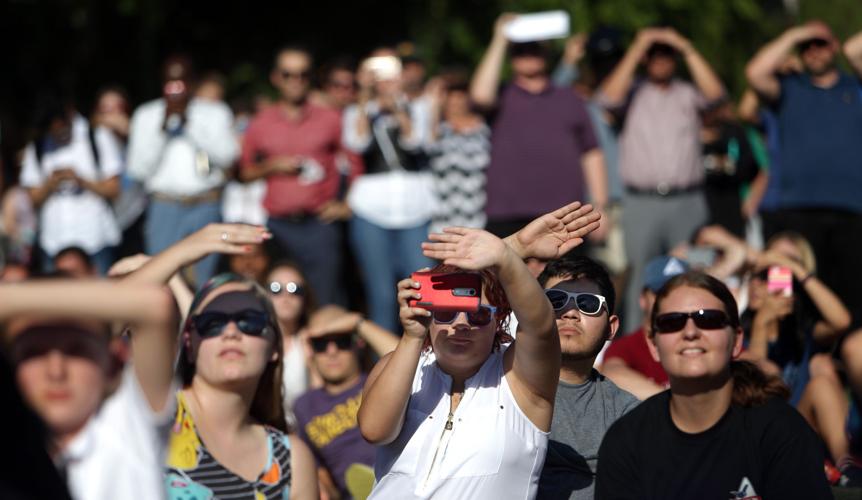
Many of the several hundred gathered on the University of Arizona mall to watch the launch of the OSIRIS-REx mission fight the sun to see the big screen showing the liftoff, Thursday, Sept. 8, 2016, Tucson, Ariz. Kelly Presnell / Arizona Daily Star
Asteroid Chase
- Joel Kowsky / NASA
- Updated
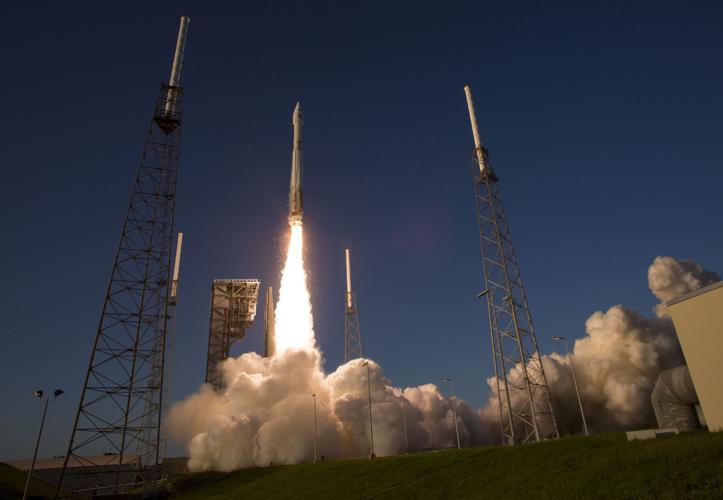
A United Launch Alliance Atlas V rocket carrying the Origins, Spectral Interpretation, Resource Identification, Security-Regolith Explorer (OSIRIS-REx) spacecraft lifts off from launch complex 41 at the Cape Canaveral Air Force Station, Thursday, Sept. 8, 2016, in Cape Canaveral, Fla. Osiris-Rex will travel to asteroid Bennu, collect ground samples, then haul them back to Earth. (Joel Kowsky/NASA via AP)
ATLAS V ROCKET LAUNCH
- Craig Rubadoux / Florida Today
- Updated
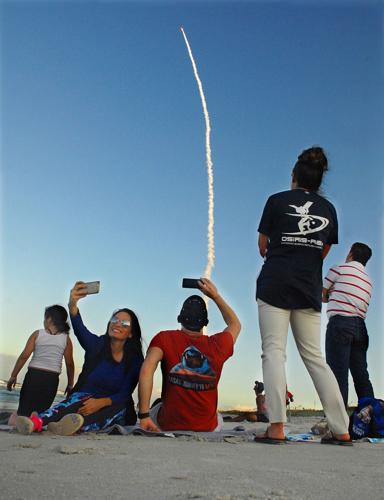
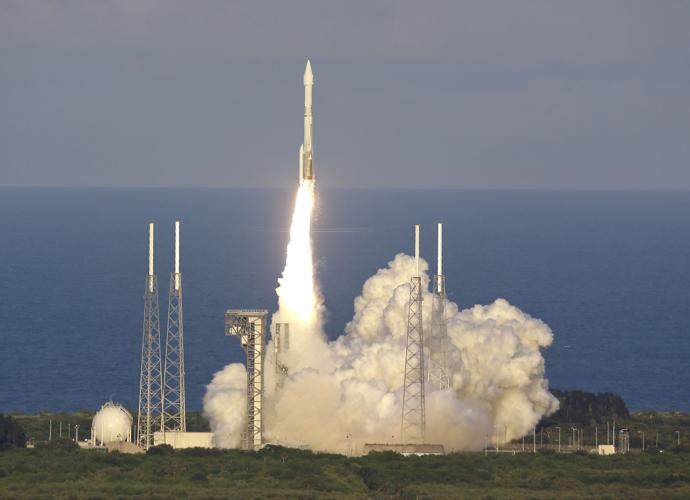
Hundreds of people pack the Canaveral National Seashore in Cape Canaveral, Fla., Thursday, Sept. 8, 2016, to witness the launch of a United Launch Alliance Atlas V rocket as it lights up the sky during liftoff from Launch Complex 41 at the Cape Canaveral Air Force Station on the OSIRIS-REx mission,NASA first asteroid sample return mission. (Craig Rubadoux/Florida Today via AP)
OSIRIS-REx Mission
- John Raoux
- Updated
A United Launch Alliance Atlas V rocket carrying the Origins, Spectral Interpretation, Resource Identification, Security-Regolith Explorer (OSIRIS-REx) spacecraft lifts off from launch complex 41 at the Cape Canaveral Air Force Station, Thursday, Sept. 8, 2016, in Cape Canaveral, Fla. Osiris-Rex will travel to asteroid Bennu, collect ground samples, then haul them back to Earth. (AP Photo/John Raoux)
OSIRIS-REx Mission
- John Raoux
- Updated
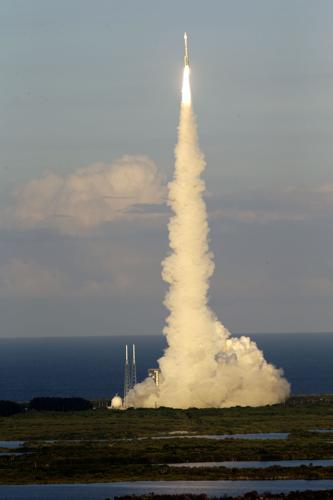
A United Launch Alliance Atlas V rocket carrying the Origins, Spectral Interpretation, Resource Identification, Security-Regolith Explorer (OSIRIS-REx) spacecraft lifts off from launch complex 41 at the Cape Canaveral Air Force Station, Thursday, Sept. 8, 2016, in Cape Canaveral, Fla. Osiris-Rex will travel to asteroid Bennu, collect ground samples, then haul them back to Earth. (AP Photo/John Raoux)

OSIRIS-REx Mission
- John Raoux
- Updated
A United Launch Alliance Atlas V rocket carrying the Origins, Spectral Interpretation, Resource Identification, Security-Regolith Explorer (OSIRIS-REx) spacecraft lifts off from launch complex 41 at the Cape Canaveral Air Force Station, Thursday, Sept. 8, 2016, in Cape Canaveral, Fla. Osiris-Rex will travel to asteroid Bennu, collect ground samples, then haul them back to Earth. (AP Photo/John Raoux)
Space Asteroid Chase
- Kim Shiflett
- Updated
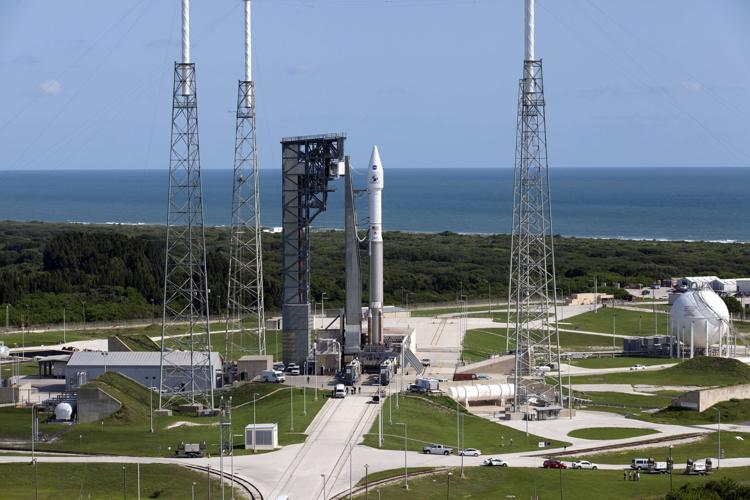
In this Wednesday, Sept. 7, 2016 photo made available by NASA, a United Launch Alliance Atlas V rocket, carrying NASA's OSIRIS-REx spacecraft, is brought to its launchpad at Cape Canaveral Air Force Station in Florida. The mission, scheduled to launch on Thursday, Sept. 8, is the first U.S. attempt to reach an asteroid return a sample to Earth for study. (Kim Shiflett/NASA via AP)

OSIRIS-REx
- HOGP
- Updated
This artist's rendering made available by NASA in July 2016 shows the mapping of the near-Earth asteroid Bennu by the OSIRIS-REx spacecraft. The spacecraft will spend a year surveying Bennu before collecting a sample that will be returned to Earth for analysis. (NASA/Goddard/University of Arizona via AP)
OSIRIS-REx
- Rebecca Marie Sasnett / for the Arizona Daily Star
- Updated
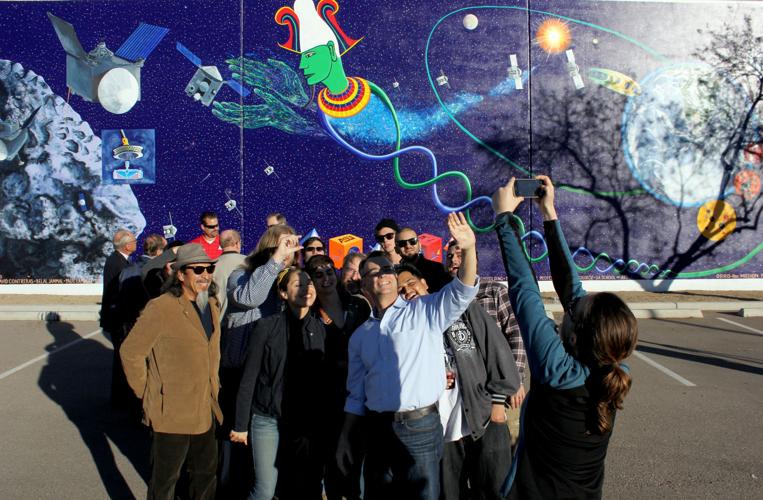
Alessondra Springmann (left), graduate researcher for the OSIRIS-REx mission, helps Dante Lauretta (center), principal investigator of OSIRIS-REx mission, take a "selfie" with the student artists and art professor during the showcase of the 20-by-60-foot mural painted by University of Arizona art students to celebrate OSIRIS-REx, NASA's $1 billion mission led by UA, outside of Michael J. Drake Building, 1415 N. Sixth Avenue, on Thursday, Jan. 22, 2015. The mission will send a spacecraft to Bennu, an asteroid close to earth, to pick up a sample, close to the size of a golfball, to help scientists better understand the solar system, asteroids and how life began. The launch date for the spacecraft OSIRIS-REx is expected for late 2016. Photo taken on Thursday, Jan. 22, 2015. Photo by Rebecca Marie Sasnett / for the Arizona Daily Star
OSIRIS-REx
- Malcolm Denemark
- Updated
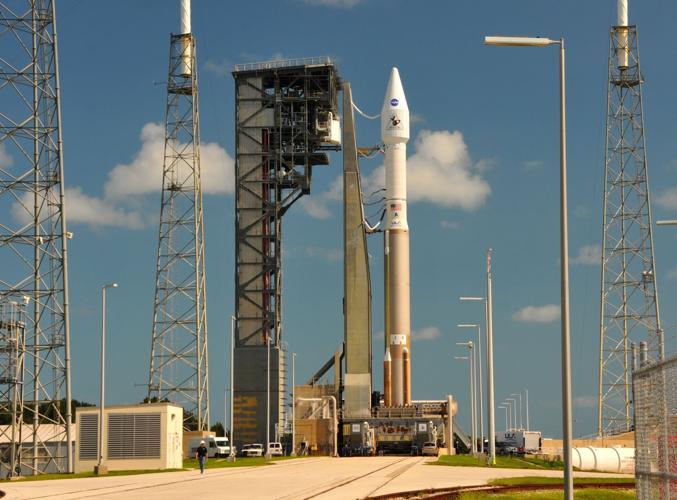
NASA's OSIRIS-REx sits on a launch pad Wednesday, Sept. 7, 2016, before a planned 7:05 p.m. Thursday blastoff from Cape Canaveral Air Force Station in Florida. A United Launch Alliance Atlas V rocket carrying the $800 million mission's spacecraft rolled on a transporter from a processing tower to the pad at Launch Complex 41 Wednesday morning, completing the quarter-mile move in less than an hour. (Malcolm Denemark/Florida Today via AP)
OSIRIS-REx
- Tim Shortt
- Updated
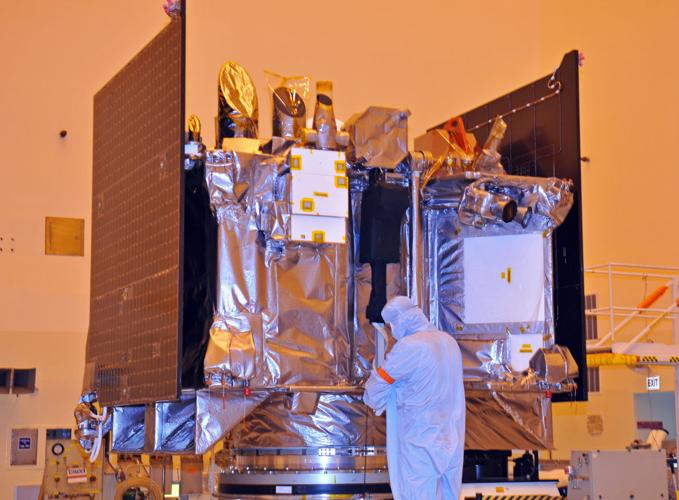
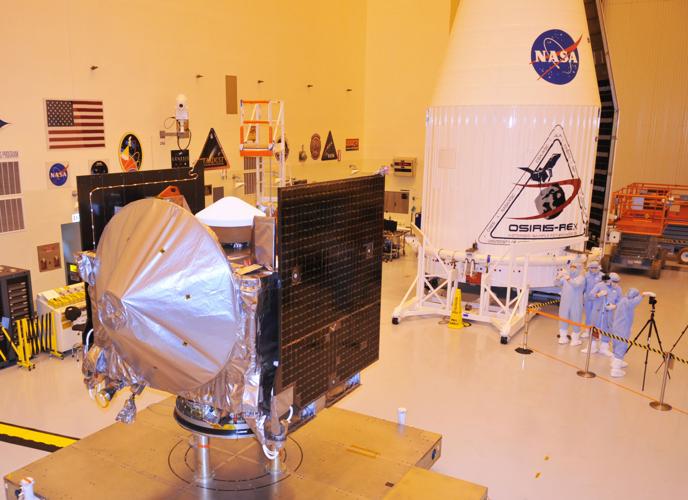
This photo taken Aug. 20, 2016 shows the inside the Payload Hazardous Servicing facility (PHSF) is the NASA's OSIRIS-REx (Origins, Spectral Interpretation, Resource Identification, Security-Regolith Explorer) at Kennedy Space Center, Fla. The mission will travel to the Bennu asteroid and is the first U.S. mission that will attempt to retrieve a pristine asteroid sample to be studied. (Tim Shortt/Florida Today via AP)
OSIRIS-REx
- Tim Shortt
- Updated
Inside the Payload Hazardous Servicing facility (PHSF) is the NASA's OSIRIS-REx (Origins, Spectral Interpretation, Resource Identification, Security-Regolith Explorer) ay Kennedy Space Center, Fla., Saturday, Aug. 20, 2016. The mission will travel to the Bennu asteroid and is the first U.S. mission that will attempt to retrieve a pristine asteroid sample to be studied. (Tim Shortt/Florida Today via AP)

OSIRIS-REx
- Dimitri Gerondidakis
- Updated
This May 21, 2016 photo provided by NASA shows the OSIRIS-REx spacecraft inside a servicing facility at Kennedy Space Center in Florida after arriving from Lockheed Martin's facility near Denver. Its mission, planned for launch on Thursday, Sept. 8, 2016, aims to return a sample of the asteroid Bennu to Earth for study as well as return detailed information about the asteroid and its trajectory. (Dimitri Gerondidakis/NASA via AP)
OSIRIS-REx
- HOGP
- Updated
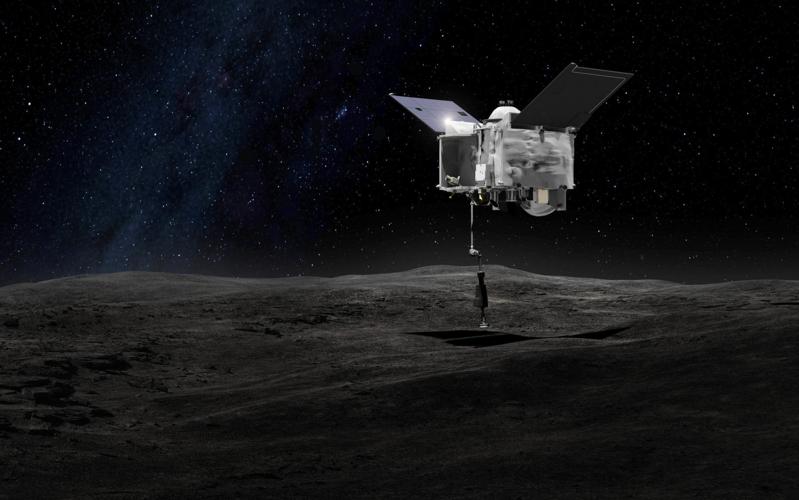
This artist's rendering made available by NASA on Tuesday, Sept. 6, 2016 shows the Origins Spectral Interpretation Resource Identification Security - Regolith Explorer (OSIRIS-REx) spacecraft contacting the asteroid Bennu with the Touch-And-Go Sample Arm Mechanism. The mission, planned for launch on Thursday, Sept. 8, 2016, aims to return a sample of Bennu's surface to Earth for study as well as return detailed information about the asteroid and its trajectory. (NASA/Goddard Space Flight Center via AP)
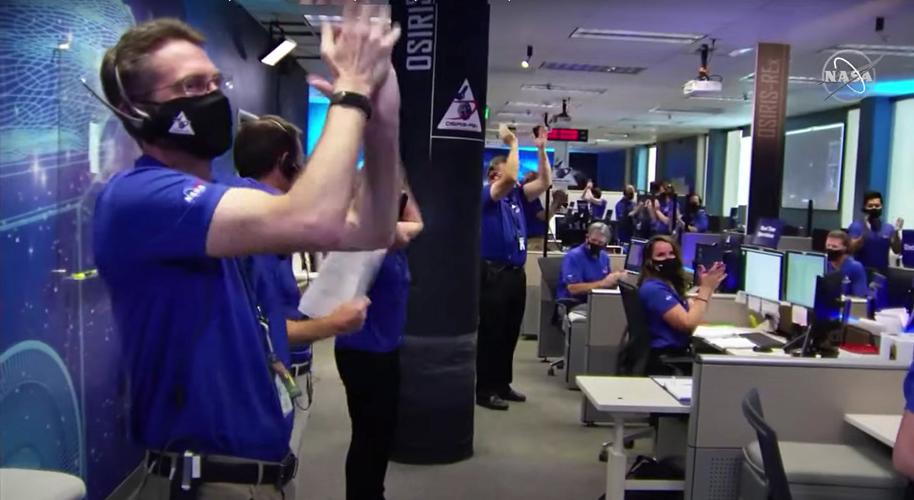
A space probe with Tucson roots scratched the surface of a distant world on Tuesday, but it didn’t linger there for long.
The University of Arizona-led OSIRIS-REx mission made contact with the asteroid Bennu for about 4.7 seconds, roughly half as long as it took Neil Armstrong to announce his “one small step for man, one giant leap for mankind” in 1969.
Tuesday’s long-awaited touchdown came at about 3:11 p.m. Tucson time and was broadcast live by NASA from the mission’s operation center at Lockheed Martin, in the Denver suburb of Littleton, Colorado.
Team members from the UA, Lockheed Martin and NASA’s Goddard Space Flight Center broke into cheers when they got word that the spacecraft had completed the delicate and dangerous rock-sampling maneuver.
“It’s almost hard to process everything that’s happening right now,” said OSIRIS-REx principal investigator and UA professor Dante Lauretta over NASA’s live feed. “This is historic. This is amazing.”
Based on preliminary data beamed back to Earth from more than 207 million miles away, mission team members know the spacecraft touched the surface, went through the collection process and safely maneuvered back into orbit. What they don’t yet know is whether OSIRIS-REx succeeded in gathering any rocks and dirt from the asteroid.
Their first clue should come Wednesday, Oct. 21, as the spacecraft transmits video footage from the touch-and-go on Bennu.
Over the next week, the team will use the probe’s cameras to visually inspect the sampling arm for telltale signs of dust. Then they will direct the spacecraft to perform a spin maneuver that should tell them the approximate mass of the material collected.
If Tuesday’s sampling run failed to collect enough stuff, the team could try again at a different location on the spinning asteroid roughly one-third of a mile wide.
The mission’s goal is to return with at least 2 ounces of minerals left over from the formation of the solar system 4.5 billion years ago, but the team is hoping to bring back considerably more dirt to play with. The spacecraft can hold over 4 pounds of samples, enough to fuel countless discoveries about the formation of the planets and the origins of life on Earth.
That’s why Betsy Cantwell, UA senior vice president for research and innovation, describes OSIRIS-REx as a “generational science mission.”
She said she can’t wait to see what UA researchers might learn from the asteroid samples due to arrive back on Earth in September 2023.
“We’re going to have decades of science out of this,” she said. “These kinds of events change the way we understand the world we live in.”
A lot could have gone wrong on Tuesday.
To reach the designated sampling site, the unmanned craft the size of a passenger van had to steer past boulders the size of buildings and into a rock-strewn crater to touch down in an area no larger than a tennis court.
Contact was made by the craft’s 11-foot sampling arm, which is equipped with a collection disc designed to linger on the surface just long enough to gather small particles of dust and rock stirred up by a blast of compressed nitrogen gas.
Because of the 18-minute communication delay between the Earth and Bennu, the mission team could only watch and wait as the spacecraft guided itself through the descent, touchdown and return to orbit using a sequence of commands uploaded into its computer in advance.
The spacecraft appears to have kissed the surface within about 3 feet of its intended target, said Dani DellaGiustina, lead scientist with OSIRIS-REx’s Image Processing Team.
“So that’s incredible,” she said. “It looks like everything went exactly according to plan.”
Sara Knutson, lead engineer for the mission’s science operations team, said she woke up Tuesday feeling calm and confident, but her nerves started to kick in as the spacecraft descended to within about 100 meters of the surface.
As it turned out, she had nothing to worry about. “My instincts were right. It went great,” she said.
Knutson and DellaGiustina were part of the local contingent of team members who monitored the touch-and-go from the UA’s Drake Building, which is named for Michael Drake, the former director of the university’s Lunar and Planetary Lab and the original principal investigator for the OSIRIS-REx mission.
Drake died in 2011, six months after NASA awarded the UA an $803 million contract to bring back asteroid samples.
Lauretta had his late friend and mentor on his mind in the moments leading up to the spacecraft’s historic brush with Bennu.
“I miss him. I wish he was here today,” Lauretta said of Drake from the mission’s operation center in Colorado. “I know he’d be really proud of us.”
Asteroid Chase
- Craig Rubadoux / Florida Today
Hundreds of people pack the Canaveral National Seashore in Cape Canaveral, Fla., Thursday, Sept. 8, 2016, to witness the launch of a United Launch Alliance Atlas V rocket as it lights up the sky during liftoff from Launch Complex 41 at the Cape Canaveral Air Force Station on the OSIRIS-REx mission,NASA first asteroid sample return mission.
OSIRIS-REx Mission
- Kelly Presnell / Arizona Daily Star
Seven year-old Claire Meador and her aunt Korie Birkholz celebrate along with the several hundred others gathered on the University of Arizona mall to watch the successful launch of the OSIRIS-REx mission, Thursday, Sept. 8, 2016, Tucson, Ariz. Kelly Presnell / Arizona Daily Star
OSIRIS-REx Mission
- Kelly Presnell / Arizona Daily Star 2016
Many of the several hundred gathered on the University of Arizona mall to watch the launch of the OSIRIS-REx mission fight the sun to see the big screen showing the liftoff, Thursday, Sept. 8, 2016, Tucson, Ariz. Kelly Presnell / Arizona Daily Star
Asteroid Chase
- Joel Kowsky / NASA
A United Launch Alliance Atlas V rocket carrying the Origins, Spectral Interpretation, Resource Identification, Security-Regolith Explorer (OSIRIS-REx) spacecraft lifts off from launch complex 41 at the Cape Canaveral Air Force Station, Thursday, Sept. 8, 2016, in Cape Canaveral, Fla. Osiris-Rex will travel to asteroid Bennu, collect ground samples, then haul them back to Earth. (Joel Kowsky/NASA via AP)
ATLAS V ROCKET LAUNCH
- Craig Rubadoux / Florida Today
Hundreds of people pack the Canaveral National Seashore in Cape Canaveral, Fla., Thursday, Sept. 8, 2016, to witness the launch of a United Launch Alliance Atlas V rocket as it lights up the sky during liftoff from Launch Complex 41 at the Cape Canaveral Air Force Station on the OSIRIS-REx mission,NASA first asteroid sample return mission. (Craig Rubadoux/Florida Today via AP)
OSIRIS-REx Mission
- John Raoux
A United Launch Alliance Atlas V rocket carrying the Origins, Spectral Interpretation, Resource Identification, Security-Regolith Explorer (OSIRIS-REx) spacecraft lifts off from launch complex 41 at the Cape Canaveral Air Force Station, Thursday, Sept. 8, 2016, in Cape Canaveral, Fla. Osiris-Rex will travel to asteroid Bennu, collect ground samples, then haul them back to Earth. (AP Photo/John Raoux)
OSIRIS-REx Mission
- John Raoux
A United Launch Alliance Atlas V rocket carrying the Origins, Spectral Interpretation, Resource Identification, Security-Regolith Explorer (OSIRIS-REx) spacecraft lifts off from launch complex 41 at the Cape Canaveral Air Force Station, Thursday, Sept. 8, 2016, in Cape Canaveral, Fla. Osiris-Rex will travel to asteroid Bennu, collect ground samples, then haul them back to Earth. (AP Photo/John Raoux)
OSIRIS-REx Mission
- John Raoux
A United Launch Alliance Atlas V rocket carrying the Origins, Spectral Interpretation, Resource Identification, Security-Regolith Explorer (OSIRIS-REx) spacecraft lifts off from launch complex 41 at the Cape Canaveral Air Force Station, Thursday, Sept. 8, 2016, in Cape Canaveral, Fla. Osiris-Rex will travel to asteroid Bennu, collect ground samples, then haul them back to Earth. (AP Photo/John Raoux)
Space Asteroid Chase
- Kim Shiflett
In this Wednesday, Sept. 7, 2016 photo made available by NASA, a United Launch Alliance Atlas V rocket, carrying NASA's OSIRIS-REx spacecraft, is brought to its launchpad at Cape Canaveral Air Force Station in Florida. The mission, scheduled to launch on Thursday, Sept. 8, is the first U.S. attempt to reach an asteroid return a sample to Earth for study. (Kim Shiflett/NASA via AP)
OSIRIS-REx
- HOGP
This artist's rendering made available by NASA in July 2016 shows the mapping of the near-Earth asteroid Bennu by the OSIRIS-REx spacecraft. The spacecraft will spend a year surveying Bennu before collecting a sample that will be returned to Earth for analysis. (NASA/Goddard/University of Arizona via AP)
OSIRIS-REx
- Rebecca Marie Sasnett / for the Arizona Daily Star
Alessondra Springmann (left), graduate researcher for the OSIRIS-REx mission, helps Dante Lauretta (center), principal investigator of OSIRIS-REx mission, take a "selfie" with the student artists and art professor during the showcase of the 20-by-60-foot mural painted by University of Arizona art students to celebrate OSIRIS-REx, NASA's $1 billion mission led by UA, outside of Michael J. Drake Building, 1415 N. Sixth Avenue, on Thursday, Jan. 22, 2015. The mission will send a spacecraft to Bennu, an asteroid close to earth, to pick up a sample, close to the size of a golfball, to help scientists better understand the solar system, asteroids and how life began. The launch date for the spacecraft OSIRIS-REx is expected for late 2016. Photo taken on Thursday, Jan. 22, 2015. Photo by Rebecca Marie Sasnett / for the Arizona Daily Star
OSIRIS-REx
- Malcolm Denemark
NASA's OSIRIS-REx sits on a launch pad Wednesday, Sept. 7, 2016, before a planned 7:05 p.m. Thursday blastoff from Cape Canaveral Air Force Station in Florida. A United Launch Alliance Atlas V rocket carrying the $800 million mission's spacecraft rolled on a transporter from a processing tower to the pad at Launch Complex 41 Wednesday morning, completing the quarter-mile move in less than an hour. (Malcolm Denemark/Florida Today via AP)
OSIRIS-REx
- Tim Shortt
This photo taken Aug. 20, 2016 shows the inside the Payload Hazardous Servicing facility (PHSF) is the NASA's OSIRIS-REx (Origins, Spectral Interpretation, Resource Identification, Security-Regolith Explorer) at Kennedy Space Center, Fla. The mission will travel to the Bennu asteroid and is the first U.S. mission that will attempt to retrieve a pristine asteroid sample to be studied. (Tim Shortt/Florida Today via AP)
OSIRIS-REx
- Tim Shortt
Inside the Payload Hazardous Servicing facility (PHSF) is the NASA's OSIRIS-REx (Origins, Spectral Interpretation, Resource Identification, Security-Regolith Explorer) ay Kennedy Space Center, Fla., Saturday, Aug. 20, 2016. The mission will travel to the Bennu asteroid and is the first U.S. mission that will attempt to retrieve a pristine asteroid sample to be studied. (Tim Shortt/Florida Today via AP)
OSIRIS-REx
- Dimitri Gerondidakis
This May 21, 2016 photo provided by NASA shows the OSIRIS-REx spacecraft inside a servicing facility at Kennedy Space Center in Florida after arriving from Lockheed Martin's facility near Denver. Its mission, planned for launch on Thursday, Sept. 8, 2016, aims to return a sample of the asteroid Bennu to Earth for study as well as return detailed information about the asteroid and its trajectory. (Dimitri Gerondidakis/NASA via AP)
OSIRIS-REx
- HOGP
This artist's rendering made available by NASA on Tuesday, Sept. 6, 2016 shows the Origins Spectral Interpretation Resource Identification Security - Regolith Explorer (OSIRIS-REx) spacecraft contacting the asteroid Bennu with the Touch-And-Go Sample Arm Mechanism. The mission, planned for launch on Thursday, Sept. 8, 2016, aims to return a sample of Bennu's surface to Earth for study as well as return detailed information about the asteroid and its trajectory. (NASA/Goddard Space Flight Center via AP)
A space probe with Tucson roots scratched the surface of a distant world on Tuesday, but it didn’t linger there for long.
The University of Arizona-led OSIRIS-REx mission made contact with the asteroid Bennu for about 4.7 seconds, roughly half as long as it took Neil Armstrong to announce his “one small step for man, one giant leap for mankind” in 1969.
Tuesday’s long-awaited touchdown came at about 3:11 p.m. Tucson time and was broadcast live by NASA from the mission’s operation center at Lockheed Martin, in the Denver suburb of Littleton, Colorado.
Team members from the UA, Lockheed Martin and NASA’s Goddard Space Flight Center broke into cheers when they got word that the spacecraft had completed the delicate and dangerous rock-sampling maneuver.
“It’s almost hard to process everything that’s happening right now,” said OSIRIS-REx principal investigator and UA professor Dante Lauretta over NASA’s live feed. “This is historic. This is amazing.”
Based on preliminary data beamed back to Earth from more than 207 million miles away, mission team members know the spacecraft touched the surface, went through the collection process and safely maneuvered back into orbit. What they don’t yet know is whether OSIRIS-REx succeeded in gathering any rocks and dirt from the asteroid.
Their first clue should come Wednesday, Oct. 21, as the spacecraft transmits video footage from the touch-and-go on Bennu.
Over the next week, the team will use the probe’s cameras to visually inspect the sampling arm for telltale signs of dust. Then they will direct the spacecraft to perform a spin maneuver that should tell them the approximate mass of the material collected.
If Tuesday’s sampling run failed to collect enough stuff, the team could try again at a different location on the spinning asteroid roughly one-third of a mile wide.
The mission’s goal is to return with at least 2 ounces of minerals left over from the formation of the solar system 4.5 billion years ago, but the team is hoping to bring back considerably more dirt to play with. The spacecraft can hold over 4 pounds of samples, enough to fuel countless discoveries about the formation of the planets and the origins of life on Earth.
That’s why Betsy Cantwell, UA senior vice president for research and innovation, describes OSIRIS-REx as a “generational science mission.”
She said she can’t wait to see what UA researchers might learn from the asteroid samples due to arrive back on Earth in September 2023.
“We’re going to have decades of science out of this,” she said. “These kinds of events change the way we understand the world we live in.”
A lot could have gone wrong on Tuesday.
To reach the designated sampling site, the unmanned craft the size of a passenger van had to steer past boulders the size of buildings and into a rock-strewn crater to touch down in an area no larger than a tennis court.
Contact was made by the craft’s 11-foot sampling arm, which is equipped with a collection disc designed to linger on the surface just long enough to gather small particles of dust and rock stirred up by a blast of compressed nitrogen gas.
Because of the 18-minute communication delay between the Earth and Bennu, the mission team could only watch and wait as the spacecraft guided itself through the descent, touchdown and return to orbit using a sequence of commands uploaded into its computer in advance.
The spacecraft appears to have kissed the surface within about 3 feet of its intended target, said Dani DellaGiustina, lead scientist with OSIRIS-REx’s Image Processing Team.
“So that’s incredible,” she said. “It looks like everything went exactly according to plan.”
Sara Knutson, lead engineer for the mission’s science operations team, said she woke up Tuesday feeling calm and confident, but her nerves started to kick in as the spacecraft descended to within about 100 meters of the surface.
As it turned out, she had nothing to worry about. “My instincts were right. It went great,” she said.
Knutson and DellaGiustina were part of the local contingent of team members who monitored the touch-and-go from the UA’s Drake Building, which is named for Michael Drake, the former director of the university’s Lunar and Planetary Lab and the original principal investigator for the OSIRIS-REx mission.
Drake died in 2011, six months after NASA awarded the UA an $803 million contract to bring back asteroid samples.
Lauretta had his late friend and mentor on his mind in the moments leading up to the spacecraft’s historic brush with Bennu.
“I miss him. I wish he was here today,” Lauretta said of Drake from the mission’s operation center in Colorado. “I know he’d be really proud of us.”
As featured on

Launch went off on-time; separation stages still to come.

Perfect launch sends tiny craft on a 4-billion-mile journey to bring back a handful of dust.

As OSIRIS-REx cruises to Bennu, Lauretta and his team are gearing up to receive its treasure.
More information
- New University of Arizona center hopes to bring order to space chaos
- University of Arizona-led OSIRIS-REx mission also scanning space for 'Trojan' asteroids
- Astronomers say Arizona becoming hub for asteroid exploration
- 'Flawless' practice run sets up University of Arizona-led asteroid-sampling mission
- First images from asteroid touchdown indicate success for UA-led space mission


View this profile on Instagram#ThisIsTucson 🌵 (@this_is_tucson) • Instagram photos and videos
Most viewed stories
-
Conservation park for endangered animal could open south of Tucson
-
New owner saves Tucson's oldest bookstore from closing
-
39 fun events to check out February 27 - March 1!
-
Surprise! Wildflower season is starting early. Here's where to find the best blooms 🌼
-
Jamie vs. Sonoran Dogs pt. 2: I continue down the Sonoran Dog Trail
-
20-plus breweries, 1 day: It's Tucson beer crawl time 🍻
-
Over 60 fun events happening in Tucson in February 💖🐎
-
43 events you won't want to miss, February 20-22! 🤠🐎
-
LQBTQ events at Hotel Congress and BreakOut Studios celebrate Pride this weekend
-
4th Ave. is getting cheesier: A new quesadilla spot is now open!