

5 Tucson stories you need to know today: Apology letter from ex-El Charro waitress goes viral
- Updated
Here's a look at the top 5 trending stories on tucson.com this morning.
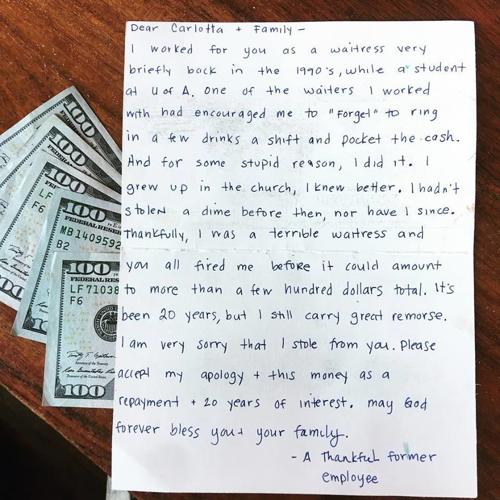
An anonymous apology letter and $1,000 in cash from a person claiming to be a former waitress who stole money from El Charro Cafe more than two decades ago has lifted the spirits of the Tucson restaurant owner and spread quickly across the internet.
Last week, Ray Flores, El Charro’s president, shared the story on his Facebook page.
"I worked for you as a waitress very briefly back in the 1990's, while a student at U of A. One of the waiters I worked with had encouraged me to 'forget' to ring in a few drinks a shift and pocket the cash. And for some stupid reason, I did it,” the letter reads.
“I grew up in the church, I knew better. I hadn't stolen a dime before then, nor have I since. Thankfully, I was a terrible waitress and you all fired me before it could amount to more than a few hundred dollars total. It's been 20 years, but I still carry great remorse. I am very sorry that I stole from you. Please accept my apology plus this money as a repayment plus 20 years of interest. May God forever bless you and your family."
Flores says the letter came just two days after his mother, El Charro owner and chef Carlotta Flores, was shoved and had her purse stolen by a man while grocery shopping.
"She had been very down over that experience and then this kind act occurred," Flores wrote in his Facebook posting.
The story about trying to right a wrong at the iconic Tucson restaurant has since gone viral on social media and has been reported on several news outlets, such as CNN and the Daily Mail.
"Most of us don't think about feeling guilty over such a long time," said Daniel Sullivan, an assistant professor in the University of Arizona's psychology department. "Most research about guilt tends to be more short-term."
Sullivan also says research shows that guilt affects personality types differently.
"People who want to give back money, apologize, or try to make it right — those people tend to be healthier in a variety of outcomes," Sullivan says. "They tend to do better in the workplace, for example. They also tend to be less aggressive and less depressed."
"Making amends is the healthiest way to deal with guilt,” Sullivan said.

A national company is expanding its Tucson footprint with plans to add about three dozen jobs with an average annual salary of $143,000 each.
Dubbed “Project Treasure” in filings with the city, the unnamed company is described as “professional and scientific services” with more than 300 local employees currently.
As part of the project, the company is preparing to invest more than $29 million to build a 110,000- to 125,000-square- foot, three- or four-story development at the Williams Centre, near Broadway and Craycroft Road, according to a memo to the Tucson City Council.
The City Council recently approved the company’s request for incentives.
City and economic-development officials said they are under a nondisclosure agreement and could not share any information about the company.
A project assessment prepared for Sun Corridor Inc. and filed with the city shows that from 2019 to 2023, this company’s economic impact is projected at more than $1 billion. That figure includes jobs, payroll, tax revenues and secondary impacts at local businesses.
The new facility will allow Project Treasure to increase employment “in the areas of electrical engineering, financial managers, electrical and electronics technicians, general administration and operations managers, and financial specialists,” the memo says.
Companies qualify for the city’s Primary Jobs Incentive if they meet the following criteria:
- Invest a minimum of $5 million in facilities or equipment.
- Create 25 jobs that pay wages of at least $52,400.
- Cover at least 75 percent of employee health insurance premiums.
In this case, the incentives for the unnamed company include reimbursement of building-permit fees, valued at approximately $81,000, and offsets to impact fees for the project or job training, which in this case are estimated to be $338,364.
Reimbursement by the city is contingent upon Project Treasure meeting its employment projections of 35 jobs within five years from the execution of the development agreement.
“For example, if seven new jobs are created then 20 percent of the impact fees and/or job training will be reimbursed,” the memo says.
The proposed construction site is an 8.2-acre parcel — the last vacant spot in Williams Centre.
Pima County assessor’s records show the land is owned by two Scottsdale-based limited-liability corporations.

- Bruce Pascoe Arizona Daily Star
- Updated
Busting the Brackets rates McKale Center the No. 25 best home-court atmosphere in college basketball — and No. 2 in the state of Arizona.
It has GCU at No. 22. Other home courts in the West that are rated higher: No. 3 Gonzaga, No. 17 New Mexico, No. 18 Utah State and No. 20 San Diego State. Not surprisingly, Duke is rated second and Kansas No. 1.
UCLA and Washington did not make the list.
In my experience, at least in games I've covered in the West involving Arizona, there have been great home-court atmospheres at Washington, Gonzaga, New Mexico and San Diego State, while Gonzaga has a particularly organized and enthusiastic student section (also it helps greatly when those student sections are located on the sidelines as at Gonzaga and Washington, not the baselines).
Oregon had some great atmospheres at McArthur Court but not so much at Matthew Knight Arena. I once covered games at Utah State that had my ears ringing. ...
Yahoo Sports takes a look at why things have been quiet regarding the federal investigation into college basketball, noting that they could heat up this fall.
CBS Sports says feedback from coaches may result in the first July recruiting period being preserved for the Peach Jam and other travel-ball events. The issue has been raising a lot of concern for event organizers and coaches, among others.
Some key UA targets picked up new offers: Boogie Ellis got one from Gonzaga, and Josh Green received one from North Carolina.
Green, meanwhile, was named to the Australian national team for its next World Cup qualifying action.
Jason Terry says his historical perspective suggests Arizona must really like 2021 prospect Devin Askew.
Amphi's Jackson Ruai says he's thankful for his travel-ball experience.
Texas Southern will stop in Tempe after facing the Wildcats at McKale on Nov. 28.

- Shaq Davis Arizona Daily Star
- Updated
Tucson police shot and killed a man they say was firing a gun in a house then came outside after a long standoff carrying two guns early Wednesday morning.
David Judge, 53, had barricaded himself inside the house in the 6100 block of South Earp Wash Lane, near East Valencia Road and South Alvernon Way, after police responded to a call about 6:30 p.m. Tuesday about someone firing a rifle inside, police said in a news release.
His mother told police Judge had fired the gun and that he was alone inside. SWAT officers were called in and hostage negotiators spent hours trying to convince Judge to surrender, the release said.
Shortly after midnight, Judge walked outside armed with two handguns and was shot multiple times by a SWAT officer, the news release said.
Tucson fire paramedics immediately rendered aid, but Judge died at the scene.
No officers were injured in the shooting.
Detective David Ortiz, a 13-year-veteran, was identified as the officer who shot Judge.
The investigation into the incident as well as the circumstances of the shooting continues.
- Tim Steller Arizona Daily Star
- Updated
Tuesday morning, I drove east down Broadway until I passed Camino Seco and entered the part of town where recycling barrels were out on the curb for pickup.
Then I parked on South Evelyn Avenue, snapped on nitrile gloves and started digging into the blue barrels.
What I found wasn’t pretty.
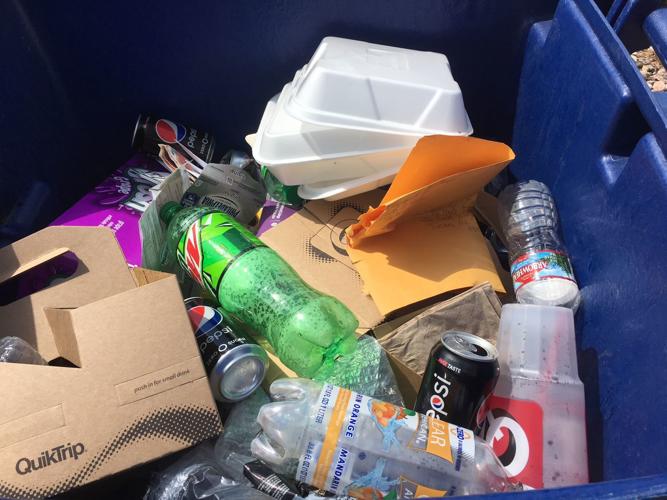
No, it’s not that the recycling smelled terrible or was particularly nasty. It really wasn’t bad, despite the melting heat that had me soaking in sweat after a few minutes. It’s just that the recycling bins were largely “contaminated.” That’s the term used by the industry to describe materials that are put in recycling bins and don’t belong.
You may have read my colleague Tony Davis’ story in Sunday’s paper about this problem of contamination and the issues it’s causing in the global recycling market.
China has imposed a nearly impossible to reach 99.5 percent minimum purity standard — in other words, no more than 0.5 percent contamination in recyclable materials shipped there.
That’s a tough problem for residents of Tucson, where contamination rates have risen from 16 percent to 22 percent over the last seven years. We’re not even close to meeting the standard. Not coincidentally, we’re now losing money on a recycling program that used to make us money. And the city government is considering options for shoring it up.
In a memo sent to the City Council on Monday, the director of the city’s Environmental and General Services Department, Carlos De La Torre, said the city’s recycling contractor wants to raise its fee by 34 percent, from $33.90 per ton to $45.46 per ton. Its contract allows the company, Republic Services, to raise fees to cover increasing costs.
If approved, that increase would force the city to add 26 cents to the existing 45-cent-per-month recycling surcharge paid by residential customers, De La Torre said.
Global dynamics are driving much of the change in the market, and it is leading communities around the country to scale back, charge more, eliminate or otherwise alter their recycling programs. But our own poor performance as recyclers is also part of the problem.
On Tuesday morning, I dug into 11 bins — nine were significantly contaminated.
The first can I looked in had two styrofoam containers and three plastic bags. Not bad, but not good. As I moved on, I found some real head-scratchers. One full bin contained dozens of plastic hangers as well as three plastic desktop paper organizers. When I spoke to the resident, he said he had been cleaning out his kids’ clothes and thought the hangers were recyclable.
We didn’t get to talking about the desk organizers before his daughter dropped a styrofoam container in the recycling barrel and they took off.
Down the street, I opened a very light bin that was sitting on the curb. It contained two empty one-gallon milk jugs — perfectly recyclable plastic — plus, mysteriously, three large branches and an oval wooden frame for a hanging mirror.
I spoke with the homeowner, Jan Swink, who told me she understood yard waste wasn’t supposed to be in the recycling, but she wasn’t sure about the wooden frame.
“I don’t know if that kind of thing is recyclable. It should be,” she said. Overall, she said, “It’s not real clear” what is and is not recyclable.
After I dug through her recycling, neighbor Pat Kaiser told me she gets confused about a few items — such as styrofoam egg cartons.
“Why don’t the people put the eggs in cardboard containers?” she asked. “Other than that, I think I’m OK.”
There was also a styrofoam QT cup in her barrel and some plastic bags, though.
A nearby neighbor, who wasn’t home when I knocked on the door, had the best barrel of all. It was filled with crushed cans of Coors Light and other beers and sodas, along with the cardboard boxes that the 30-packs had come in.
I was going to stop inspecting barrels after 10, but then I saw Ed Godel picking weeds on Evelyn Avenue as I drove back to Broadway. A look through his recycling barrel showed it was pretty good, but he sighed when he realized his wife had put grass clippings in there and pushed the barrel out only about one-third full.
“I don’t normally take it out till it’s this full,” he told me, holding his hand about two-thirds of the way up inside the barrel.
All these details — the Styrofoam, the hangers, the plastic bags, the grass and branches — used to be something we could get away with. But now, with China eliminated as a market for most of America’s recycling, it’s starting to cost us individually.
“The contamination is a big cost,” Environmental Services spokeswoman Cristina Polsgrove told me. “When the contamination is in there, we’re being charged to process it in the garbage.”
“The turkey carcass in the aluminum roasting pan is just garbage. The dirty diaper is just garbage.”
Customers can help by learning what is recyclable and remembering to throw the higher-value objects into the bin. Those are the plastic soda and water bottles, which are mostly thrown away, and aluminum cans.
The good news is that we are so confused about what to throw in the blue barrels that it shouldn’t be hard to improve a lot.
An anonymous apology letter and $1,000 in cash from a person claiming to be a former waitress who stole money from El Charro Cafe more than two decades ago has lifted the spirits of the Tucson restaurant owner and spread quickly across the internet.
Last week, Ray Flores, El Charro’s president, shared the story on his Facebook page.
"I worked for you as a waitress very briefly back in the 1990's, while a student at U of A. One of the waiters I worked with had encouraged me to 'forget' to ring in a few drinks a shift and pocket the cash. And for some stupid reason, I did it,” the letter reads.
“I grew up in the church, I knew better. I hadn't stolen a dime before then, nor have I since. Thankfully, I was a terrible waitress and you all fired me before it could amount to more than a few hundred dollars total. It's been 20 years, but I still carry great remorse. I am very sorry that I stole from you. Please accept my apology plus this money as a repayment plus 20 years of interest. May God forever bless you and your family."
Flores says the letter came just two days after his mother, El Charro owner and chef Carlotta Flores, was shoved and had her purse stolen by a man while grocery shopping.
"She had been very down over that experience and then this kind act occurred," Flores wrote in his Facebook posting.
The story about trying to right a wrong at the iconic Tucson restaurant has since gone viral on social media and has been reported on several news outlets, such as CNN and the Daily Mail.
"Most of us don't think about feeling guilty over such a long time," said Daniel Sullivan, an assistant professor in the University of Arizona's psychology department. "Most research about guilt tends to be more short-term."
Sullivan also says research shows that guilt affects personality types differently.
"People who want to give back money, apologize, or try to make it right — those people tend to be healthier in a variety of outcomes," Sullivan says. "They tend to do better in the workplace, for example. They also tend to be less aggressive and less depressed."
"Making amends is the healthiest way to deal with guilt,” Sullivan said.
A national company is expanding its Tucson footprint with plans to add about three dozen jobs with an average annual salary of $143,000 each.
Dubbed “Project Treasure” in filings with the city, the unnamed company is described as “professional and scientific services” with more than 300 local employees currently.
As part of the project, the company is preparing to invest more than $29 million to build a 110,000- to 125,000-square- foot, three- or four-story development at the Williams Centre, near Broadway and Craycroft Road, according to a memo to the Tucson City Council.
The City Council recently approved the company’s request for incentives.
City and economic-development officials said they are under a nondisclosure agreement and could not share any information about the company.
A project assessment prepared for Sun Corridor Inc. and filed with the city shows that from 2019 to 2023, this company’s economic impact is projected at more than $1 billion. That figure includes jobs, payroll, tax revenues and secondary impacts at local businesses.
The new facility will allow Project Treasure to increase employment “in the areas of electrical engineering, financial managers, electrical and electronics technicians, general administration and operations managers, and financial specialists,” the memo says.
Companies qualify for the city’s Primary Jobs Incentive if they meet the following criteria:
- Invest a minimum of $5 million in facilities or equipment.
- Create 25 jobs that pay wages of at least $52,400.
- Cover at least 75 percent of employee health insurance premiums.
In this case, the incentives for the unnamed company include reimbursement of building-permit fees, valued at approximately $81,000, and offsets to impact fees for the project or job training, which in this case are estimated to be $338,364.
Reimbursement by the city is contingent upon Project Treasure meeting its employment projections of 35 jobs within five years from the execution of the development agreement.
“For example, if seven new jobs are created then 20 percent of the impact fees and/or job training will be reimbursed,” the memo says.
The proposed construction site is an 8.2-acre parcel — the last vacant spot in Williams Centre.
Pima County assessor’s records show the land is owned by two Scottsdale-based limited-liability corporations.
Busting the Brackets rates McKale Center the No. 25 best home-court atmosphere in college basketball — and No. 2 in the state of Arizona.
It has GCU at No. 22. Other home courts in the West that are rated higher: No. 3 Gonzaga, No. 17 New Mexico, No. 18 Utah State and No. 20 San Diego State. Not surprisingly, Duke is rated second and Kansas No. 1.
UCLA and Washington did not make the list.
In my experience, at least in games I've covered in the West involving Arizona, there have been great home-court atmospheres at Washington, Gonzaga, New Mexico and San Diego State, while Gonzaga has a particularly organized and enthusiastic student section (also it helps greatly when those student sections are located on the sidelines as at Gonzaga and Washington, not the baselines).
Oregon had some great atmospheres at McArthur Court but not so much at Matthew Knight Arena. I once covered games at Utah State that had my ears ringing. ...
Yahoo Sports takes a look at why things have been quiet regarding the federal investigation into college basketball, noting that they could heat up this fall.
CBS Sports says feedback from coaches may result in the first July recruiting period being preserved for the Peach Jam and other travel-ball events. The issue has been raising a lot of concern for event organizers and coaches, among others.
Some key UA targets picked up new offers: Boogie Ellis got one from Gonzaga, and Josh Green received one from North Carolina.
Green, meanwhile, was named to the Australian national team for its next World Cup qualifying action.
Jason Terry says his historical perspective suggests Arizona must really like 2021 prospect Devin Askew.
Amphi's Jackson Ruai says he's thankful for his travel-ball experience.
Texas Southern will stop in Tempe after facing the Wildcats at McKale on Nov. 28.
Tucson police shot and killed a man they say was firing a gun in a house then came outside after a long standoff carrying two guns early Wednesday morning.
David Judge, 53, had barricaded himself inside the house in the 6100 block of South Earp Wash Lane, near East Valencia Road and South Alvernon Way, after police responded to a call about 6:30 p.m. Tuesday about someone firing a rifle inside, police said in a news release.
His mother told police Judge had fired the gun and that he was alone inside. SWAT officers were called in and hostage negotiators spent hours trying to convince Judge to surrender, the release said.
Shortly after midnight, Judge walked outside armed with two handguns and was shot multiple times by a SWAT officer, the news release said.
Tucson fire paramedics immediately rendered aid, but Judge died at the scene.
No officers were injured in the shooting.
Detective David Ortiz, a 13-year-veteran, was identified as the officer who shot Judge.
The investigation into the incident as well as the circumstances of the shooting continues.
Tuesday morning, I drove east down Broadway until I passed Camino Seco and entered the part of town where recycling barrels were out on the curb for pickup.
Then I parked on South Evelyn Avenue, snapped on nitrile gloves and started digging into the blue barrels.
What I found wasn’t pretty.
No, it’s not that the recycling smelled terrible or was particularly nasty. It really wasn’t bad, despite the melting heat that had me soaking in sweat after a few minutes. It’s just that the recycling bins were largely “contaminated.” That’s the term used by the industry to describe materials that are put in recycling bins and don’t belong.
You may have read my colleague Tony Davis’ story in Sunday’s paper about this problem of contamination and the issues it’s causing in the global recycling market.
China has imposed a nearly impossible to reach 99.5 percent minimum purity standard — in other words, no more than 0.5 percent contamination in recyclable materials shipped there.
That’s a tough problem for residents of Tucson, where contamination rates have risen from 16 percent to 22 percent over the last seven years. We’re not even close to meeting the standard. Not coincidentally, we’re now losing money on a recycling program that used to make us money. And the city government is considering options for shoring it up.
In a memo sent to the City Council on Monday, the director of the city’s Environmental and General Services Department, Carlos De La Torre, said the city’s recycling contractor wants to raise its fee by 34 percent, from $33.90 per ton to $45.46 per ton. Its contract allows the company, Republic Services, to raise fees to cover increasing costs.
If approved, that increase would force the city to add 26 cents to the existing 45-cent-per-month recycling surcharge paid by residential customers, De La Torre said.
Global dynamics are driving much of the change in the market, and it is leading communities around the country to scale back, charge more, eliminate or otherwise alter their recycling programs. But our own poor performance as recyclers is also part of the problem.
On Tuesday morning, I dug into 11 bins — nine were significantly contaminated.
The first can I looked in had two styrofoam containers and three plastic bags. Not bad, but not good. As I moved on, I found some real head-scratchers. One full bin contained dozens of plastic hangers as well as three plastic desktop paper organizers. When I spoke to the resident, he said he had been cleaning out his kids’ clothes and thought the hangers were recyclable.
We didn’t get to talking about the desk organizers before his daughter dropped a styrofoam container in the recycling barrel and they took off.
Down the street, I opened a very light bin that was sitting on the curb. It contained two empty one-gallon milk jugs — perfectly recyclable plastic — plus, mysteriously, three large branches and an oval wooden frame for a hanging mirror.
I spoke with the homeowner, Jan Swink, who told me she understood yard waste wasn’t supposed to be in the recycling, but she wasn’t sure about the wooden frame.
“I don’t know if that kind of thing is recyclable. It should be,” she said. Overall, she said, “It’s not real clear” what is and is not recyclable.
After I dug through her recycling, neighbor Pat Kaiser told me she gets confused about a few items — such as styrofoam egg cartons.
“Why don’t the people put the eggs in cardboard containers?” she asked. “Other than that, I think I’m OK.”
There was also a styrofoam QT cup in her barrel and some plastic bags, though.
A nearby neighbor, who wasn’t home when I knocked on the door, had the best barrel of all. It was filled with crushed cans of Coors Light and other beers and sodas, along with the cardboard boxes that the 30-packs had come in.
I was going to stop inspecting barrels after 10, but then I saw Ed Godel picking weeds on Evelyn Avenue as I drove back to Broadway. A look through his recycling barrel showed it was pretty good, but he sighed when he realized his wife had put grass clippings in there and pushed the barrel out only about one-third full.
“I don’t normally take it out till it’s this full,” he told me, holding his hand about two-thirds of the way up inside the barrel.
All these details — the Styrofoam, the hangers, the plastic bags, the grass and branches — used to be something we could get away with. But now, with China eliminated as a market for most of America’s recycling, it’s starting to cost us individually.
“The contamination is a big cost,” Environmental Services spokeswoman Cristina Polsgrove told me. “When the contamination is in there, we’re being charged to process it in the garbage.”
“The turkey carcass in the aluminum roasting pan is just garbage. The dirty diaper is just garbage.”
Customers can help by learning what is recyclable and remembering to throw the higher-value objects into the bin. Those are the plastic soda and water bottles, which are mostly thrown away, and aluminum cans.
The good news is that we are so confused about what to throw in the blue barrels that it shouldn’t be hard to improve a lot.
Tags
More information
- Tucson bargain hunters: Hugely popular UA rummage sale starts Friday
- 'Sorry that I stole from you,' ex-waitress tells Tucson restaurant owner in letter filled with $1,000
- Cochise County deputies up their game in latest lip sync challenge post
- Ex-Pima County court employee convicted in child pornography case
- Sahuarita dance team advances to next round on America's Got Talent


View this profile on Instagram#ThisIsTucson 🌵 (@this_is_tucson) • Instagram photos and videos
Most viewed stories
-
27 exciting events to check out this weekend, January 16-18 💎
-
New eats! 10 new restaurants that opened in Tucson this fall
-
Tucson's twin winter music festivals kick off this weekend 🎵
-
What a delicious year: the best meals I ate in Tucson in 2025 💖
-
Nearly 50 fun events happening in the month of January! ✨
-
Looking ahead to Tucson's new and cool for '26
-
Horchata lattes and breakfast burritos: Tucson's Barista del Barrio opens 2nd location
-
Glitter and boas: Dress up '70s style for ABBA tribute show at the Rialto 🪩✨
-
Get ready to eat all the spicy tuna rolls you can at this viral sushi spot 🍣
-
Create the icy dessert of your dreams at this new frozen yogurt spot 🍨