

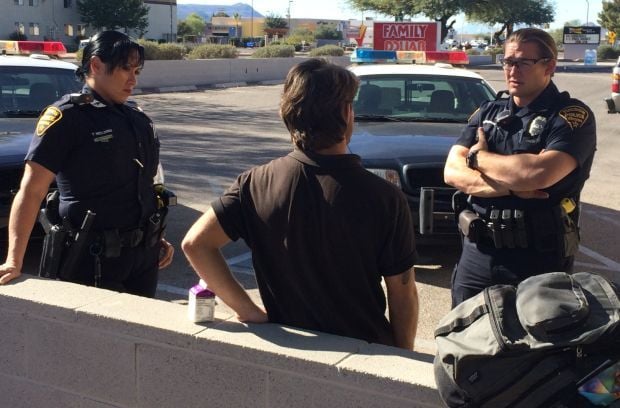

Officer Timothy Anderson enters cop mode before he even puts on his uniform or opens the door of his patrol car.
Leaving home, a couple of hours before his shift, is when the “hypervigilance” kicks in, he said.
“There is a part of this career that you are constantly on guard,” the Tucson police officer told me during a ride-along Thursday. That’s because, he said, when you wear the uniform, “you become a target.”
For Tucson police, the pace of attacks on them has been moderate, but this sense of hypervigilance is a nearly universal coping mechanism, Tucson-based police psychologist Kevin Gilmartin said. When officers are shot and killed in Pennsylvania or Oregon or Canada, colleagues everywhere hear about it, and it reinforces their vigilance.
That sense of vulnerability bears remembering when we consider the recent wave of protests against police brutality and how it pertains to our own city. In Tucson, as I’ve seen it over the last 18 years, police have not had a particularly fractured relationship with residents.
I asked Jeremy Christopher, who’s chair of the Citizen Police Advisory Review Board, if I’m seeing this correctly.
“There are pockets of tension and specific incidents, but as a whole I’d say TPD is as good as or maybe even a little better than peer communities when it comes to relationships with the community,” he said.
That board reviews TPD internal-affairs investigations to see whether the agency has carried out a good investigation and otherwise hears out possible police issues. At 5:30 p.m. Tuesday, the board will discuss the police response to protests against police abuse, of which there have been a couple in Tucson and there likely will be more. It’s at the Ward 6 office, 3202 E. First St.
***
Anderson is young, muscular and a SWAT team member .
Stereotypical gung-ho cop, right? Well, he also majored in early and pre-modern literature at the University of California-Santa Cruz and got a double major in philosophy, he told me. After exploring a variety of philosophical approaches, the one that’s stuck with him is existentialism, which emphasizes the individual’s free will.
He had hoped to study in Iceland before the financial crash, but ended up working in elder care with dementia sufferers as he applied for police jobs. After graduating from TPD’s academy in 2011, he now patrols Tucson’s south side. It could be a setup for conflict.
“I did not grow up in a rough part of town,” said Anderson, 31, who was raised in Southern California. “But if you talk to people, you learn how they want to be talked to.”
He and fellow officer Dan Bowling, an Ohio transplant of about the same age, routinely walk the Roy Laos Transit Center and nearby grounds of El Pueblo Regional Center as a part of a special project to make that area safer. When a young man stabbed a bus driver at Laos last month, they knew right away who it was, from making the rounds, talking to people.
But that personal approach doesn’t work with everyone.
“There are times,” he said, “you’ll walk up to somebody and say, ‘Can I talk to you for a minute?’ They’ll look you in the face and say, ‘No.’ It’s like, ‘Well, this is awkward,’ and you walk away.
“It’s a give and take with this job,” he said. “Some folks want to work with us. Others don’t.”
***
The flash points we’ve had in Tucson have included protests attempting to keep Tucson police from handing undocumented immigrants over to the Border Patrol, efforts to roust homeless people from sidewalks or camping spots, and “sports riots” after UA basketball games.
It may be how the department handles one incident from the most recent sports riot that should tell us how comfortable we can feel with our Police Department.
When Sgt. Joel Mann knocked over then-UA student Christina Gardilcic on March 29, it was clear to us civilians that he went too far. A video taken by a bystander happened to catch Mann when he used his baton to deck Gardilcic, knocking her over a bench. Without that video, I suspect the incident would have gone largely unnoticed and unpunished.
You can imagine that police officers, when they see the video, at least understand where Mann was coming from, if not the blow he delivered. Mann was protecting the back side of a Tucson police line when the student walked up unaware. His hypervigilance met a possible threat, Gardilcic, who was oblivious to him.
A Tucson police board of inquiry agreed Mann went too far, but the Pima County Attorney’s Office declined in October to prosecute it as a crime.
It wasn’t Ferguson, Missouri, nor New York City — places where grand juries decided not to indict cops who killed people in questionable circumstances — but it is a test case for Tucson.
We shouldn’t get stuck on the idea that a criminal charge is the only consequence an officer may face. What about suspension, demotion or, most severely, decertification? These administrative acts would leave an impact on the offending officers, and others would notice, too, even though the acts are short of a criminal charge.
***
Nationwide, killings of police hit a low point of 27 last year, the FBI reported, though the number appears to have increased this year. The Tucson Police Department has lost two officers to shootings in recent years: Patrick Hardesty in 2003 and Eric Hite in 2008. Sgt. Robert Carpenter was shot in the head in 2012 and survived.
Even officers who’ve joined the department recently, like Anderson, know the risks.
“I try not to let that kind of trend or concern affect my job,” he said.
But almost contradictorily, he acknowledged the concern for safety is a routine part of the job that overflows beyond work hours.
“I try to keep that mind-set in my everyday life,” he said. “Not today: I won’t be a victim; I’ll be a survivor.”
That’s one of the reasons police officers learn to have a “command presence” when they come into a situation. It backs down potential aggressors, allowing the officer to minimize risks.
“An officer needs to be able to raise their presence, then quickly de-escalate,” Anderson told me. “I really don’t have a lot of people fighting me.”
***
Some people are spoiling for a fight, though. The national debate on police tactics has riled up, among the broader police-abuse protesters, an anti-police faction that is planning actions in Tucson, beginning with an organizing a barbecue here this weekend.
Don’t be surprised if you see news of a knot of masked demonstrators trying to stop traffic on I-10 or some other major roadway. Some already tried once, on Dec. 5, but police stopped them at the exits before reaching the main roadway.
“We understand people have the right to protest,” said Christopher, of the citizens advisory board. “But what happens when you start affecting the rights of others?”
It’s a tough balance for police to strike — but they must, especially when the demonstrations they’re monitoring are against police abuse.
It’s important that officers keep their understandable vigilance from overwhelming their common sense. Otherwise, the department will owe us more tangible accountability, and a downward spiral of mistrust could accelerate.

