


U.S. District Judge David Bury works three short blocks west of Veinte de Agosto Park where it borders Church Avenue downtown.
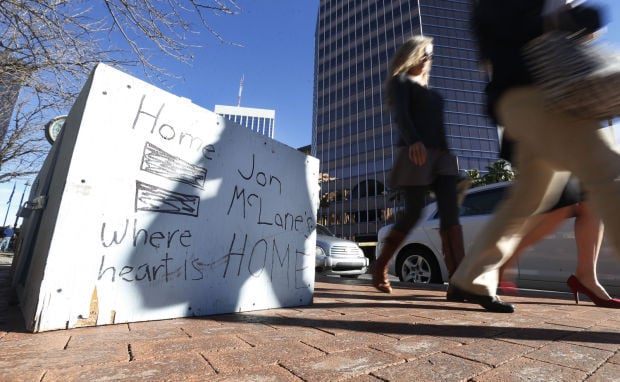
You would think that once in a while he walks or drives up the street from the federal courthouse and sees what his Dec. 22 decision on the homeless camp there has wrought. It’s no longer just rows of people sleeping under donated gray blankets, but now there are a half-dozen “sleeping pods” wheeled in for women or couples to sleep in, with more to come.
On Tuesday at midday, what he would have seen was the strange but harmonious meeting of two distinct Tucson subcultures: The food trucks and the sleeping pods.
The sleeping pods — raised boxes big enough for a person or two to sleep in — are a relatively new addition, reported last week by my colleague Darren DaRonco. The food trucks were gathered in a “rally” that unintentionally brought workers and jurors together with homeless people outside the pods, all gathered along the sidewalk that has become the focus of legal contention.
It’s all part of the dance the city of Tucson has been forced into thanks to the audacious legal maneuvering of Jon McLane and John Cooper. The two activists — McLane asked me Tuesday to call him a “civil rights leader” — have forced the city into a defensive posture. So even as McLane lines the sidewalk with pods, the city is doing nothing about it.
“We were concerned about a situation like this developing,” City Attorney Mike Rankin told me Tuesday.
The city last year imposed a “3-B” policy that limited the possessions a person sleeping on the sidewalk could have with them to a bedroll, a blanket and a backpack. Police sometimes seized additional belongings or those that appeared abandoned.
But Bury deemed that policy a violation of the homeless residents’ First Amendment rights. He also said people may sleep on the sidewalk as long as they leave a 5-foot-wide passage for pedestrians.
The whole thing, McLane and Cooper have argued, is not a homeless camp but a demonstration where people are exercising their free-speech rights.
Walk around on any given day and you’ll know that explanation is largely nonsense, despite the slogans written on signs and the sides of pods. What the site amounts to, for most people staying there, is a secure spot to spend the night.
I talked with a couple of people there on Tuesday, who saw the “Safe Park” site just that way.
“It’s warm. You don’t get rained on. It’s a safe place to sleep,” said Carlos Rodriguez, 40, who came to Tucson on a Greyhound from Bakersfield, California, in November.
He’s staying in a pod with a girlfriend he met here.
“I didn’t come here to be on the street,” he said. “I’m not trying to stay down. I’m trying to go up.”
Jonathan Thomas, 44, had spent his first night on the sidewalk there overnight Monday into Tuesday. Originally a Mainer, Thomas criss-crossed the country by bus last year, Bangor to San Francisco to Miami to Houston to Tucson, he said. Here he spent a couple of months in a shelter before ending up on the sidewalk Monday night.
He slept beneath a table that is topped with a long plastic cover. Not as comfortable as a pod, but OK, he said.
“I’ve been to a lot of shelters across the states,” he told me. He hasn’t been able to get a job, he said, because “the employers are just too damn picky.”
As winter has gone by, the number of homeless people sleeping near the park has grown. Now there is a long row of perhaps dozens of people also sleeping underneath the pedestrian bridge over West Congress Street that connects the Pima County complex to La Placita. A pod or two have also been rolled in there.
Overall, the scene is one approaching permanence, far from the free-speech zone that Bury sought to protect.
“We’re willing to absolutely respect and protect their protected First Amendment activity,” Rankin said. “We also have to be able to manage public spaces for reasonable access.”
Council member Steve Kozachik, who represents some of the affected area, has grown fed up with the situation.
McLane, he said, “has got his own agenda, and he’s doing a disservice to the homeless community writ large. The people in those boxes do not reflect the homeless people in the community and nationwide.”
By and large, Kozachik said, homeless people tend to be working-poor families, youth from difficult family situations, women who have fled domestic abuse, and seniors who can no longer afford their home. The downtown group isn’t representative, he argued.
Terri Franco, a homeless woman who lives in the Santa Cruz river bottom whom I wrote about last year, texted me as soon as she saw DaRonco’s article on the sleeping pods.
“Box houses on sidewalks? Really?” she wrote. “Moves like this is why regular society doesn’t like or want 2 help homeless people.”
The move by McLane and Cooper to make a semi-permanent sleeping zone on the downtown sidewalk is characteristically audacious but may turn out to be a bridge too far. Now the city is planning to ask Bury to review his ruling by showing him what it led to.
A walk up Congress would make it plain for Bury to see.

