


An admirable human instinct has proven deadly again in Tucson. And once again, the tragedy appears unnecessary.
The killing Thursday night of an employee at a Tucson 7-Eleven store stemmed from a brazen attempt to steal alcohol, and from the employee's effort to physically stop it, Tucson police say in a criminal complaint.
Employee Scott Kennedy was shot to death by a young man trying to steal about eight containers of BeatBox wine drinks, Smirnoff Ice vodka drinks and BuzzBallz canned cocktails, the complaint says. Kennedy, known as "Cowboy" for the hat he wore, is the second person to die in Tucson in two months during confrontations over brazen retail theft.
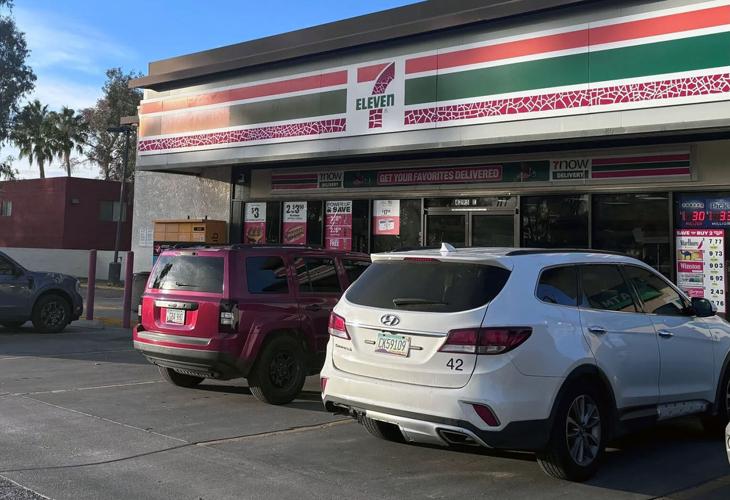
About 11 p.m. at the store at 4295 E. 29th Street, Kennedy saw a man, later identified as Andres McKale, taking alcohol from the cooler, the complaint says. Kennedy was armed but had not drawn his gun when Andres McKale, holding a gun, tried to leave with the drinks, the complaint says. Kennedy blocked the door.
"Andres told Scott to get out of the way and that he was going to shoot him," the complaint says, citing witness accounts and video evidence. "Scott responded that Andres would have to shoot him because he's not going to move."

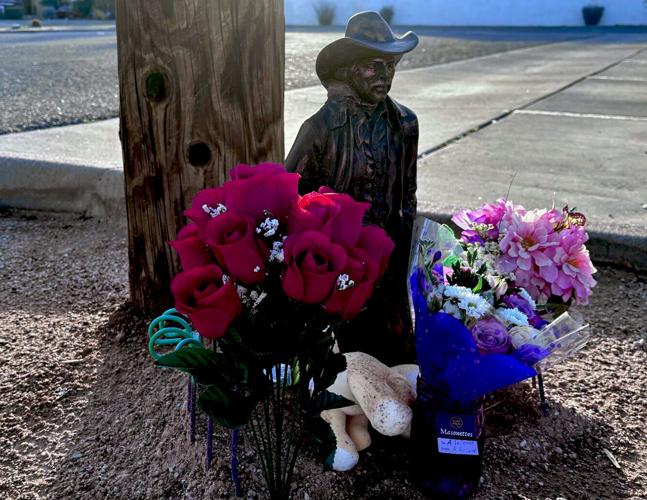
A small memorial near the 7-Eleven where Scott "Cowboy" Kennedy worked, 4295 E. 29th St., features flowers and a small sculpture.
McKale then fired, police said, and fled with the drinks. Now McKale, who was released from prison in December, is in Pima County Jail, charged with armed robbery and first-degree murder, on a $500,000 bond.
Of course, this death should not have happened.
In the other recent case, it was the alleged shoplifter, Emery Kirk, who was killed after a scuffle with a customer who saw him stealing cigarettes and intervened. The customer, Andrew Anaya, has since been indicted on a manslaughter charge by a Pima County grand jury.
This shouldn't have happened either.
Neither should the other cases like this I recall from years past. In 2006, Quik Mart clerk Kevin Cottle died after following three customers who had each stolen a case of beer out of the store. In 2015, an accused shoplifter, Gerald Ramon, was killed by a customer who followed him out of a Circle K for two blocks, leading to a deadly confrontation.
People sometimes can't resist the urge to stop a wrong happening right in front of them. But in cases like this, when no one is being hurt, people should resist, and not just because it can save a life, maybe their own.

On Thursday, Jan. 22, an employee was killed at the 7-Eleven store at 4295 E. 29th St. Scott "Cowboy" Kennedy was trying to prevent a young man from stealing alcoholic drinks, police said.
We don't know what's going on behind the scenes as retailers try to crack down on theft. These days, when we see someone openly stealing off the shelves of a convenience store, pharmacy or big-box retailer, the retailers are sometimes building cases against these thieves.
"What I need the community to understand is that in 2026, all this is recorded and surveilled on really high-quality camera equipment," Pima County Laura Conover told me as we talked on the Bill Buckmaster show Jan. 16.
The retailers and law enforcement, including the county attorney's office, meet regularly to discuss retail theft and share information on perpetrators. Together, they build cases that are no longer just misdemeanor theft, but felony organized retail theft, as they gather evidence together from different stores.
"It’s not just the surveillance cameras," Conover added. "There’s high-level training now. You give people nicknames so that it goes into the same file, like 'Right Eye Scar.'"
The different retailers share this information in their networks. In some stores, individual employees can upload their reports on apps that feed into these systems.
That's one of the reasons that most retailers tell employees not to physically intervene in shoplifting cases.
"Every company has their own detailed policies, but across the board, we instruct our employees to not engage with any kind of illegal activity in the store, because we're worried about their safety and the safety of customers, said Michelle Ahlmer of the Arizona Retailers Association.
This is frustrating, of course, because it contributes to an overall sense of lawlessness, and it also raises prices as retailers inevitably pass on their losses from theft to other customers.
But it is so much worse to lose people over comparatively trivial material losses for the corporations.
"Cowboy," for example, was a known figure in the neighborhoods near Roberts-Naylor K-8 School. One of his regular customers, Eli Hawley, told me that Cowboy helped him read labels and get cash out of the ATM.
"He helped me big time, because I had a tough time reading," Hawley said. "He was a good guy. Ever since he died, ever since he got murdered, I’m having a rough time sleeping, and it really got to me, because he was my friend."
Another customer, Jessica Amador, told me via Facebook that Kennedy watched out for the kids in the neighborhood.
"He always wore funny shirts that had funny sayings on them," Amador said. "He would say 'check this one out,' and show his shirt and just laugh."
It's more than a shame to lose such a person over a few prepackaged drinks that cost the company maybe $30.

