



Three days of mind-numbing testimony couldn’t make them decide.
Neither could an hour of vicious arguing.
The Arizona Corporation Commission had a couple of high-stakes decisions to make as last week began. And as this week begins, they still do — these issues just aren’t going away.
Both delayed decisions derive from the hot conflict over rooftop solar. Tedious time was spent at meetings last week considering whether to impose new rates on UniSource Energy Services customers who have their own solar panels, the issue that has been the focus of public interest in the commission for years.
On that big decision, they punted.
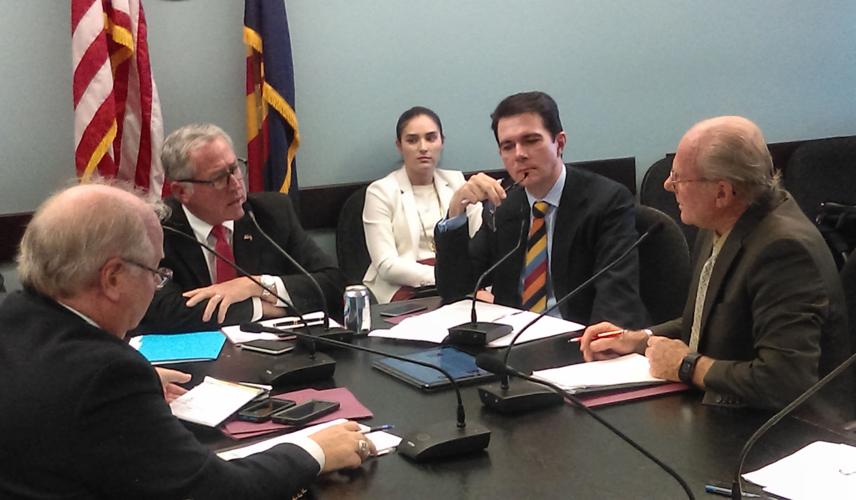
The fighting erupted over whether to hire an attorney to investigate if outside interests (Arizona Public Service presumably being the primary suspect) have undue influence at the commission. APS’s apparent involvement in commission elections started with their fight over this so-called “net metering” of rooftop solar customers.
On that issue, other commissioners defeated colleague Bob Burns’ effort to hire an attorney and get to the bottom of it — did APS donate the $3.2 million in dark money spent to influence the 2014 Corporation Commission elections, and is it having an effect?
The winning argument against Burns was circular: Since there’s no specific evidence of wrongful influence, there’s no need to look for it.
Neither issue is going away, just shifting venues.
On net-metering, the utilities have tried for years to lower the cost they’re forced to pay rooftop-solar customers for the excess energy those customers produce. First they did it by filing separate cases on this issue. But solar advocates said it would be better to consider the issue in full-blown rate cases — the cases that the utilities file every few years to establish just how much customers will be paying and how much the utilities will be making.
So the utilies filed rate cases — APS did, TEP did, so did Trico and UniSource Energy. Last week’s rate case for UES, the small sister company of TEP that serves Santa Cruz and Mohave counties, happened to go first.
The utilities saw an opportunity to set a precedent and pushed hard. APS, for example, went to the unusual length of hiring outside experts to produce testimony benefiting their point of view in a rate case that wasn’t even theirs.
The reason: They want to set a precedent, a pattern by which the commission favors the utility in one case then chooses the same justification in case after case.
That didn’t work, even when UniSource came up with a compromise proposal on solar. Instead, the commission decided to continue evaluating the net-metering issue in the context of another case — the so-called “value and cost of solar” docket. So now, we’re all waiting for them to go through that exercise before they go back to the utilities’ cases and apply their findings.
As Commission Chairman Doug Little explained it to me: “The whole purpose of that docket is to collect information so that when we’re done with it we’ll have a finding of facts, and those facts will be able to inform the commission in our decisions about rate cases, so that we’ll know what the value and cost of DG (distributed generation, via rooftop solar panels) actually is.”
It sounds so clean and abstract when Little describes the process, but the question that was the subject of that outbreak of arguing is whether monied utilities are influencing their decisions. The solar-leasing companies — most notably SolarCity — are also suspected of trying to use undue influence.
It’s easy to understand why these companies would try. Consider the question of return on equity — this is the percentage that utilities take in as profit, and it is determined by the Arizona Corporation Commission. Normally, the commission approves a return in the 8 to 10 percent range.
Both Arizona Public Service and Tucson Electric Power, for example, are allowed a 10 percent return on equity. Any shift up or down by 1 percent would mean about a $16 million swing in profits for TEP. For APS, a 1 percent change makes about a $50 million difference.
The stakes are high.
Not only is there big money at stake, but there are three Arizona Corporation Commission seats up for election. Burns and appointed Commissioner Andy Tobin are up for election, and there is an open seat as Commissioner Bob Stump hits his term limit.
There is also an FBI investigation into possible campaign shenanigans involving former Commissioner Gary Pierce and APS back in 2014.
So no wonder commissioners such as Little puffed themselves into full defense-of-honor mode in fighting off Burns’ effort to investigate undue influence at the commission.
“You’ve been basically impugning our integrity for a year,” Little told Burns, who denied the accusation.
Little told me his real problem with Burns’ effort to hire an attorney to investigate influences on the commission was that he thinks the attorney Burns picked has disqualifying connections to the solar industry. But then he went on to say that he believes corporations have the right, as upheld in Citizens United case, to spend money anonymously in politics.
“If you want disclosure, change the law,” he said. “Don’t force anyone to abandon their rights under the First Amendment.”
So, really, Little is OK with regulated companies influencing the election of the people who regulate them, as a matter of principle.
Too many people, myself included, feel differently about this issue for the discussion to end there.
However, on this and the net-metering issue, the discussions may play out very differently depending on who wins the November elections for commission.

