


Over the years, we in Tucson and Pima County have worked hard to screw up some of our economic opportunities.
The Grand Canyon University fumble of two years ago was just the latest in this series of unfortunate events.
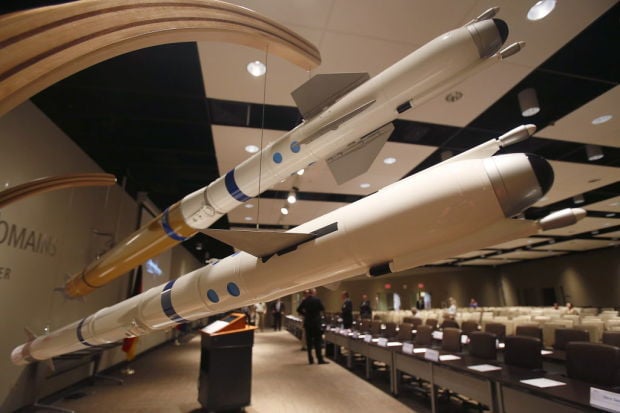
But here’s one thing we haven’t screwed up so far: the handling of Raytheon Missile Systems and its environs south and west of Tucson International Airport.
On Tuesday, the Pima County Board of Supervisors voted 4-1 to approve a three-year economic development plan that touches on many of the Tucson area’s economic pillars. It talks about facilitating tourism, trade with Mexico and logistics among other familiar areas of economic emphasis.
But it prioritizes Raytheon, the area’s largest private employer with about 9,600 full-time equivalents on staff. The first part of the first chapter addresses how to help the company expand its Tucson operation, and the second part proposes establishing an aerospace business park on adjacent land.
The company has been a sensitive issue since Raytheon Missile Systems confirmed in 2010 that it would build a new missile factory in Huntsville, Ala., rather than in Tucson. After that disappointment, attributable in part to Raytheon’s lack of a buffer zone and land for expansion here, local government agencies have actually worked pretty well together to be sure it doesn’t happen again.
Despite those efforts, rumors burn through Tucson now and then that Raytheon is planning to leave the city altogether — something that, if it ever happened, would be disastrous.
The sensitivity of the situation may explain both those rumors and a flare-up of the traditional city-county hostilities that occurred last month.
On July 7, the City Council approved an extension of the Tucson Airport Authority’s lease of the airport property — a relatively non-controversial item, even though it extends the relationship to an almost-unimaginable year, 2098. What caught Pima County Administrator Chuck Huckelberry‘s unblinking eye was this clause in a memorandum to the council:
TAA will cooperate with the City to secure a safety buffer for Raytheon; with the buffer to be provided at no cost to the City – the result of which could satisfy the City’s commitment to Raytheon under the City’s annexation agreement with Raytheon, and free agreement.
Those looked to Huckelberry like wiggle words — like the city was trying to worm out of its commitment to spend tax money collected from Raytheon on a buffer zone Raytheon would need to expand. In 2009, the company agreed to have its land annexed by the city, provided that up to $8 million of the utility and equipment taxes Raytheon pays would go into a fund to buy property around the plant.
Huckelberry suspected the city was declaring the buffer zone complete and trying to tap that fund for its own purposes. There’s no doubt the city needs the money. On July 13, Huckelberry fired off a letter to a Raytheon vice president questioning the city’s aims and pledging that the county is “fully committed to having Raytheon remain here and to helping you expand your operations in Tucson.”
He explained to me Tuesday that two areas of buffer land south of Raytheon — an 80-acre parcel that removes restrictions from Raytheon’s current plant, and a 320-acre parcel that allows for expansion — still need to be fully secured. Negotiations are ongoing for both parcels, which are owned by the Tucson Airport Authority.
“We want Raytheon to be buffered so they can expand,” he said. “If there’s no source of revenues, then Raytheon is tied to their existing footprint and can never expand.”
Losing the city’s $8 million fund would be dangerous. But in the end, the kerfuffle appears to have been a mix-up.
“The agreement we reached with TAA does not affect whatever the county is trying to do to assure the existence of the buffer,” Tucson City Attorney Mike Rankin told me Tuesday. “Our agreement doesn’t affect that annexation account one way or another.”
So the years-long march toward giving Raytheon the room it needs to grow continues. But that doesn’t mean the county’s economic development plan is without opposition.
Supervisor Ally Miller told the board she’s voting against the plan because too much of it depends on the assumption of more bond debt to spend money on public projects. This fall, we’re being asked to vote on seven bond questions that would add $816 million in bond debt if approved.
The Raytheon-area project depends little on the bond issues, though. Only one of the projects, the $30 million Sonoran Corridor highway, has any bearing on the area. And that project is part of the first bond question, relating to road projects and repairs — the most likely bond question to be approved.
Somehow, in spite of ourselves, we seem to be carrying this thing out.

