



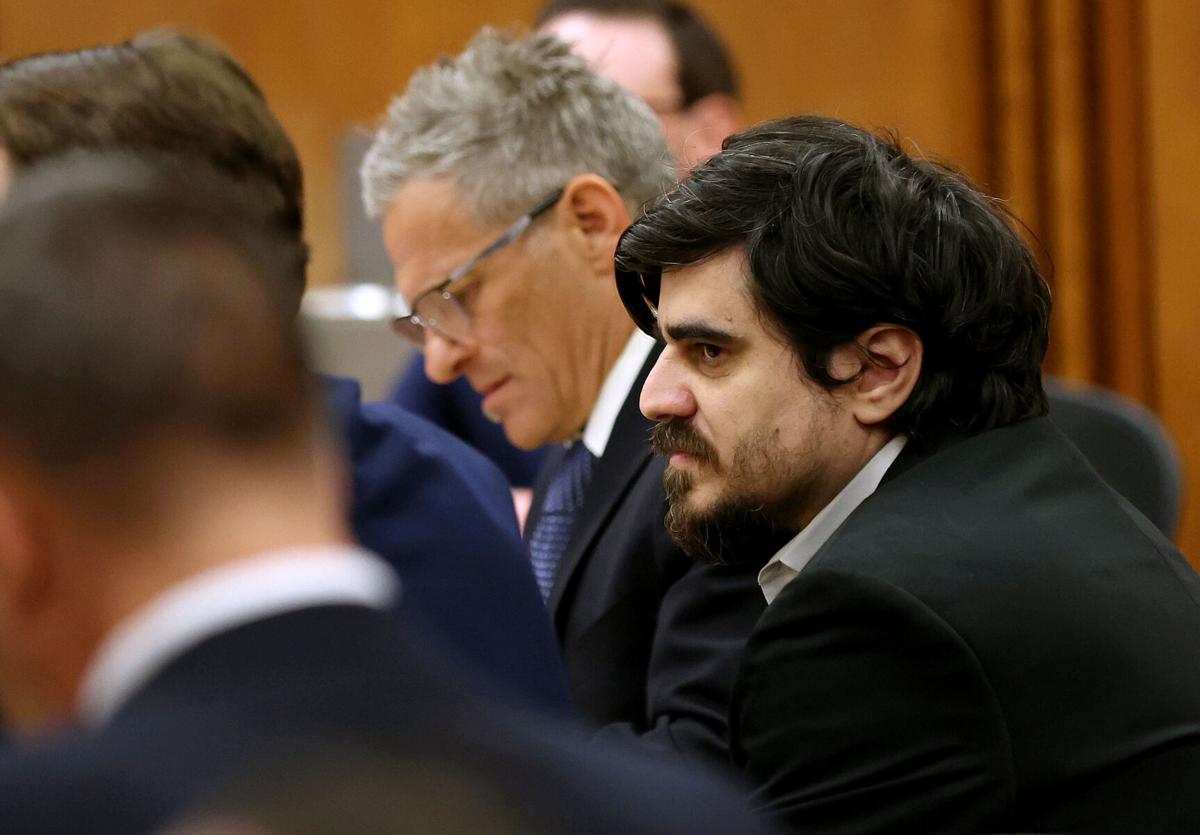
The criminal case for a former University of Arizona graduate student accused in the deadly on-campus shooting of a professor in October 2022 is now in the hands of the jury.
Murad Dervish, 48, faces a total of seven felony counts in the accused killing of Prof. Thomas Meixner, 52, on Oct. 5, 2022. They include: a count of premeditated first degree murder; a count of aggravated assault with a deadly weapon; a count of first degree burglary; one count of misconduct involving weapons; and three counts of endangerment.
Dervish had been expelled and was banned from campus months before the shooting following several threats to staff, including Meixner.
“Does the evidence prove that this was a premeditated murder beyond a reasonable doubt? Absolutely. (And) has the defendant proven that he did not appreciate the wrongfulness of his crimes by clear and convincing evidence? Absolutely not,” Deputy County Attorney Mark Hotchkiss told jurors in his closing arguments Monday afternoon as the Pima County Superior Court trial came to an end.
Among indications of premeditation Hotchkiss cited: threatening communications Dervish wrote Meixner, then head of the UA’s Department of Hydrology and Atmospheric Sciences, including one saying “I hope somebody blows your f**ckin head off; ” the purchase of a gun in September 2022; and turning his car into a living space so he was ready to flee after the shooting.
On the day of the shooting, Dervish carried a Ruger 9mm handgun into the Harshbarger building, lingered around waiting for class to be over and upon confronting Meixner, fired 11 shots while chasing him down a hallway, said Hotchkiss.
The prosecution also pointed out that Dervish’s narrative of the incident changed over time. His two arguments — one, that he was in the building only because he wanted to speak to Meixner, and second, that he doesn’t remember much of the shooting itself — weren’t brought up by him during initial interviews in the investigation.
Defense Attorney Leo Masursky in his closing arguments cited numerous mental health issues Dervish dealt with throughout his life — psychosis, autism with schizoid features, clinical depression — as proof that he was not in his right mind the day of the shooting.
As his academic career at the UA deescalated, his mental health worsened to the point where he was psychotic and delusional, Masursky told jurors.
Masursky pleaded with jurors to reduce Dervish’s charge to a second degree murder and find the he is guilty except insane. Masursky told jurors they should hold his client accountable for his actions, but also take into consideration his mental health difficulties.
The prosecution disagreed, stating that the defendant being guilty of second degree murder would be an insult. Justice requires that Dervish should be convicted as charged, said Hotchkiss.
“The evidence shows beyond any reasonable doubt that this defendant is guilty of all the charges,” said Hotchkiss.
“He’s not guilty except insane. He’s just guilty.”

